Enhancing Aquatic Habitat Monitoring: Optimizing Management and Regulatory Objectives
120 likes | 240 Views
This document outlines strategic recommendations for refining monitoring objectives related to aquatic and wetland habitats. It advocates for a comprehensive multi-year monitoring plan that not only meets regulatory requirements but also enhances the value derived from expenditures. Key management questions are addressed, focusing on potential impacts on existing habitats and the risk of mercury bioaccumulation in restored areas. The use of biosentinels is emphasized to ensure standardized comparisons, and cost-saving measures are proposed by evaluating the necessity of winter monitoring and prioritizing based on existing knowledge.


Enhancing Aquatic Habitat Monitoring: Optimizing Management and Regulatory Objectives
E N D
Presentation Transcript
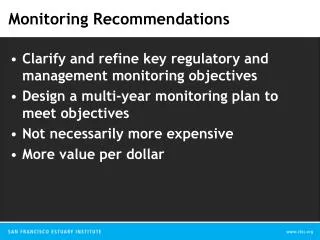
Monitoring Recommendations Clarify and refine key regulatory and management monitoring objectives Design a multi-year monitoring plan to meet objectives Not necessarily more expensive More value per dollar
Likely Management Questions Q1: Does the project negatively impact existing aquatic and wetland habitats? Monitoring: Pre- and post-project comparisons of existing conditions
Monitoring Recommendations Q2: Do the restored habitats increase the risk of Hg bioaccumulation? Monitoring: Compare habitat types within breached areas to the ambient condition of same types of habitats within the North Bay.
Q1: Impact to Existing Habitats? • Marsh restoration does not appear to affect risk in subtidal habitats adjacent to marsh (see right) • Risk to adjacent marsh habitats is unknown
Q2: Do Restored Habitats increase Risk? • Pond 2A restored in 1995 • MeHg in subtidal food web is typical of North Bay region • MeHg in restored marsh food web is unknown
Use Biosentinels to Standardize These comparisons should be based on the same biosentinel species for each habitat type that is monitored shallow subtidal intertidal aquatic intertidal marsh
Silversides Excellent Subtidal Biosentinel Bay margin, large sloughs, and managed ponds
Add Marsh Biosentinels Silversides, and other transient fish, do not provide information about Hg risk in marsh Assess bioaccumulation in tidal marsh Does not need to increase overall cost. Prioritize based on management questions and what is already known.
Small fish indicate subtidal Other indicators for marsh risk Song sparrow Small fish
Is Winter Monitoring Necessary? How do we use results of winter fish Hg concentrations in management decisions? Lower risk to wildlife in winter, because birds are not breeding Lower biomass of small fish in winter, so less important in the food web Save costs by eliminating winter monitoring, in the absence of a specific management question?
For project report and data:http://www.sfei.org/projects/NBaySmallFishHg
Thank You • Karen Taylor, CDFG • Tom Gandesbury and Betsy Wilson, State Coastal Conservancy • Project collaborators – Darell Slotton, Shaun Ayers, Letitia Grenier • John Ross, Cristina Grosso, Don Yee, April Robinson, Josh Collins, SFEI • The California State Coastal Conservancy and the San Francisco Foundation