
Renewing the Sectional Struggle: Popular Sovereignty, California Gold, and the Compromise of 1850
E N D
Presentation Transcript
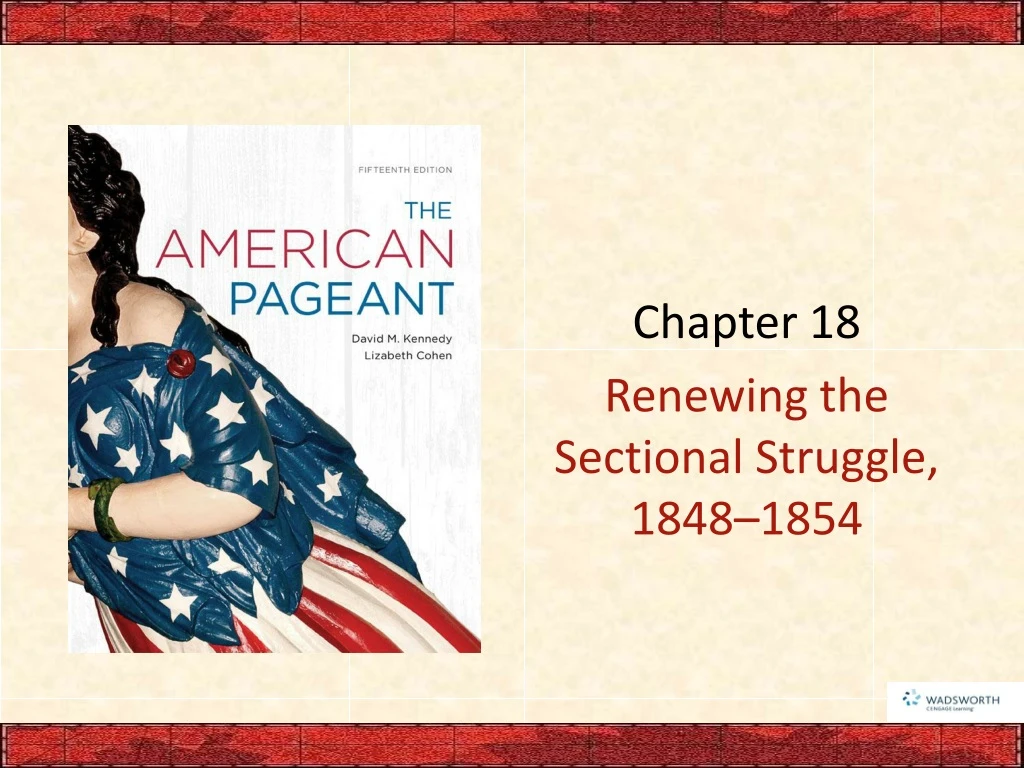
Chapter 18 Renewing the Sectional Struggle, 1848–1854
I. The Popular Sovereignty Panacea • 1848 Democrats nominated General Lewis Cass • Cass was the reputed father of popular sovereignty • Doctrine said each state would decide slavery issue • It had a persuasive appeal • People liked the democratic tradition • Self-determination for each state • Made it a ‘state’ issue, not a national issue • Politicians liked the ‘comfortable compromise’ • The free-soilers’ bid for a ban on slavery • Southern demands that Congress protect slavery • Yet, popular sovereignty had one fatal defect • It might serve to spread the blight of slavery.
II. Political Triumphs for General Taylor • The Whigs nominated Zachary Taylor (war hero) • Free Soil partynominated Martin van Buren • Also wanted internal improvement, free homesteads • They foreshadowed the Republican party • 1848 election results • Zachary Taylor wins Taylor (W) Cass (D) Van Buren (FS) Popular 1,360,967 1,222,342 291,263* Electoral 163 127 0 *Van Buren hurt Cass in the critical state of New York
III. “Californy Gold” • The discovery of gold on the American River • Sutter’s Mill, California, early in 1848 • The California gold rush(“forty-niners”) • Attracted tens of thousands of people • Influx & crime demanded more government • Drafted a constitution in 1849 that excluded slavery • Had been encouraged by President Taylor • California applied for statehood • Bypassed the usual territorial stage
IV. Sectional Balance and the Underground Railroad • The South of 1850 was relatively well-off • But worried by the ever-tipping political balance: • 15 slave states and 15 free states • Southerner slave states • Concerned about abolition in District of Columbia • Wanted more stringent fugitive-slave law (1850) • Underground Railroad allowed slaves to escape • Amazing conductor: Harriet Tubman. • Texas had additional grievances • Concerned about territory east of the Rio Grande
V. Twilight of the Senatorial Giants • Congressional catastrophe in 1850 • Free-soil California wanted admission • “Fire-eaters” in the South threatened secession • Henry Clay-The “Great Compromiser” • John C. Calhoun-The “Great Nullifier” • Daniel Webster-Seventh of March speech(1850) • Webster regarded slavery as evil but disunion worse
VI. Deadlock and Danger on Capitol Hill • William H. Seward led younger antislaveryites • Pres. Taylor promised to veto Cong. compromise
VII. Breaking the Congressional Logjam • Millard Fillmore=President when Taylor dies • He gladly signed Compromise of 1850 • Heat in the Congress • “fire-eaters” violently opposed to compromise • Met in Nashville, decided no succession • The second Era of Good Feelings dawned • Talk of secession subsided • Peace-loving people, happy with compromise • Slavery issue had “finality”
VIII. Balancing the Compromise Scales • Measuring the 1850 Compromise • For the North = California becomes a free state • Tipped the balance to the North • 16 free states, 15 slave states • For the South = Fugitive Slave Law (1850) • Fleeing slaves: Couldn’t testify, denied a jury trial • Free blacks subject to “man-stealing” • Northerners liable to be fined / jailed • Angered and rallied anti-slavery Northerners
IX. Defeat and Doom for the Whigs • 1852 Elections • Democrats nominate Franklin Pierce • Prosouthern northerner, supported compromise • Supported territorial expansion • The Whigs nominated Winfield Scott • Best general of his generation, supported compromise • Whig party split over slavery • 1852 Election Results • Pierce won in a landslide 254 electoral vote to 42 • Popular vote 1,601,117 to 1,385,453 for Pierce • Marked the effective end of the Whig party
X. Expansionist Stirrings South of the Border • The spirit of Manifest Destiny was revived • Desire for a transcontinental railroad • Desire to control isthmus of Panama • Southern “slavocrats” looked southward • Promoted revolution in Nicaragua • Then legalized slavery • Sugar-rich Cuba • Enticing prospect for annexation • They already had a large population of enslaved blacks • Ostend Manifesto • Urged U.S. administration to offer $120 million for Cuba.
XI. The Allure of Asia • Americans wanted to tap the rich Asian markets • Opium War—Britain gained trade rights • Treaty of Wanghia (1844) Gave U.S. China rights • America now wanted trade rights in Japan • Japan isolated from world for ~200 years • Perry led U.S. ships into Tokyo Bay (July 1853) • Treaty of Kanagawa signed (March 1854)
XII. Pacific Railroad Promoters and the Gadsden Purchase • Mex. War legacy creates a geographic problem • California /Oregon, 8000 miles west of the capital • A transcontinental railroad was needed • Where to build the railroad? • The Gadsden Purchase for $10 million (1853) • James Gadsden – Santa Anna Negotiate • Best route for the southern railroad • Northerners wanted Nebraska Territory organized
XIII. Douglas’s Kansas-Nebraska Scheme • Proposed Nebraska Territory to be split • Kansas and Nebraska • Slavery would be decided by popular sovereignty • Assumption - Kansas to become a slave state • Assumption - Nebraska would become a free state. • Plan contradicted the Missouri Compromise of 1820 • Southerners supported the plan • Would create a huge political / social conflict • And make Douglas more popular
XIV. Congress Legislates a Civil War • The Kansas-Nebraska Act • One of the most momentous ongressional measures • It greased the slippery slope to Civil War • The Act wrecked two compromises (1820 and 1850) • Extremists nsaw less and less they could live with • The Democratic Party was shattered • The Republican Party was born • Gathered dissatisfied Whigs, Democrats, Free-Soilers, Know-Nothings, Kansas-Nebraska foes • Including Abraham Lincoln • Never supported south of the Mason-Dixon Line