Design and Fabrication of a Specialized Friction Wear Testing Machine
Dr. Iglesias-Victoria from the Rochester Institute of Technology is leading a project to design a specialized friction wear testing machine for the new KGCOE lab. This machine will test both lubricated and unlubricated specimens as per ASTM standards. It will feature data acquisition capabilities to monitor frictional force, test duration, and operational frequency. The project emphasizes stakeholder input to explore existing testers that meet requirements while remaining under budget, as well as understanding typical parameters and necessary accuracy for effective testing.

Design and Fabrication of a Specialized Friction Wear Testing Machine
E N D
Presentation Transcript
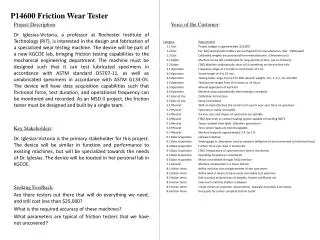
P14600 Friction Wear Tester Voice of the Customer: Project Description: Dr. Iglesias-Victoria, a professor at Rochester Institute of Technology (RIT), is interested in the design and fabrication of a specialized wear testing machine. The device will be part of a new KGCOE lab, bringing friction testing capabilities to the mechanical engineering department. The machine must be designed such that it can test lubricated specimens in accordance with ASTM standard D5707-11, as well as unlubricated specimens in accordance with ASTM G133-05. The device will have data acquisition capabilities such that frictional force, test duration, and operational frequency can be monitored and recorded. As an MSD II project, the friction tester must be designed and built by a single team. Key Stakeholders: Dr. Iglesias-Victoria is the primary stakeholder for this project. The device will be similar in function and performance to existing machines, but will be specialized towards the needs of Dr. Iglesias. The device will be located in her personal lab in KGCOE. Seeking Feedback: Are there testers out there that will do everything we need, and still cost less than $25,000? What is the required accuracy of these machines? What parameters are typical of friction testers that we have not uncovered?