Download
1 / 18
180 likes | 304 Views
This comprehensive guide by Chrystal Bobe and Gabriela Ortiz outlines the critical steps for effectively measuring and recording data on turtles. The process includes capturing turtles, weighing them accurately, and measuring their length, depth, and width. Important techniques for photography and tagging are also covered. Detailed instructions ensure minimal stress for the turtles while allowing researchers to gather vital information. Remember, accurate recording is crucial for studying turtle species and their habitats. Releasing them back into their original habitat is the final step.

E N D
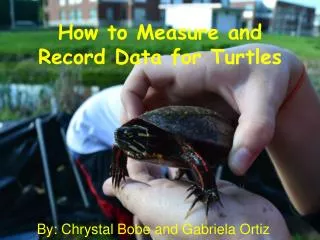
How to Measure and Record Data for Turtles By: Chrystal Bobe and Gabriela Ortiz
Step 1: Catching turtles See “How to: Pitfall”
Step 2a: Weighing turtle • Get a container accordingly to the size of your turtle and a scale.
Step 2b: Set the Scale to Zero We do this so that the weight is solely of the turtle, and does not include the weight of the container.
Step 2d: Record the weight in grams Note: turtles may be moving around a lot so record the number that shows up most.
Step 6: Take Pictures! Take lots of pictures, especially ones that can distinguish one creature from another, such as the lines on this painted turtles neck.
A top view like this can show the unique patterns on the backs of a turtle.
Step 7: Tagging the turtle Choose a spot to tag the turtle.
Step 7 Then file a groove into the shell of the turtle. It doesn’t hurt the turtles; it just feels like filing a fingernail.
Make sure to write everything down as it is happening; you don’t want to miss anything or record the wrong thing.
When you are done, release the turtle back into its original habitat!