
Canadian Paediatricians’ Knowledge and Experience with Internationally Adopted Children’s Infectious Risks
E N D
Presentation Transcript
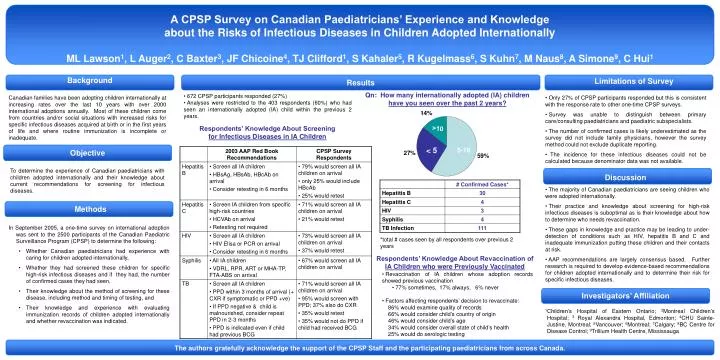
A CPSP Survey on Canadian Paediatricians’ Experience and Knowledge about the Risks of Infectious Diseases in Children Adopted InternationallyML Lawson1, L Auger2, C Baxter3, JF Chicoine4, TJ Clifford1, S Kahaler5, R Kugelmass6, S Kuhn7, M Naus8, A Simone9, C Hui1 Background Results Limitations of Survey Qn: How many internationally adopted (IA) children have you seen over the past 2 years? • 672 CPSP participants responded (27%) • Analyses were restricted to the 403 respondents (60%) who had seen an internationally adopted (IA) child within the previous 2 years. Canadian families have been adopting children internationally at increasing rates over the last 10 years with over 2000 international adoptions annually. Most of these children come from countries and/or social situations with increased risks for specific infectious diseases acquired at birth or in the first years of life and where routine immunization is incomplete or inadequate. • Only 27% of CPSP participants responded but this is consistent with the response rate to other one-time CPSP surveys. • Survey was unable to distinguish between primary care/consulting paediatricians and paediatric subspecialists. • The number of confirmed cases is likely underestimated as the survey did not include family physicians, however the survey method could not exclude duplicate reporting. • The incidence for these infectious diseases could not be calculated because denominator data was not available. Respondents’ Knowledge About Screening for Infectious Diseases in IA Children >10 < 5 Objective 5-10 Materials & Methods To determine the experience of Canadian paediatricians with children adopted internationally and their knowledge about current recommendations for screening for infectious diseases. Discussion • The majority of Canadian paediatricians are seeing children who were adopted internationally. • Their practice and knowledge about screening for high-risk infectious diseases is suboptimal as is their knowledge about how to determine who needs revaccination. • These gaps in knowledge and practice may be leading to under-detection of conditions such as HIV, hepatitis B and C and inadequate immunization putting these children and their contacts at risk. • AAP recommendations are largely consensus based. Further research is required to develop evidence-based recommendations for children adopted internationally and to determine their risk for specific infectious diseases. Methods • In September 2005, a one-time survey on international adoption was sent to the 2500 participants of the Canadian Paediatric Surveillance Program (CPSP) to determine the following: • Whether Canadian paediatricians had experience with caring for children adopted internationally, • Whether they had screened these children for specific high-risk infectious diseases and if they had, the number of confirmed cases they had seen, • Their knowledge about the method of screening for these disease, including method and timing of testing, and • Their knowledge and experience with evaluating immunization records of children adopted internationally and whether revaccination was indicated. *total # cases seen by all respondents over previous 2 years Respondents’ Knowledge About Revaccination of IA Children who were Previously Vaccinated • Revaccination of IA children whose adoption records showed previous vaccination • 77% sometimes, 17% always, 6% never • Factors affecting respondents’ decision to revaccinate: • 86% would examine quality of records • 66% would consider child’s country of origin • 46% would consider child’s age • 34% would consider overall state of child’s health • 25% would do serologic testing Investigators’ Affiliation • 1Children’s Hospital of Eastern Ontario; 2Montreal Children’s Hospital; 3 Royal Alexandra Hospital, Edmonton; 4CHU Sainte-Justine, Montreal; 5Vancouver; 6Montreal; 7Calgary; 8BC Centre for Disease Control; 9Trillium Health Centre, Mississauga The authors gratefully acknowledge the support of the CPSP Staff and the participating paediatricians from across Canada.