What Competencies Does SSGB Develop
Six Sigma Green Belt (SSGB) training is designed to bridge the gap between "front-line worker" and "strategic analyst." It develops a unique set of competencies that allow you to navigate both high-level business goals and granular data.

What Competencies Does SSGB Develop
E N D
Presentation Transcript
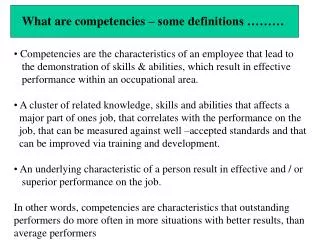
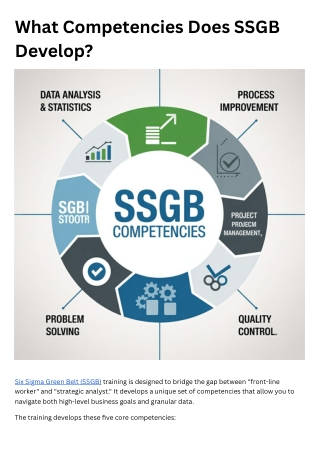
What Competencies Does SSGB Develop? Six Sigma Green Belt (SSGB) training is designed to bridge the gap between "front-line worker" and "strategic analyst." It develops a unique set of competencies that allow you to navigate both high-level business goals and granular data. The training develops these five core competencies:
1. Data-Driven Critical Thinking The most significant competency developed is the shift from subjective "intuition" to objective "proof." You learn to challenge assumptions by asking, "Where is the data to support this?" Variable Identification: Learning to distinguish between $X$ variables (inputs like temperature or staffing) and $Y$ variables (outputs like product quality or customer satisfaction), often expressed as the formula $Y = f(X)$. Sampling Strategy: Understanding how to pull a representative sample so your conclusions about a large process are actually accurate. 2. Advanced Process Mapping & Diagnostic Skills You develop the ability to "see" a process in layers. Most people see a workflow as a straight line; a Green Belt sees it as a complex system of inputs and outputs. SIPOC Competency: Learning to define the boundaries of a project by identifying Suppliers, Inputs, Processes, Outputs, and Customers. Value Stream Awareness: Identifying which steps in a process add value to the customer and which are "waste" that should be eliminated. 3. Statistical Analysis & Interpretation You don't just learn to calculate numbers; you learn to interpret what they mean for the business. Variation Reduction: Developing the competency to measure and reduce "Standard Deviation," which is the enemy of quality. Hypothesis Testing: Gaining the ability to run experiments (like T-Tests or ANOVA) to prove that a specific change actually caused an improvement. 4. Risk Assessment & Mitigation Green Belts are trained to be "pre-emptive" rather than "reactive." You learn to find the weak points in a system before they cause a crisis. FMEA (Failure Mode and Effects Analysis): You develop the competency to score risks based on their severity and likelihood, allowing you to prioritize which problems to fix first. Mistake-Proofing (Poka-Yoke): Learning to design "fail-safe" mechanisms so that human error cannot result in a defect. 5. Facilitative Leadership Since Green Belts often lead projects without having direct "boss" authority over their team
Since Green Belts often lead projects without having direct boss authority over their team members, they develop high-level "soft" competencies: Stakeholder Management: Learning how to present data to executives in a way that secures funding and "buy-in." Team Dynamics: Leading "Kaizen" (continuous improvement) events and managing group conflict during the "Storming" phase of a project. Competency Evolution Summary Competency Before SSGB Training After SSGB Training Problem Solving Reactive / "Firefighting" Proactive / Root Cause Analysis Data Usage Simple Averages Statistical Confidence Levels Project Approach Unstructured / Random DMAIC Roadmap Risk Management Dealing with failures as they happen Predictive Risk Scoring (FMEA)