Download
1 / 16
0 likes | 0 Views
provides a valuable idea of few programmes used in JAVA this gives a clear idea about some of the important concepts like array and many more. these questions are mostly from the ISC board exam question papers.

E N D
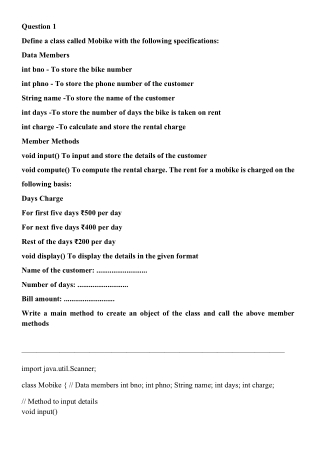
Question 1 Define a class called Mobike with the following specifications: Data Members int bno - To store the bike number int phno - To store the phone number of the customer String name -To store the name of the customer int days -To store the number of days the bike is taken on rent int charge -To calculate and store the rental charge Member Methods void input() To input and store the details of the customer void compute() To compute the rental charge. The rent for a mobike is charged on the following basis: Days Charge For first five days ₹500 per day For next five days ₹400 per day Rest of the days ₹200 per day void display() To display the details in the given format Name of the customer: ........................... Number of days: ........................... Bill amount: ........................... Write a main method to create an object of the class and call the above member methods ——————————————————————————————————— import java.util.Scanner; class Mobike { // Data members int bno; int phno; String name; int days; int charge; // Method to input details void input()
{ Scanner sc = new Scanner(System.in); System.out.print("Enter bike number: "); bno = sc.nextInt(); System.out.print("Enter phone number: "); phno = sc.nextInt(); sc.nextLine(); // to clear buffer System.out.print("Enter customer name: "); name = sc.nextLine(); System.out.print("Enter number of days: "); days = sc.nextInt(); } // Method to compute rental charge void compute() { if (days <= 5) { charge = days * 500; } else if (days <= 10) { charge = (5 * 500) + (days - 5) * 400; } else { charge = (5 * 500) + (5 * 400) + (days - 10) * 200; } } // Method to display details void display() { System.out.println("\nName of the customer: " + name); System.out.println("Number of days: " + days); System.out.println("Bill amount: ₹" + charge);
} // Main method public static void main(String args[]) { Mobike mb = new Mobike(); mb.input(); mb.compute(); mb.display(); } } ————————————————————————————————. Question 2 Define a class ElectricBill with the following specifications: Class name : ElectricBill Data members: String n — to store the name of the customer int units — to store the number of units consumed double bill — to store the amount to be paid Member methods: void accept( ) — to accept the name of the customer and number of units consumed void calculate( ) — to calculate the bill as per the following tariff: Number of units Rate per unit First 100 units Nil Next 200 units Rs.3.00 Above 300 units Rs.5.00 A surcharge of 2.5% charged if the number of units consumed is above 300 units. void print( ) — To print the details as follows: Name Units Consumed Bill amount ........................... ........................... ...........................
Write a main method to create an object of the class and call the above member Methods. ———————————————————————————————————— import java.util.Scanner; class ElectricBill { String n; int units; double bill; void accept() { Scanner sc = new Scanner(System.in); System.out.print("Enter name: "); n = sc.nextLine(); System.out.print("Enter units consumed: "); units = sc.nextInt(); } void calculate() { if (units <= 100) bill = 0; else if (units <= 300) bill = (units - 100) * 3; else { bill = (200 * 3) + (units - 300) * 5; bill = bill + bill * 0.025; } } void print() { System.out.println("Name\tUnits Consumed\tBill Amount"); System.out.println(n + "\t" + units + "\t\tRs." + bill); } public static void main(String args[]) { ElectricBill eb = new ElectricBill(); eb.accept(); eb.calculate(); eb.print(); } }
———————————————————————————————————————————————————————————————————————— Question 3 Anshul transport company charges for the parcels of its customers as per the following specifications given below: Class name: Atransport Member variables: String name – to store the name of the customer int w – to store the weight of the parcel in Kg int charge – to store the charge of the parcel Member functions: void accept ( ) – to accept the name of the customer, weight of the parcel from the user (using Scanner class) void calculate ( ) – to calculate the charge as per the weight of the parcel as per the following criteria: Weight in Kg Charge per Kg Upto 10 Kgs Rs.25 per Kg Next 20 Kgs Rs.20 per Kg Above 30 Kgs Rs.10 per Kg A surcharge of 5% is charged on the bill. void print ( ) – to print the name of the customer, weight of the parcel, total bill inclusive of surcharge. Define a class with the above-mentioned specifications, create the main method, create an object
and invoke the member methods ———————————————————————————————————— —————————— import java.util.Scanner; class Atransport { String name; int w; double charge; void accept() { Scanner sc = new Scanner(System.in); System.out.print("Enter customer name: "); name = sc.nextLine(); System.out.print("Enter weight: of the parcell "); w = sc.nextInt(); } void calculate() { if (w <= 10) charge = w * 25; else if (w <= 30) charge = (10 * 25) + (w - 10) * 20; else charge = (10 * 25) + (20 * 20) + (w - 30) * 10; charge = charge + charge * 0.05; } void print() { System.out.println("Name: " + name); System.out.println("Weight: " + w); System.out.println("Total Charge: Rs." + charge); } public static void main(String args[]) { Atransport at = new Atransport(); at.accept(); at.calculate(); at.print();
} } ———————————————————————————————————— —————————— Question 4: Define a class named BookFair with the following description: Instance variables/data members: String bName – stores the name of the book double price – stores the price of the book Member functions: void input() – to input and store the name and the price of the book void calculate() – to calculate the price after discount. Discount is calculated based on the following criteria: Price Discount Less than or equal to ₹ 1000 2% of price More than ₹ 1000 and less than or equal to ₹ 3000 10% of price More than ₹ 3000 15% of price void display() – to display the name and price of the book after discount. Write a main() method to create an object of the class and call the above methods. ———————————————————————————————————— —————————— import java.util.Scanner; class BookFair { String bName;
double price; void input() { Scanner sc = new Scanner(System.in); System.out.print("Enter book name: "); bName = sc.nextLine(); System.out.print("Enter price: "); price = sc.nextDouble(); } void calculate() { if (price <= 1000) price -= price * 0.02; else if (price <= 3000) price -= price * 0.10; else price -= price * 0.15; } void display() { System.out.println("Book Name: " + bName); System.out.println("Price after discount: Rs." + price); }
public static void main(String args[]) { BookFair bf = new BookFair(); bf.input(); bf.calculate(); bf.display(); } } ———————————————————————————————————— ————————— Question 5: Write a java program to print the Fibonacci Series. ———————————————————————————————————— —————————— class Fibonacci { public static void main(String args[]) { int a = 0, b = 1, c; System.out.print(a + " " + b + " "); for (int i = 1; i <= 8; i++) { c = a + b; System.out.print(c + " "); a = b; b = c; } }}
———————————————————————————————————————————————————————————————————————— —————————— Question 6: Write a menu driven program to print the following patterns. 1. To print Floyd’s triangle 1 2 3 4 5 6 7 8 9 10 2. To print the given pattern @ # @ # @ # @ @ # @ ———————————————————————————————————— ——————— import java.util.Scanner; class Patterns { public static void main(String args[]) { Scanner sc = new Scanner(System.in); System.out.println("1. Floyd's Triangle or 2. @ # Pattern"); int ch = sc.nextInt(); switch (ch) { case 1: int num = 1; for (int i = 1; i <= 4; i++) { for (int j = 1; j <= i; j++) System.out.print(num++ + " "); System.out.println();
} break; case 2: for (int i = 4; i >= 1; i--) { for (int j = 1; j <= i; j++) System.out.print((j % 2 == 1) ? "@ " : "# "); System.out.println(); } break; default: System.out.println("Invalid choice"); } } } ————————————————————————————————— —————————— Question 7: Write a program to input a number and verify whether it is a Lead Number or not. A number is called a Lead number if the sum of even digits is equal to the sum of the odd digits. ————————————————————————————————— —————————— import java.util.Scanner; class LeadNumber { public static void main(String args[]) { Scanner sc = new Scanner(System.in); int n, sEven = 0, sOdd = 0; System.out.println("Enter a number"); n = sc.nextInt(); while (n > 0) { int d = n % 10; if (d % 2 == 0) sEven += d; else sOdd += d;
n /= 10; } if (sEven == sOdd) System.out.println("Lead Number"); else System.out.println("Not a Lead Number"); } } ————————————————————————————————— —————————— Question 8: Write a program to accept a number and check whether the number is perfect number or not. A number is called perfect number, if the sum of all factors(except number itself) of the number is equal to that number. (For eg 6 is a perfect number. Factors are 1,2 & 3 and the sum is 1+2+3=6). ————————————————————————————————— —————————— import java.util.Scanner; class PerfectNumber { public static void main(String args[]) { Scanner sc = new Scanner(System.in); int n,sum = 0; System.out.println("Enter a number to check"); n = sc.nextInt(); for (int i = 1; i < n; i++) if (n % i == 0) sum += i; if (sum == n) System.out.println("Perfect Number"); else System.out.println("Not a Perfect Number"); } } ————————————————————————————————— —————————— Using the switch statement, write a menu-driven program for the following: (i) To print the given pattern
A A B A B C A B C D (ii) To display the sum of the series given below: ? − ? = 1 ? + 2 ? − 3 ? + 4 ? … … … ?????? ————————————————————————————————— —————————— import java.util.Scanner; class MenuProgram { public static void main(String args[]) { Scanner sc = new Scanner(System.in); System.out.println("1. Alphabet Pattern"); System.out.println("2. Series Sum"); int ch = sc.nextInt(); switch (ch) { case 1: for (char i = 'A'; i <= 'D'; i++) { for (char j = 'A'; j <= i; j++) System.out.print(j + " "); System.out.println(); } 5 For an incorrect option, an appropriate error message should be displayed.
break; case 2: System.out.print("Enter x and n: "); int x = sc.nextInt(); int n = sc.nextInt(); double sum = 0; for (int i = 1; i <= n; i++) sum += Math.pow(-1, i + 1) * Math.pow(x, i); System.out.println("Sum = " + sum); break; default: System.out.println("Invalid option"); } } } ————————————————————————————————— —————————— Write a program to input a number and check and print whether it is an EvenPal number or not. Note: The number is said to be an EvenPal number when the number is a palindrome number and the sum of its digits is an even number. Example: Number 121 is a palindrome number and the sum of its digits is 1 + 2 + 1 = 4, which is an even number. Therefore, 121 is an EvenPal number. ————————————————————————————————— —————————— import java.util.Scanner; class EvenPal { public static void main(String args[]) { Scanner sc = new Scanner(System.in); int n, temp, rev = 0, sum = 0; System.out.println("Enter a number to check"); n = sc.nextInt();
temp=n; while (temp > 0) { int d = temp % 10; rev = rev * 10 + d; sum += d; temp /= 10; } if (rev == n && sum % 2 == 0) System.out.println("EvenPal Number"); else System.out.println("Not an EvenPal Number"); } } ————————————————————————————————— ——————————