magento vs shopify
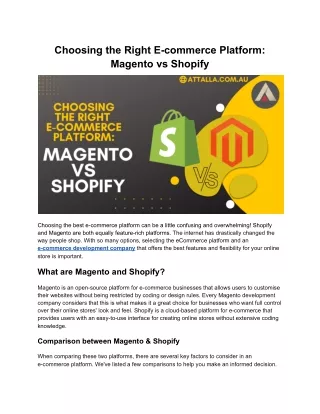
Discover the pros and cons of Magento and Shopify to make the best choice for your e-commerce business. Our in-depth comparison helps you decide which platform is right for you! Magento and Shopify are two popular e-commerce platforms that provide a range of features and benefits. Weighing their pros and cons will help you decide which platform is the best fit for your business. Start reading our comparison to make an informed decision today!

magento vs shopify
E N D
Presentation Transcript
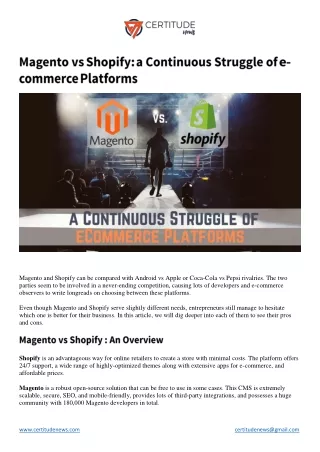
Magento eCommerce platform to choose? Vs Shopify - Which Magento and Shopify are two of the most widely used platforms in the current eCommerce market. It can be challenging to decide which platform is best when consumers have so many alternatives for where to shop and business owners have so many options for where to sell their items online. Prominent eCommerce platforms Magento and Shopify have a wide range of active eCommerce websites, with 21% on Shopify and 12% on Magento. Each company has a distinctive spot in the eCommerce market and has millions of loyal customers.
Source: Google Trends Both Magento and Shopify provide distinctive eCommerce shop experiences, yet they vary greatly in several respects. Shopify will work for certain companies, but Magento may be effective for others. Businesses must evaluate a variety of factors before selecting one of the following eCommerce systems. Below, we will be explaining the basics of these two platforms, along with the features and key differences between Magento and Shopify. Let’s get started. What is Shopify?
Shopify is a hosted e-commerce platform. You wouldn't have to worry about the financial and logistical aspects of hosting. It works well for drop shipping and small companies that rely on social media marketing in online stores. Shopify is simple to use even for new users. You can drag and drop sections to design your store, with an intuitive dashboard and out-of-the-box features. You can finish it over a weekend or in a few hours. Shopify can be more suitable for you if you own a small company and want to handle the majority of the optimization and day-to-day operations. Shopify Pros & Cons Explained! Pros ● Beginner-friendly ● Enhanced Customer support ● Faster page load time ● Easy to integrate your store with other platforms Cons ● Not much recommended for SEO ● It cannot be entirely customizable ● A transaction fee in Shopify is charged per sale If you are looking to leverage this platform for your Shopify app development needs, you can reach out to the best Shopify Development company that holds the right expertise and skills to handle your development project.
What is Magento? Magento is an open-source platform for online stores. It was introduced in 2008 and has since become a major player in the market. This platform can be used to run a multi-shop operation with numerous websites, different currencies, and different languages, or as a solely online business. It interfaces with a variety of third-party programs, including Facebook Ads Manager and Google Adwords. In addition to the platform's base features, there are a plethora of extensions available for more sophisticated capabilities. Magento also has a great selection of tools and features and gives you the freedom to create the appearance and feel you want for your online store. For end-to-end implementation, partner with a leading Magento development company to utilize the features and offer your users user-friendly end solutions. Magento Pros & Cons Explained! Magento Pros ● Huge Magento developer community with robust support. ● Enriched with lots of customization options. ● Wide range of themes available ● No real coding knowledge is needed for Magento commerce ● Magento is open source and free to use
Magento Cons ● Complex learning curve(especially for beginners) ● Requires a lot of time to set up. ● Higher costs associated with setting up your store Shopify Vs Magento - A quick glance at the differences between Magento and Shopify. Feature Shopify Magento Monthly subscription Open-source (free) or Pricing fees starting at $29 Enterprise Edition (paid) Self-hosted or cloud Hosting Fully hosted by Shopify hosting options Limited customization Highly customizable and Customization options flexible
Wide selection of Extensive library of free Themes themes in the Shopify and paid themes Theme Store Beginner-friendly with Steeper learning curve, user-friendly interface Ease of Use more technical and drag-and-drop knowledge required functionality Highly scalable and Scalable for small to Scalability suitable for large businesses enterprise-level stores Large app store with Robust extension App various third-party marketplace with Marketplace integrations extensive functionality
24/7 customer support Community-driven Support and extensive support and extensive documentation documentation Strong SEO capabilities Built-in SEO features SEO and customization and optimization tools options Mobile-friendly design Mobile Fully responsive and and progressive web Commerce mobile-friendly design app (PWA) support Supports multiple Payment Wide range of payment payment gateways and Options gateways available custom payment integrations
Strong focus on security, Secure hosting and but self-hosted Security regular security installations require updates additional security measures Multilingual support Built-in multilingual Multilingual available through apps capabilities Limited multistore Supports multiple stores Multistore capabilities from a single installation
Magento Differences between Magento & Shopify. Vs Shopify - The Ultimate Comparison of Magento Vs Shopify - Ease of Use The simplicity of usage is crucial since it increases your independence from outside sources. Magento As an enterprise-oriented solution, Magento demands strong technical skills to set up an online business. However, if you require particularly specific features, Magento offers you a wide range of customization options. Shopify Shopify was designed as an intuitive drag-and-drop solution for all styles of online stores, making it simple to set up, personalize, and use. It could not be versatile in the case of shops with an enterprise scale. Conclusion
In conclusion, Shopify has become more user-friendly and simpler to use, which is crucial for business owners who want to quickly launch their online stores. For more complex requirements, Magento is better. Magento Vs Shopify - Pricing The pricing and Magento and Shopify vary significantly, so based on your requirements and budget - you can choose the right platform. Shopify There are no setup fees with Shopify. They actually provide a 14-day free trial. Shopify offers four distinct plans, each of which has a monthly price of $9 for the Shopify Lite plan, $29 for the Basic Shopify Plan, $79 for the Shopify Plan, and $299 for the Advanced Shopify Plan. Magento The issue of setup costs simply does not arise with Magento because it is available for free. You must, however, cover the cost of your own hosting. To obtain templates and add-ons, you must also pay more. Conclusion: In terms of pricing, it's difficult to compare Magento vs Shopify. Setup costs are included with Shopify, however, Magento is free. The issue with Magento is that there are numerous unforeseen costs. Magento Vs Shopify - Themes Magento and Shopify offer a range of themes for their users; based on your requirements - you can choose the right platforms and themes. Magento Magento charges up to $499 for one of five completely mobile-responsive themes. Even better, you can build a theme yourself, but it requires coding know-how or the money to hire Magento developers from a leading ecommerce development companyy. ● Flexible opportunities for customization. ● Interesting animations. ● You have the choice of adding a featured product slider to your homepage.
Shopify Shopify offers more than nine free and 88 paid mobile-friendly themes. When compared to Magento themes, each theme is reasonably priced, ranging from $150 to $350. ● A drag-and-drop editor is used to add, switch, remove, and resize items. ● It is simple to add new pages and change them. ● It's simpler to integrate social media with Shopify. Conclusion Compared to Magento, Shopify has a greater selection of inexpensive themes, and you don't necessarily need to be an expert Shopify developer. However, Magento themes have better customizations but require more coding skills. You can hire the best Shopify and Magento development company, choose the themes and build one from scratch. Magento vs Shopify - Marketing Marketing is at the core of all businesses, and eCommerce needs robust marketing features to increase visibility and reach more customers. Shopify Shopify provides several built-in marketing features that can help businesses promote their products and improve their online visibility. It includes built-in SEO features such as customizable meta tags and URLs, leading to better optimizations. Furthermore, It also offers social media integrations, to connect and advertise on popular social media platforms. Magento Magento even offers robust marketing capabilities but requires more technical expertise to set up and configure. It provides strong SEO capabilities with extensive customization options, allowing businesses to optimize their websites for search engines. Magento offers integrations with popular email marketing platforms and even social media integrations, enabling businesses to connect and advertise on various social media platforms. Conclusion
Overall, both Shopify and Magento offer a range of marketing features to help businesses promote their products and engage with their target audience. Shopify provides a user-friendly experience with built-in marketing tools, whereas Magento offers more advanced and customizable marketing capabilities. To conclude You have now read about the main similarities and differences between Magento vs Shopify. Now that you are aware of which platform is best for you, let's briefly review their key distinctions. Shopify is a good choice if... ● It's important to open your store as soon as you can. ● You wish to transition from the e-commerce website builder you've been using (such as Wix, Squarespace, or Weebly). ● Even if you're just getting started, you want to grow your e-commerce business to its greatest potential. Magento is a good choice if... ● You want to create an internet store for your medium- or large-sized business and have coding expertise. ● With coding, you want to have complete creative control over your eCommerce store. If you are looking for the best implementation partner, then the leading eCommerce development company - Sufalam Technologies can help you out! Our team of dedicated Magento and Shopify Developers understands your requirements and offers personalized solutions. Frequently Asked Questions(FAQs) Which one is better: Magento vs Shopify? Magento & Shopify are two of the most popular eCommerce development platforms. You need to consider factors such as budget, business needs, customizations required, etc. To get the best solution, you can reach out to a certified Shopify or Magento development company to assist you!
Why choose Shopify over Magento? Shopify is more preferable over Magento because of its user-friendly interface, extensive app store with easy integrations, and scalability. While Magento has its strengths, Shopify's overall ease of use and convenience make it a popular choice for many businesses. How is Magento different from Shopify? Magento and Shopify differ in hosting, customization, cost, and ease of use. Magento's strength lies in its customization capabilities, scalability, active community, extensive B2B features, and the availability of the open-source Community Edition. These factors make it a compelling choice for businesses looking to develop a highly scalable flexible and feature-rich eCommerce platform.