Python Tuples vs Lists - Which Is More Efficient
https://pythonflood.com/python-tuples-vs-lists-which-is-more-efficient-36b6374c5b3c

Python Tuples vs Lists - Which Is More Efficient
E N D
Presentation Transcript
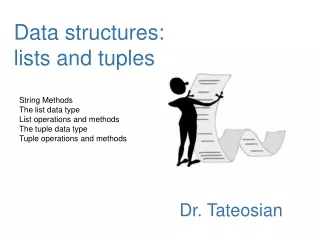
Python Tuples vs Lists - Which Is More Efficient? Python is a popular programming language that offers a variety of data structures to store and manipulate data. Two of the most commonly used data structures in Python are lists and tuples. In this guide, we will discuss the differences between lists and tuples, their characteristics, use cases, methods, and operations.
Lists vs Tuples: A list is a collection of items that are ordered and changeable. Lists are denoted by square brackets [ ]. A tuple, on the other hand, is a collection of items that are ordered and unchangeable. Tuples are denoted by parentheses ( ). Here’s an example of a list and a tuple: my_list = [1, 2, 3, 4]
my_tuple = (1, 2, 3, 4) As you can see, the list is defined using square brackets, while the tuple is defined using parentheses. This difference in syntax is essential as it indicates whether a collection of items is mutable or immutable. Lists vs Tuples: Mutability One of the most significant differences between lists and tuples is that lists are mutable, while tuples are immutable. This means that you can modify the elements of a list, but you cannot modify the elements of a tuple. For example, consider the following list and tuple: my_list = [1, 2, 3, 4] my_tuple = (1, 2, 3, 4)
You can change the second element of the list as follows: my_list[1] = 5 print(my_list) Output: [1, 5, 3, 4] However, if you try to change the second element of the tuple, you will get an error: my_tuple[1] = 5 Output: TypeError: ‘tuple’ object does not support item assignment This difference in mutability is important because it affects how you use lists and tuples in your code. If you need to modify the elements of
a collection of items, you should use a list. If you need a collection of items that cannot be changed, you should use a tuple. Lists vs Tuples: Performance Tuples are faster than lists in terms of performance. This is because tuples are immutable, and Python does not need to allocate additional memory to accommodate any changes made to them. Lists, on the other hand, are mutable, and Python needs to allocate additional memory every time you modify them. For example, if you append an item to a list, Python needs to allocate additional memory to store the new item. However, if you add an item to a tuple, Python does not need to allocate additional memory because the tuple is immutable.
In addition, because tuples are immutable, they can be used as dictionary keys, while lists cannot. Lists vs Tuples: Memory Usage Lists use more memory than tuples. This is because lists are mutable, and Python needs to allocate additional memory every time you modify them. Tuples, on the other hand, are immutable, and Python only needs to allocate memory for them once. This difference in memory usage is important if you are working with large collections of data. If you have a collection of items that you need to modify frequently, you should use a list. If you have a collection of items that you do not need to modify, you should use a tuple. Lists vs Tuples: Use Cases
Lists are best used for collections of data that need to be modified, sorted, or searched. For example, you might use a list to store a list of names, and then sort the list in alphabetical order or search for a specific name in the list. Tuples, on the other hand, are best used for collections of data that do not need to be modified, such as coordinates or dates. For example, you might use a tuple to store the latitude and longitude of a location or the date and time of an event. Lists vs Tuples: Methods and Operations Both lists and tuples have similar methods and operations, but there are some differences. Methods: ● append() method: adds an item to the end of a list
● count() method: returns the number of times a specified item appears in a list or tuple ● index() method: returns the index of the first occurrence of a specified item in a list or tuple ● len() function: returns the number of items in a list or tuple Operations: ● concatenation: using the + operator to combine two lists or tuples ● repetition: using the * operator to repeat a list or tuple a certain number of times ● membership: using the in operator to check if an item is in a list or tuple Here’s an example of using some of these methods and operations with a list and a tuple:
my_list = [1, 2, 3, 4] my_tuple = (1, 2, 3, 4) # appending an item my_list.append(5) print(my_list) # counting the number of times an item appears count = my_tuple.count(3) print(count) # concatenating two lists new_list = my_list + [6, 7, 8] print(new_list) # checking if an item is in a tuple
is_present = 5 in my_tuple print(is_present) Output: [1, 2, 3, 4, 5] 1 [1, 2, 3, 4, 5, 6, 7, 8] False Conclusion Lists and tuples are both useful data structures in Python, but they have different characteristics and use cases. Lists are mutable, and they are best used for collections of data that need to be modified, sorted, or searched. Tuples are immutable, and they are best used for collections of data that do not need to be modified. When choosing between lists and tuples, consider the mutability, performance, memory usage, and use case of your collection of data. By choosing the
appropriate data structure, you can optimize your code and make it more efficient.