Download
1 / 4
0 likes | 3 Views
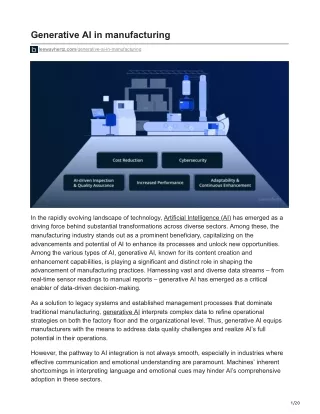
Conversational AI can revolutionize workforce training in manufacturing facilities by offering on-demand, personalized learning experiences. Through AI-powered tools like chatbots and voice assistants, employees can receive real-time support, troubleshoot issues, and access training materials at their convenience. This technology ensures consistency in training across the workforce while adapting to individual learning styles. It also reduces training costs by eliminating the need for extensive human instructors and physical materials. Additionally, conversational AI provides valuable data ana

E N D
What Are the Key Metrics for Evaluating Conversational AI Performance in Healthcare? The integration of Conversational AI in healthcare has significantly enhanced patient engagement, streamlined administrative tasks, and improved accessibility to medical services. However, to ensure optimal performance and effectiveness, it is crucial to measure its success through key performance metrics. Evaluating Conversational AI in healthcare involves analyzing various factors, from accuracy to patient satisfaction. Below are the key metrics for assessing its performance: 1. Response Accuracy One of the most critical metrics for Conversational AI in healthcare is response accuracy. AI chatbots and virtual assistants must provide precise and relevant information, especially when dealing with medical inquiries. High response accuracy ensures patient safety, reduces misinformation, and improves trust in AI-driven healthcare solutions. How to Measure: •Compare AI-generated responses with verified medical information. •Track instances of incorrect or misleading responses.
•Monitor user feedback on response correctness. 2. First Contact Resolution (FCR) Rate FCR measures the percentage of queries resolved during the first interaction without requiring escalation to a human agent. A higher FCR rate indicates that the AI is effectively handling patient inquiries, reducing the need for human intervention, and improving efficiency. How to Measure: •Calculate the percentage of conversations resolved without further escalation. •Analyze patterns in unresolved queries requiring human assistance. 3. User Satisfaction Score (CSAT) Patient experience is vital in healthcare. Measuring user satisfaction helps determine whether the Conversational AI is meeting patient expectations and delivering a seamless experience. How to Measure: •Conduct post-interaction surveys asking users to rate their experience. •Analyze feedback trends to identify areas for improvement. •Track positive and negative sentiments from reviews and comments. 4. Engagement Rate Engagement rate indicates how effectively the AI interacts with users. It includes metrics such as session length, number of interactions per session, and repeat usage. How to Measure: •Track the number of messages exchanged in a session. •Monitor the average duration of interactions. •Identify repeat users to assess continued trust in AI services.
5. Drop-off Rate A high drop-off rate suggests that users abandon the conversation before obtaining the necessary information. This could be due to poor AI comprehension, slow response times, or an unsatisfactory user experience. How to Measure: •Track sessions that end abruptly without resolution. •Analyze common points where users disengage. •Gather qualitative feedback on why users left the conversation. 6. Conversational Comprehension Rate Conversational AI should accurately understand user intent and context. The comprehension rate measures the AI’s ability to process natural language inputs effectively. How to Measure: •Compare user inputs with AI-generated responses. •Analyze instances where users must rephrase or repeat queries. •Use Natural Language Understanding (NLU) accuracy scores. 7. Task Completion Rate Healthcare Conversational AI Solutions often facilitate tasks like appointment scheduling, prescription refills, or symptom assessments. The task completion rate measures how successfully the AI completes these actions. How to Measure: •Track the percentage of completed tasks initiated by AI interactions. •Identify common failure points in task execution. 8. Latency and Response Time Fast response times are crucial in healthcare, where timely information can impact patient outcomes. Latency refers to the time taken by the AI to process and return a response.
How to Measure: •Monitor the average response time for different types of queries. •Identify delays and optimize AI models for faster performance. 9. Compliance and Security Metrics Healthcare data is highly sensitive, and AI solutions must comply with regulations like HIPAA (Health Insurance Portability and Accountability Act) and GDPR (General Data Protection Regulation). Measuring compliance ensures data protection and legal adherence. How to Measure: •Conduct regular audits for compliance adherence. •Track data encryption and access control measures. •Monitor security breach incidents and resolution times. 10. Escalation Rate to Human Agents While Conversational AI enhances automation, certain cases require human intervention. The escalation rate tracks how often the AI hands off conversations to human agents. How to Measure: •Monitor the percentage of queries escalated to human agents. •Identify patterns in the types of queries requiring escalation. •Improve AI training models to reduce unnecessary escalations. Conclusion Measuring the performance of Conversational AI in healthcare is essential for ensuring effectiveness, accuracy, and user satisfaction. By tracking metrics such as response accuracy, task completion rate, user engagement, and compliance adherence, healthcare providers can refine AI solutions for better service delivery. A well-optimized Conversational AI system improves patient interactions, reduces operational burdens, and enhances the overall healthcare experience.