Download
1 / 61
0 likes | 0 Views
https://files.oaiusercontent.com/file-9nVeR8RgHnA6LmOPKlJ3dT?download=true

E N D
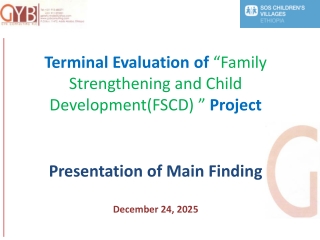
Terminal Evaluation of “Family Strengthening and Child Development(FSCD)”ProjectPresentation of Main FindingDecember 24, 2025
CONTENTS Background Objectives of the Evaluation Evaluation Aspects Evaluation Criteria Methodology Main Findings Conclusion REcommendation
Background: : SOS FSCD at a Glance • Implemented by SOS Children’s Villages Ethiopia in Lalibela • Timeframe: 2023–2025 | Coverage: 4 kebeles • Goal: Improve the wellbeing of vulnerable children by strengthening families • Integrated approach covering: • Child protection & positive parenting • Education support • Health, nutrition & MHPSS • Economic empowerment & livelihoods • Implemented in close collaboration with communities and government institutions to ensure sustainability and local ownership
Why FSCD? • Many vulnerable children face poverty, family stress, conflict impacts, and weak protection systems • Isolated interventions donot address the interconnected causes of child vulnerability • FSCD responds holistically by strengthening families as the primary caregivers and protectors of children • Supporting caregivers’ livelihoods, parenting skills, andwellbeing leads to better outcomes for children • Strengthened community and government systemsensure protection and services continue beyond the project
Core Components and Objectives • Child Protection & Parenting – to ensure children grow up safe, cared for, and protected • Economic Empowerment – to stabilize families and reduce vulnerability at household level • Education Support – to improve access, retention, and learning outcomes • Health, Nutrition & MHPSS – to address physical and psychosocial wellbeing • Community Systems Strengthening – to sustain impact through local ownership
Objectives of the End-line Evaluation Main Objective: • To measure the project’s performance against planned outcomes and identify successes, challenges, and lessons for future programming. Specific Objectives: ✅ Assess relevance, effectiveness, efficiency, sustainability, and impact of the project. ✅ Evaluate progress toward expected results compared to the planned schedule. ✅ Determine whether implementation is moving in the intended direction. ✅ Identify any unintended effects—positive or negative. ✅ Review validity of original design assumptions. ✅ Assess organizational structure, management, and institutional relationships. ✅ Examine beneficiary outcomes and overall project impact. ✅ Provide evidence-based recommendations for future program improvement and replication.
Evaluation Aspects • Project Management Aspect • Project Accomplishments and Results Aspect • Monitoring and Evaluation (M&E) Aspect • Lessons Learned( what worked and what has not worked)
Evaluation Criteria • We use OECD’s DAC criteria: • Relevance, • Effectiveness, • Efficiency, • Potential impact and • Sustainability)
Scope, Coverage, and Study Population Geographic Coverage: • Location:Lalibela Town, Amhara Region • Coverage: 4 kebeles • Roha • DebreZeit • DebreSina • MeskelKibra • Focus: Vulnerable children and families in high-need urban communities Population Studied: • Vulnerable children and adolescents • Caregivers and households supported by FSCD • Community structures (CCSCs, RuSACCOs) • Schools and government stakeholders
Sampling and Data Collection Methods Quantitative Sampling: • The baseline determined the quantitative sample size using the standard formula for a finite population: • n=N1+N(e)2n = \frac{N}{1 + N(e)^2}n=1+N(e)2N • Where: • N = Total population of caregivers = 450 • e = Margin of error = 0.05 (5%) • Confidence level = 95%, Z-score = 1.96 • Standard deviation assumed = 0.5 • Applying the formula: • n=4501+450(0.05)2=207n = \frac{450}{1 + 450(0.05)^2} = 207n=1+450(0.05)2450=207 • Thus, the sample size for both baseline and endline is: 207 caregivers and 207 children.
Qualitative Sampling • Purposive sampling used for key informants and focus group participants. • Captured insights from those directly involved in implementation. • Availability Sampling
Data Sources and methods • Household Survey • Desk Research (Review of secondary documents) • Focus Group Discussions (FGDs) with 8-10 members. • In-depth interviews with Key informants • Process Consultation, • Schools, Infrastructure and activity Observation • Field (Participant) observation and • Case studies.
Qualitative data collection tools • Questionnaire for children • Questions for Caregivers • FGD Questions for Project Beneficiary Children(older) • FGD Questions for SACCOs • FGD Questions for Woredaseducation officers • Questions for Government Stakeholders (Signatories) • Questions for Project Staff and the Donor
Recruitment, Training and Field Organization • Recruitment of Field Staffs • Training Approach • Field Organization • Data Collection and Data Quality Assurance Plan
Pretest • Pretest of the tool will be made on 20 community members in Gondar
Ethical considerations • Given the purpose of the study, ethical clearance is not sought but support letter was secured. • Informed consent, confidentiality and clear communication is strictly made. • Respondents’ privacy strictly maintained. • SOS child safeguarding policy is strictly adhered
Analysis of Data • SPSS version 23 for the survey and • Colaizzi's procedural steps for qualitative data • Used interactive debriefing with project teams to validate findings.
FindingsOverall Achievements • Achieved nearly 100% of planned objectives as per the project log frame. • Demonstrated positive outcomes in the lives of target children and families with concrete outcome in Lalibela. “ Project is not new in Lalibella but SOS is unique as it touches the heart of the community beyond the target beneficiaries” City Finance and Economy
Outcome 1: Strengthened Family and Community-Based Child Protection Systems
Outcome 2: Improved Household Economic Resilience and Livelihood Stability
Outcome 3: Enhanced Access to Quality Education and Improved Learning Outcomes
Effectiveness Effectiveness was evaluated based on the below 4 dimensions: • Children’s Educational Outcomes – school attendance, performance, and retention. • Caregiver Livelihoods & Resilience – income generation, savings, and parenting capacity. • School Capacity Building – teacher training, infrastructure, and learning quality. • Community & Institutional Collaboration – partnerships among CCSCs, SACCOs, and local government.
Relevance of the project Approach in the Evaluation: • Analyzed contextual relevance — fit with real challenges facing families and schools. • Reviewed policy and strategic relevance — contribution to Ethiopia’s Education and Social Protection strategies. • Assessed programmatic and community relevance — effectiveness of community-based structures (CCSCs & SACCOs) and local ownership.
Contextual Relevance Key Realities Addressed: • Widespread poverty and food insecurity. • Conflict and displacement disrupting schooling. • Limited access to child protection and social support. • Gender-based vulnerabilities affecting girls’ education. Project Response: • Combined education, livelihood, and psychosocial support for maximum impact. • Provided school materials, food stipends, and medical care to prevent dropouts. • Empowered families through vocational training and financial inclusion. • Strengthened local community coalitions (CCSCs) to respond to child protection needs.
Programmatic and Community Relevance Design Strengths: • Rooted in evidence and lessons from previous FSCD phases. • Uses community structures (CCSCs & SACCOs) to ensure local ownership. • Promotes sustainability by reducing dependency and building local capacity. • Addresses cross-cutting issues: gender equity, inclusion, and psychosocial well-being. Community Voices: “ When the conflict displaced families, we coordinated quickly to re-enroll children. We didn’t wait for outside aid.” — CCSC Member, Gondar
Efficiency • Highly efficient project mainly due to • Resource absorption • Extremely cost-effective • Extreme staff motivation and commitment • Strict budget allocation and administration • Efficient Project Implementation and Continuous Assessment
Challenges and Limitations Affecting Efficiency 1. Procurement Delays and Centralization • The centralized procurement system (managed from Addis Ababa) slowed the timely delivery of materials and equipment to project sites. • Limited flexibility at field level reduced responsiveness to urgent local needs (e.g., replacing damaged school materials or restocking supplies). • The process occasionally caused implementation lags and disrupted the planned schedule for school support activities.
Limitations… 2. Limited Induction and Capacity building for staff • Inadequate induction and training for new personnel slowed activity continuity and reduced efficiency. 3.Logistical and Security Constraints 4. Coordination and Communication Bottlenecks • Occasional communication gaps between national and field offices led to duplicated efforts or delayed decision-making. • The volume of reporting and administrative tasks sometimes diverted staff from core implementation activities.
Impact • Educational Impact: Dropout reduced from 10% to 4%, with 96% of children enrolled and 93% promoted annually. • Economic Impact: 87% of caregivers increased income and achieved self-reliance, sustaining children’s schooling. • Community Impact: Functional CCSCs and SACCOs strengthened local child protection and family support systems. • Behavioral Impact: Children showed improved confidence and discipline; families embraced education and saving cultures.
Sustainability • Community Ownership – CCSCs & SACCOs functioning independently. • Government Alignment – Integrated with local education and social systems. • Capacity Retention – Trained teachers & caregivers sustain skills. • Economic Self-Reliance – Caregiver savings and livelihoods continue. • Partnership Networks – Strong SOS–school–government collaboration. • Challenges: • Funding Gaps – Some community groups still depend on external support. • Context Risks – Conflict and inflation threaten local continuity.
Conclusion • Highly Relevant and Responsive – The project effectively addressed educational and socio-economic needs in conflict-affected communities. • Holistic and Effective Approach – Integrating education, livelihoods, and psychosocial support produced strong, measurable results. • Sustainable Community Systems – Strengthened CCSCs, SACCOs, and government linkages ensure continued child and family support. • Scalable Model – FSCD 4.0 offers a proven, adaptable framework for replication in other regions facing similar vulnerabilities.
Recommendation • Scale Up the Model – Expand FSCD to more districts, prioritizing conflict-affected and low-income areas. • Decentralize Operations – Allow site-level procurement and decision-making for faster, more efficient delivery. • Strengthen Capacity – Institutionalize staff induction, continuous training, and digital M&E tools. • Deepen Collaboration – Integrate FSCD’s approach into local education and social protection systems. • Promote Inclusion & Resilience – Enhance disability inclusion, climate awareness, and livelihood diversification.
GYB Team Response to Review Comments • The GYB team appreciates the constructive feedback provided by reviewers. • All comments were reviewed openly and professionally. • Feedback was seen as an opportunity to strengthen the quality, clarity, and credibility of the report.
Comments… • Methodology sections were clarified and better aligned with evaluation objectives. • Data gaps and inconsistencies were corrected or explained. • Narrative sections were revised for clarity, coherence, and evidence-based conclusions. • Reviewer suggestions were incorporated while maintaining report integrity.
The Revised Report Ensures… • Improved structure, readability, and logical flow of the report. • Stronger linkage between findings, conclusions, and recommendations. • Enhanced transparency and credibility of analysis. • Final report reflects a collaborative and responsive review process.
Abera • Include care givers 91% self-reliant • Keep lesson learned in separate section • Include promotion rate in the report Tade: • Overall performance 100%. • Case story or case study • 2 lijbecha • What do we do without baseline(before and after analysis) • Low / high, weak/strong Yaze Include all indicators at output level(we did but we will). Baseline laYyelelu
Be logframumeseretyikemet(adult literacy outcome 3) Michael • 4 outcome( child care and protection… astekakil) • Disability • Informed consent Coherence yikatet Effectiveness Nearly 100% xyibalim(specify) Data protection(Yiferem, all involved research team leofficeYilak back date) Belog frame yikireb( baseline, endline, target), What is 100%(of the participants and not the beneficiaries). Youth wiout caregivers hunyta Lesson has to be (observation, good practice, challenge,,) • Most significant changes yikatet
ACRE Project – Terminal Report • Afar–Cross Border Resilience and Empowerment (ACRE) Project • Terminal Report Presentation
Project Overview • The ACRE Project was designed to strengthen resilience, livelihoods, peace, and basic services in fragile and conflict-affected border areas through integrated and community-driven interventions.
Project Objectives • • Strengthen household resilience and livelihoods • • Improve access to WASH and basic services • • Promote peacebuilding and social cohesion • • Enhance institutional and community capacities
Implementation Approach • The project applied a Triple Nexus approach integrating humanitarian response, development actions, and peacebuilding, ensuring sustainability and conflict sensitivity.
Key Achievements – Summary • The project successfully achieved most planned outputs, demonstrating strong community engagement, effective coordination with local authorities, and measurable improvements in livelihoods, WASH, and social cohesion.
Monitoring, Learning & Accountability • Robust M&E systems, participatory monitoring, and continuous learning mechanisms ensured quality delivery, accountability, and adaptive management throughout the project cycle.
Challenges & Mitigation Measures • Key challenges included climatic shocks, insecurity, and access constraints. These were mitigated through flexible planning, strong local partnerships, and adaptive implementation strategies.



![[PDF] Free Download Warhammer 40000: Kill Team Enhanced Edition By Games Workshop](https://cdn4.slideserve.com/7993413/slide1-dt.jpg)
![[PDF] Free Download Her Final Hour By Carla Kovach](https://cdn4.slideserve.com/8000673/slide1-dt.jpg)
![[PDF] Free Download Codex: Orks Enhanced Edition By Games Workshop](https://cdn4.slideserve.com/8071663/slide1-dt.jpg)