Custom vs Template
Choosing between a custom website and a template website is a critical decision that affects cost, functionality, design flexibility, and long-term scalability.


Custom vs Template
E N D
Presentation Transcript
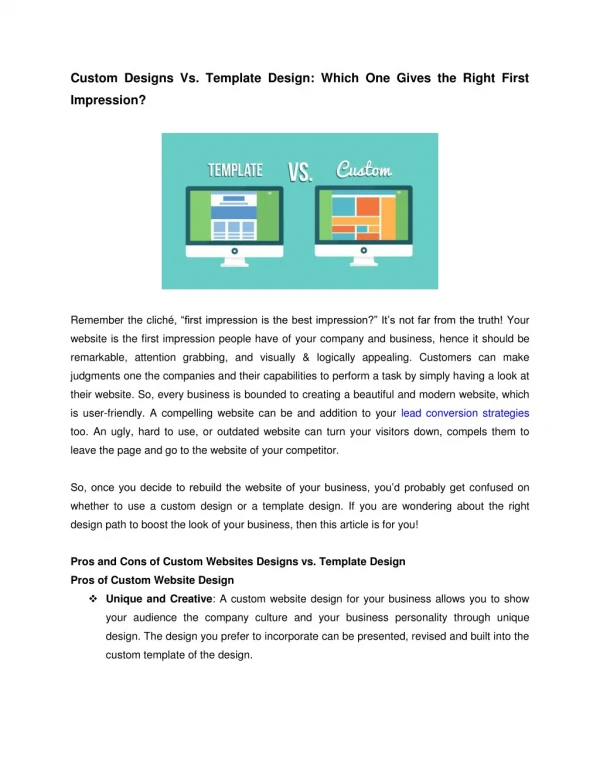
Custom vs. Template Websites: Key Factors, Trade-offs & Challenges In today’s digital age, your website is often the first impression your business makes. Whether you're a startup or an established company, choosing between a custom website and a template website is a major decision that can impact your brand identity, user experience, and overall success online. This article offers a clear comparison between the two, highlighting important trade-offs and challenges involved. What Are Template Websites? Template websitesare pre-designed layouts created for quick deployment. Platforms like WordPress, Wix, and Shopify offer thousands of templates that can be customized with your content, colors and images. Pros: • Cost-Effective: Ideal for small businesses with tight budgets. • Faster Launch Time: Templates can be live within days. • No Coding Required: Most are drag-and-drop and user-friendly. Cons: • Limited Customization: You're constrained by the design and structure.
• Performance Issues: Many templates come with bloated code and unnecessary features. • Generic Look: Other businesses may be using the exact same design. What Are Custom Websites? Custom websitesare built from scratch or designed using a flexible framework tailored to your specific needs. A custom site is usually developed by awebsite designing companyor a professional web developer. Pros: • Unique Branding: Your website will reflect your brand's personality and voice. • Better Performance: Clean code and tailored functionality enhance speed and user experience. • Scalable: Easily updated and expanded as your business grows. Cons: • Higher Cost: Custom development is more expensive upfront. • Longer Development Time: It may take weeks or months to complete. • Requires Technical Expertise: You’ll likely need professional support for updates and maintenance. Key Factors to Consider When deciding between acustom vs. template website, consider the following: 1.Budget Templates are budget-friendly, while custom designs involve more investment. However, the ROI of a custom website may be higher in the long run if it converts better and supports business growth. 2.Brand Identity If your brand relies heavily on a distinct visual identity, acustom websiteoffers the flexibility to design exactly what you envision. Templates may restrict your creativity. 3.SEO and Performance Custom websites can be optimized for SEO from the ground up, improving your chances of ranking well on search engines. Some templates, especially free ones, may be poorly coded, slowing down your site and harming SEO performance. 4.Functionality If you need unique features like booking systems, custom dashboards, or advanced integrations, acustom siteis usually the better choice. 5.Time to Launch If you need a website live within a week, templates are your go-to option. Custom websites require a longer timeline due to planning, design, development, and testing phases.
The Balancing Act: Tradeoffs and Challenges Choosing between a custom and template website involves balancingcost, time, scalability, and design flexibility. A template may be faster and cheaper, but it could limit growth and uniqueness. On the other hand, a custom site offers superior performance and branding but requires greater investment and time. Business owners must assess theirlong-term goals, audience needs, and budget constraintswhen making this decision. For example, a boutique e-commerce brand aiming to stand out may benefit more from acustom solution, while a local service provider could thrive with a well-optimized template. Conclusion There's no one-size-fits-all answer to thecustom vs. template websitedebate. Each option comes with its own set of pros, cons, and challenges. Carefully evaluating your business needs, budget, and future goals will help you make the right choice. Whether you go custom or template, ensuring your website is responsive, SEO-friendly, and aligned with your brand is key to long-term digital success.