
welding proceses
E N D
Presentation Transcript
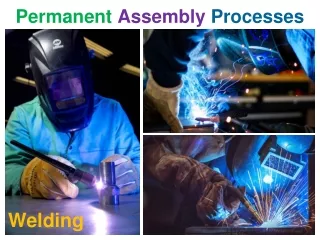
Permanent Assembly Processes Welding
Processes for permanent assembly Welding Welding is a metal joining process where coalescence (unite so as to form one group body or mass) is obtained by heat and/or pressure. It may also be defined as a metallurgical bond accomplished by the attracting forces between atoms. Before these atoms can be bonded together, absorbed vapors and oxides on contacting surfaces must be overcome. Many welding processes have been developed which differ widely in the manner in which heat is applied and in the equipment used. Some require hammering, rolling, or pressing to affect the weld; others bring the metal to a fluid state and require no pressure.
Types of welding processes Welding is a material joining process for a permanent combining of two (or more) parts that involves melting and subsequent solidification of the material from two parts thus forming a strong joint between them. The assemblage of parts is called a weldment. There are two groups of welding processes according to the state of the base material during the welding process: 1. Liquid-state welding (fusion welding), in which coalescence is accomplished by melting the two surfaces to be joined, in some cases adding filler metal to the joint, and; 2. Solid-state welding, in which heat and/or pressure are used to achieve coalescence, but no melting of base metal, occurs and no filler metal is added.
Types of welding processes Fusion welding is by far the more important category. In fusion welding, the base material is heat to melt. The most important processes in this group fall in the following categories: Oxyfuel gas welding: an oxyfuel gas produces a flame to melt the base material; Arc welding: heating and melting of the material is accomplished by an electric arc; Resistance welding: the source of heat is the electrical resistance on the interface between two parts held together under pressure.
Types of welding processes In solid-state welding, two parts are jointed together under pressure or a combination of pressure and heat. If heat is applied, the contact temperature is below the melting point of the base metal. Two welding processes are the most popular from this group: 1) Diffusion welding: parts coalesce by solid-state diffusion; 2) Friction welding: coalescence is achieved by the heat of friction between two parts.
Welding, Brazing and Soldering Fusion Welding (FW): Melting & coalescing materials by the use of heat from external source Solid state welding (SSW): Joining without fusion “noliquid metal”. Brazing & Soldering (B&S): use filler metals and involve lower temperatures than used in the above ones
Classification of welding processes Types of welding: Gas Metal Arc Welding (GMAW/MIG), Gas Tungsten Arc Welding (GTAW/TIG), Shielded Metal Arc Welding (SMAW), Flux Cored Arc Welding (FCAW), Submerged Arc Welding (SAW). Source: https://mechanicaljungle.com/what-is-welding/
Type of Welding Joints source: https://engineeringlearn.com/type-of-welding-joints-applications-advantages-disadvantages/
Type of Welding Positions Welding positions defined here for groove welds: (a) flat, (b) horizontal, (c) vertical, (d) overhead
What is an Electric Arc? An electric arc is a discharge of electric current across a gap in a circuit It is sustained by an ionized column of gas (plasma) through which the current flows To initiate the arc in AW, electrode is brought into contact with work and then quickly separated from it by a short distance
Welding Processes 1. Arc Welding 2. Resistance Welding 3. Oxyfuel Gas Welding 4. Other Fusion Welding Processes 5. Solid State Welding 6. Weld Quality 7. Weldability 8. Design Considerations in Welding
Arc Welding (AW) A fusion welding process in which coalescence of the metals is achieved by the heat from an electric arc between an electrode and the work Electric energy from the arc produces temperatures ~ 10,000 F (5500 C), hot enough to melt any metal Most AW processes add filler metal to increase volume and strength of weld joint
Arc Welding A pool of molten metal is formed near electrode tip, and as electrode is moved along joint, molten weld pool solidifies in its wake
Manual Arc Welding and Arc Time Problems with manual welding: Weld joint quality Productivity Arc Time = (time arc is on) divided by (hours worked) Also called “arc-on time” Manual welding arc time = 20% Machine welding arc time ~ 50%
Two Basic Types of Arc Welding Electrodes Consumable –consumed during welding process Source of filler metal in arc welding Nonconsumable –not consumed during welding process Filler metal must be added separately if it is added
Consumable Electrodes Forms of consumable electrodes Welding rods (a.k.a. sticks) are 9 to 18 inches and 3/8 inch or less in diameter and must be changed frequently Weld wire can be continuously fed from spools with long lengths of wire, avoiding frequent interruptions In both rod and wire forms, electrode is consumed by the arc and added to weld joint as filler metal
Nonconsumable Electrodes Made of tungsten which resists melting Gradually depleted during welding (vaporization is principal mechanism) Any filler metal must be supplied by a separate wire fed into weld pool
Arc Shielding At high temperatures in AW, metals are chemically reactive to oxygen, nitrogen, and hydrogen in air Mechanical properties of joint can be degraded by these reactions To protect operation, arc must be shielded from surrounding air in AW processes Arc shielding is accomplished by: Shielding gases, e.g., argon, helium, CO2 Flux
Flux A substance that prevents formation of oxides and other contaminants in welding, or dissolves them and facilitates removal Provides protective atmosphere for welding Stabilizes arc Reduces spattering
Various Flux Application Methods Pouring granular flux onto welding operation Stick electrode coated with flux material that melts during welding to cover operation Tubular electrodes in which flux is contained in the core and released as electrode is consumed Source: https://www.youtube.com/watch?v=TPSQJXqSwTg&t=9s
Power Source in Arc Welding Direct current (DC) vs. Alternating current (AC) AC machines less expensive to purchase and operate, but generally restricted to ferrous metals DC equipment can be used on all metals and is generally noted for better arc control Electric energy from the arc produces temperatures ~ 10,000°F (5500°C), hot enough to melt any metal Most AW processes add filler metal to increase volume and strength of weld joint
Consumable Electrode AW Processes Shielded Metal Arc Welding Gas Metal Arc Welding Flux-Cored Arc Welding Electrogas Welding Submerged Arc Welding
Shielded Metal Arc Welding (SMAW) Uses a consumable electrode consisting of a filler metal rod coated with chemicals that provide flux and shielding Sometimes called "stick welding" Power supply, connecting cables, and electrode holder available for a few thousand dollars
Shielded Metal Arc Welding (SMAW) Source: https://www.youtube.com/watch?v=elmDvqdeMKI&t=89s
Welding Stick in SMAW Composition of filler metal usually close to base metal Coating: powdered cellulose mixed with oxides and carbonates, and held together by a silicate binder Welding stick is clamped in electrode holder connected to power source Disadvantages of stick welding: Sticks must be periodically changed High current levels may melt coating prematurely Current AC or DC: (50 – 100 A, low current causes incomplete fusion), Power (10 kw)
Shielded Metal Arc Welding (SMAW) Applications Used for steels, stainless steels, cast irons, and certain nonferrous alloys Not used or rarely used for aluminum and its alloys, copper alloys, and titanium About one-half of all large-scale industrial welding operations use this process. (example: construction, pipelines)
Shielded Metal Arc Welding Source: https://www.youtube.com/watch?v=elmDvqdeMKI
Heat Transfer in Arc Welding voltage current Heat input (J or BTU) Length of the weld Welding speed Efficiency Weld cross section Specific energy required for melting Welding speed
Example # 1 Consider an Arc welding operation with V = 20 volts, I = 200 A and weld cross section area of 30 mm2. For a 75% efficiency estimate the welding speed for workpiece and electrode of (a) Aluminum, (b) Carbon steel, (C) titanium. Example # 1 Solution (a) From the table 12.3 for Aluminum u = 2.9 J/mm3 v = e VI = 0.75 (20)(200) = 34.5 mm (2.9)(30) uA s (b) From the table 12.3 for Carbon Steel u = 9.7 J/mm3 v = e VI = 0.75 (20)(200) = 10.3 mm (9.7)(30) uA s (c) From the table 12.3 for Titanium u = 14.3 J/mm3 v = e VI = 0.75 (20)(200) mm (14.3)(30) = 7 s uA
Example # 2 Consider shielded metal arc welding on steel workpiece. The weld has triangular cross section of 10 mm leg length. Using a 20 V power supply, estimate the current needed if the welding speed is 10 mm/sec and efficiency is 75%. Example # 2 Solution The weld cross sectional area is: 1 2 1 2 10 10 = 50 mm 2 A = bh = From the table 12.3 for Steel u = 9.7 J/mm3 v = e VI → I = vuA = 10 × 9.7 × 50 = 323.33 A uA eV 0.75 × 20
Shielded Metal Arc Welding (SMAW) Although the process is well suited for workpiece thickness of 3-19 mm but rage can be extended by multi-pass technique. Note: Oxides and fluxes must be removed (wire brushing) before adding a new weld bead. A weld zone showing the build-up sequence of individual weld beads in deep welds.
Gas Metal Arc Welding (GMAW) Uses a consumable bare metal wire as electrode with shielding by flooding arc with a gas Wire is fed continuously and automatically from a spool through the welding gun Shielding gases include argon and helium for aluminum welding, and CO2 for steel welding Bare electrode wire plus shielding gases eliminate slag on weld bead No need for grinding and cleaning of slag
Gas Metal Arc Welding - Setup Source: https://knordslearning.com/what-is-mig-welding/
Gas Metal Arc Welding Source: https://www.youtube.com/watch?v=twUAa5LWUvk
GMAW Advantages over SMAW (Comparison ) Better arc time because of continuous wire electrode Sticks must be periodically changed in SMAW Better use of electrode filler metal than SMAW End of stick cannot be used in SMAW Higher deposition rates Eliminates problem of slag removal Can be readily automated
Flux-Cored Arc Welding (FCAW) Adaptation of shielded metal arc welding, to overcome limitations of stick electrodes - two versions Self-shielded FCAW - core includes compounds that produce shielding gases Gas-shielded FCAW - uses externally applied shielding gases Electrode is a continuous consumable tubing (in coils) containing flux and other ingredients (e.g., alloying elements) in its core
Flux-Cored Arc Welding Presence or absence of externally supplied shielding gas distinguishes: (1) self-shielded - core provides ingredients for shielding, (2) gas- shielded - uses external shielding gases
Flux-Cored Arc Welding Source: https://www.youtube.com/watch?v=TPSQJXqSwTg
Electrogas Welding (EGW) Uses a continuous consumable electrode, flux-cored wire or bare wire with externally supplied shielding gases, and molding shoes to contain molten metal When flux-cored electrode wire is used and no external gases are supplied, then special case of self-shielded FCAW When a bare electrode wire used with shielding gases from external source, then special case of GMAW
Electro-gas Welding (EGW) Electrogas welding using flux-cored electrode wire: front view with molding shoe removed for clarity, side view showing molding shoes on both sides
Electro-gas Welding (EGW) Source: https://youtube.com/watch?v=Tkg5uOkJUEU
Submerged Arc Welding (SAW) Uses a continuous, consumable bare wire electrode, with arc shielding by a cover of granular flux Electrode wire is fed automatically from a coil Flux introduced into joint slightly ahead of arc by gravity from a hopper Completely submerges operation, preventing sparks, spatter, and radiation