engineering metrology
engineering metrology

engineering metrology
E N D
Presentation Transcript
Introduction Cross-section of a machine-tool slideway. The width, depth, angles and other dimensions all must be produced and measured accurately for the machine tool to function as expected.
Metrology • Metrology is the science of measurement • Dimensional metrology is that branch of Metrology which deals with measurement of “dimensions“ of a part or workpiece (lengths, angles, etc.) • Dimensional measurements at the required level of accuracy are the essential link between the designers’ intent and a delivered product.
Dimensional Metrology Needs Linear measurements Angular measurements Geometric form measurements Roundness Straightness Cylindricity Flatness, etc Geometric relationships Parallel, perpendicular, etc. Concentric, runout, etc. Controlled surface texture
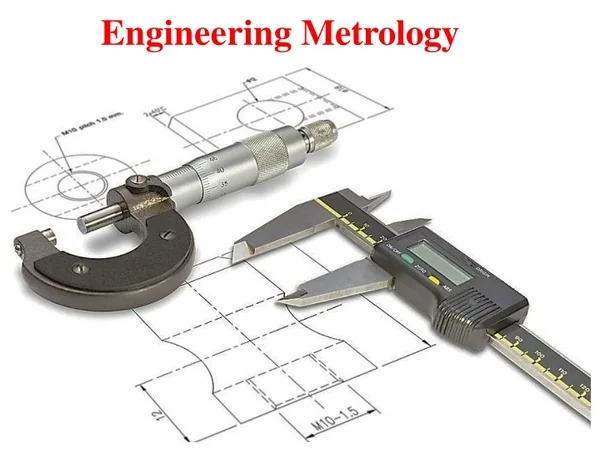
Analog and Digital Micrometers (a) A vernier (analog) micrometer. (b) A digital micrometer with a range of 0 to 1 in. (0 to 25 mm) and a resolution of 50 µin. (1.25µm). It is generally easier to read dimensions on this instrument compared to the analog micrometer.
Profile Measurement Measuring gear-tooth thickness and profile with (a) a gear-tooth caliper and (b) balls and a micrometer. Source: American Gear Manufacturers Association.
Introduction to Tolerances Can more than one or multiple parts be produced with exactly same dimensions? Why?
Tolerance “the allowable deviation from a standard, eg: the range of variation permitted in maintaining a specified dimension in a machined piece.” Webster
Some Definitions Basic Size: The size with reference to which the limits of size are fixed. Actual Size: Actual measured dimension of the part. Zero Line: It is a straight line corresponding to the basic size. The deviations are measured from this line. The positive and negative deviations are shown above and below the zero line respectively.
Some Definitions Limits of Size: The two extreme permissible sizes of a part between which the actual size should lie. Maximum Limit of Size: The greater of the two limits of size. Minimum Limit of Size: The smaller of the two limits of size. Shaft: A term used by convention to designate all external features of a part, including those which are not cylindrical. Hole: A term used by convention to designate all internal features of a part, including those which are not cylindrical.
Some Definitions Allowance: It is the difference between the basic dimensions of the mating parts. When the shaft size is less than the hole size, then the allowance is positive and when the shaft size is greater than the hole size, then the allowance is negative. Tolerance: It is the difference between the upper limit and lower limit of a dimension.
Some Definitions Tolerance Zone: It is the zone between the maximum and minimum limit size. Upper Deviation: It is the algebraic difference between the maximum size and the basic size. The upper deviation of a hole is represented by a symbol ES (Ecart Superior) and of a shaft, it is represented by es. Lower Deviation: It is the algebraic difference between the minimum size and the basic size. The lower deviation of a hole is represented by a symbol EI (Ecart Inferior) and of a shaft, it is represented by ei. Shaft
Specification of DT Unilateral Tolerance In this system, the dimension of a part is allowed to vary only on one side of the basic size, i.e. tolerance lies wholly on one side of the basic size either above or below it. Bilateral Tolerance In this system, the dimension of the part is allowed to vary on both the sides of the basic size, i.e. the limits of tolerance lie on either side of the basic size.
Exercise Q1. Type? Bilateral, Unilateral, Unilateral. Q2. Tolerance? 0.015, 0.005, 0.004 Q3. Express in limit form?
Fit A fit may be defined as the degree of tightness and looseness between two mating parts.
Clearance Fit In clearance fit, an air space or clearance exists between the shaft and hole. Such fits give loose joint. A clearance fit has positive allowance, i.e. there is minimum positive clearance between high limit of the shaft and low limit of the hole. Allows rotation or sliding between the mating parts.
Types of Clearance Fit Loose Fit It is used between those mating parts where no precision is required. It provides minimum allowance and is used on loose pulleys, agricultural machineries etc. Running Fit For a running fit, the dimension of shaft should be smaller enough to maintain a film of oil for lubrication. It is used in bearing pair etc. Slide Fit or Medium Fit It is used on those mating parts where great precision is required. It provides medium allowance and is used in tool slides, slide valve, automobile parts, etc.
Interference Fit A negative difference between diameter of the hole and the shaft is called interference. In such cases, the diameter of the shaft is always larger than the hole diameter. It used for components where motion, power has to be transmitted. Interference exists between the high limit of hole and low limit of the shaft.
Types of Interference Fit Shrink Fit or Heavy Force Fit It refers to maximum negative allowance. In assembly of the hole and the shaft, the hole is expanded by heating and then rapidly cooled in its position. It is used in fitting of rims etc. Medium Force Fit These fits have medium negative allowance. Considerable pressure is required to assemble the hole and the shaft. It is used in car wheels, armature of dynamos etc. Tight Fit or Force Fit One part can be assembled into the other with a hand hammer or by light pressure. A slight negative allowance exists between two mating parts (more than wringing fit). It gives a semi- permanent fit and is used on a keyed pulley and shaft, rocker arm, etc.
Transition Fit It may result in either clearance fit or interference fit depending on the actual value of the individual tolerances of the mating components. Transition fits are a compromise between clearance and interference fits. They are used for applications where accurate location is important but either a small amount of clearance or interference is permissible.
Types of Transition Fit Push Fit or Snug Fit It refers to zero allowance and a light pressure is required in assembling the hole and the shaft. The moving parts show least vibration with this type of fit. Force Fit or Shrink Fit A force fit is used when the two mating parts are to be rigidly fixed so that one cannot move without the other. It either requires high pressure to force the shaft into the hole or the hole to be expanded by heating. It is used in railway wheels, etc. Wringing Fit A slight negative allowance exists between two mating parts in wringing fit. It requires pressure to force the shaft into the hole and gives a light assembly. It is used in fixing keys, pins, etc.