Stud Bolts
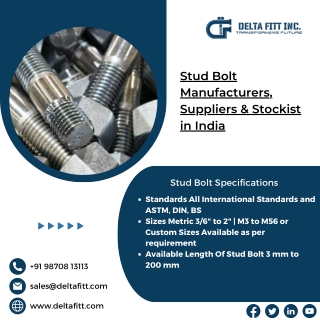
A Stud Bolt is a type of threaded fastener without a head, primarily used in flange connections for various types of pipes and fittings. Unlike regular bolts, a stud bolt is a rod threaded on both ends, or sometimes fully threaded, allowing it to be secured with two nuts. This design ensures enhanced clamping and fastening performance, which is vital in critical projects and heavy-duty assemblies.<br><br>

Stud Bolts
E N D
Presentation Transcript
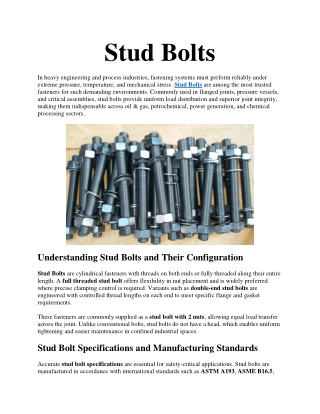
Stud Bolts In heavy engineering and process industries, fastening systems must perform reliably under extreme pressure, temperature, and mechanical stress. Stud Bolts are among the most trusted fasteners for such demanding environments. Commonly used in flanged joints, pressure vessels, and critical assemblies, stud bolts provide uniform load distribution and superior joint integrity, making them indispensable across oil & gas, petrochemical, power generation, and chemical processing sectors. Understanding Stud Bolts and Their Configuration Stud Bolts are cylindrical fasteners with threads on both ends or fully threaded along their entire length. A full threaded stud bolt offers flexibility in nut placement and is widely preferred where precise clamping control is required. Variants such as double-end stud bolts are engineered with controlled thread lengths on each end to meet specific flange and gasket requirements. These fasteners are commonly supplied as a stud bolt with 2 nuts, allowing equal load transfer across the joint. Unlike conventional bolts, stud bolts do not have a head, which enables uniform tightening and easier maintenance in confined industrial spaces. Stud Bolt Specifications and Manufacturing Standards Accurate stud bolt specifications are essential for safety-critical applications. Stud bolts are manufactured in accordance with international standards such as ASTM A193, ASME B16.5,
DIN 976, and ISO 898-1, ensuring mechanical strength, dimensional accuracy, and material consistency. A widely used grade is the B7 stud bolt, produced under ASTM A193 stud bolts specification. This grade offers excellent tensile strength and is suitable for high-temperature and high-pressure environments. Other common materials include carbon steel stud bolts, alloy steel stud bolts, and stainless steel stud bolts, each selected based on operating conditions. Stud Bolts vs Other Fastening Solutions The comparison of stud bolt vs hex bolt often arises in flange applications. Stud bolts provide better load distribution, reduced thread wear, and easier retightening compared to hex bolts. Similarly, when considering threaded rod vs stud bolt, stud bolts offer superior dimensional control, mechanical properties, and compliance with pressure equipment standards. These differences make industrial stud bolts the preferred choice for critical joints where safety and reliability are non-negotiable. Industrial Applications and Sector-Specific Importance Oil & Gas and Offshore Installations Chemical and Petrochemical Processing Power Generation and Heavy Industry Dimensions, Grades, and Customization Accurate stud bolt dimensions are critical to achieving correct preload and gasket sealing. Stud bolts are available in metric stud bolts as well as imperial sizes, with grades defined by strength, hardness, and chemical composition. Common stud bolt grades include ASTM A193 B7, B16, and B8 for various temperature and corrosion requirements. For specialized projects, custom stud bolts are manufactured to meet non-standard lengths, coatings, or material specifications. Precision machining ensures tight tolerances and consistent thread profiles in precision-engineered stud bolts. Surface Treatments and Corrosion Protection Surface finishes enhance performance and service life. Galvanized stud bolts offer basic corrosion resistance for outdoor applications, while PTFE-coated and alloy-based fasteners
provide advanced protection in chemically aggressive environments. Proper coating selection reduces maintenance frequency and improves long-term reliability. Global Usage and Supply Chain Relevance Countries with strong industrial infrastructure such as India, the UAE, the United States, and Europe extensively use stud bolts in energy, processing, and infrastructure projects. Regions with oil & gas activity rely heavily on stud bolt suppliers in UAE and South Asia, supported by standardized manufacturing practices and global fastener specifications. A stable stud bolt distributor network ensures timely availability, quality compliance, and traceability across international supply chains. Conclusion: Stud Bolts as a Foundation of Industrial Safety Stud Bolts play a vital role in ensuring the safety, performance, and longevity of critical industrial assemblies. Their superior load distribution, compliance with global standards, and adaptability to harsh operating environments make them essential fasteners in modern engineering. As industries evolve toward higher pressures, temperatures, and efficiency demands, the importance of correctly specified and manufactured stud bolts will continue to grow, reinforcing their position as a cornerstone of industrial fastening systems.