Download
1 / 1
10 likes | 24 Views
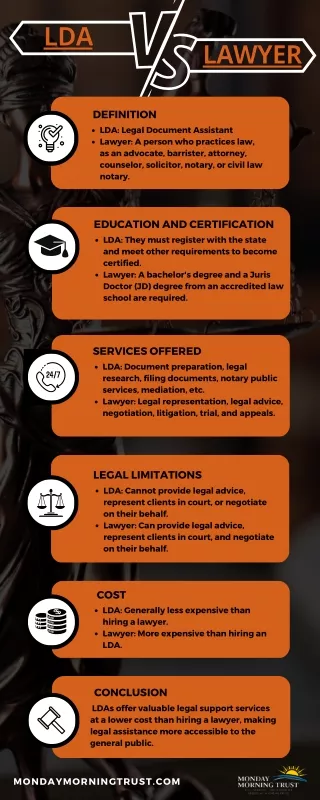
Legal Document Assistants (LDAs) and lawyers both offer legal services, but there are significant differences in their qualifications, scope of practice, and the services they provide. With easy-to-understand visuals, this infographic can help you understand the difference between an LDA and a lawyer.

E N D
DEFINITION LDA: Legal Document Assistant Lawyer: A person who practices law, as an advocate, barrister, attorney, counselor, solicitor, notary, or civil law notary. EDUCATION AND CERTIFICATION LDA: They must register with the state and meet other requirements to become certified. Lawyer: A bachelor's degree and a Juris Doctor (JD) degree from an accredited law school are required. SERVICES OFFERED LDA: Document preparation, legal research, filing documents, notary public services, mediation, etc. Lawyer: Legal representation, legal advice, negotiation, litigation, trial, and appeals. LEGAL LIMITATIONS LDA: Cannot provide legal advice, represent clients in court, or negotiate on their behalf. Lawyer: Can provide legal advice, represent clients in court, and negotiate on their behalf. COST LDA: Generally less expensive than hiring a lawyer. Lawyer: More expensive than hiring an LDA. CONCLUSION LDAs offer valuable legal support services at a lower cost than hiring a lawyer, making legal assistance more accessible to the general public. MONDAYMORNINGTRUST.COM