Download
1 / 9
0 likes | 2 Views
Atomic force microscopy is a powerful tool that lets scientists see and measure the smallest details on surfaces by scanning a tiny tip over the sample. It builds detailed pictures at the nanoscale and helps researchers understand materials, biology, and nanotechnology. This PDF from Molecular Imaging explains the basics of atomic force microscopy, how it works, and why it matters for modern science and discovery.

E N D
ATOMIC FORCE MICROSCOPY: UNLOCKING THE NANOSCALE WORLD WITH PRECISION IMAGING ATOMIC FORCE MICROSCOPY
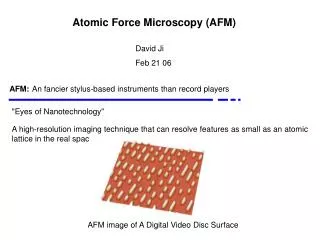
In the world of nanotechnology and surface science, few tools have transformed research as profoundly as atomic force microscopy. This groundbreaking technique allows scientists to visualize, measure, and manipulate matter at the nanoscale with astonishing precision. From mapping biological molecules in liquid environments to analyzing semiconductor surfaces, afm atomic force microscopy has become an essential instrument across disciplines. Unlike traditional microscopes that rely on light or electrons, atomic force microscopy uses a sharp probe that “feels” the surface of a sample. This probe scans across the material, detecting minute forces between the tip and the surface atoms. The result is an incredibly detailed, three-dimensional image that reveals structures invisible to conventional imaging methods.
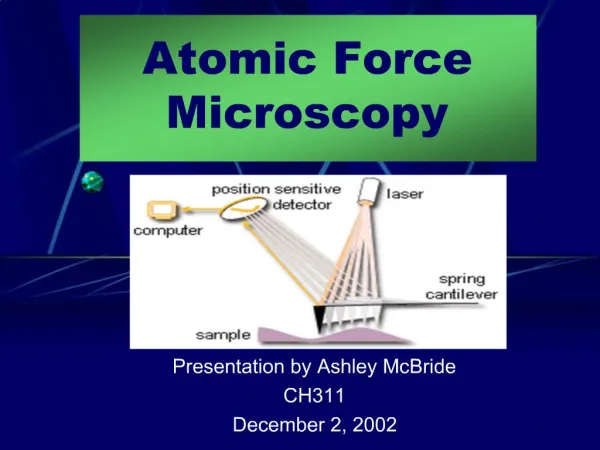
HOW AFM WORKS AT THE NANOSCALE At the heart of afm atomic force microscopy is a cantilever with an ultra-sharp tip that interacts with the sample surface. As the tip moves across the sample, tiny deflections in the cantilever are measured using a laser detection system. These deflections correspond to variations in surface height, mechanical properties, and even electrical characteristics. This method allows atomic force microscopy to operate in multiple modes, including contact, tapping, and non-contact modes. Each mode serves a specific purpose depending on the material being studied. For delicate biological samples, tapping mode is often preferred, while harder materials may be examined using contact mode for higher resolution data.
APPLICATIONS ACROSS SCIENCE AND ENGINEERING The versatility of afm atomic force microscopy makes it invaluable in a wide range of applications: Biotechnology and Life Sciences: Imaging proteins, DNA strands, and living cells in liquid without damaging them. Materials Science: Studying surface roughness, nanostructures, and coatings at atomic resolution. Semiconductor Industry: Inspecting wafers, thin films, and nanoelectronic components for defects. Nanomechanics: Measuring stiffness, adhesion, and friction at the molecular level. Researchers frequently rely on molecular imaging afm techniques to explore the structural details of molecules in real time. This approach enables scientists to observe dynamic processes such as protein folding, molecular interactions, and chemical reactions as they happen.
IMAGING IN LIQUID: A GAME CHANGER One of the most powerful features of atomic force microscopy is its ability to operate in liquid environments. This capability is crucial for studying biological systems under natural conditions. With molecular imaging afm, researchers can observe living cells and biomolecules without the need for staining or vacuum conditions, preserving the integrity of the sample. This advancement has opened doors for breakthroughs in drug development, molecular biology, and biomedical research.
PRECISION, VERSATILITY, AND INNOVATION The precision offered by afm atomic force microscopy continues to push the boundaries of what scientists can achieve at the nanoscale. High-resolution imaging combined with force measurement enables a deeper understanding of material behavior at the atomic level. Leading innovators like Molecular Imaging have played a vital role in advancing molecular imaging afm technology. Their cutting- edge systems are designed to deliver superior stability, accuracy, and ease of use for researchers across industries.
The Future of Nanoscale Exploration As nanotechnology continues to evolve, atomic force microscopy will remain a cornerstone of scientific discovery. With ongoing improvements in probe technology, imaging speed, and environmental control, the capabilities of afm atomic force microscopy are expanding rapidly. From unraveling the mysteries of molecular structures to ensuring the reliability of nanoscale devices, molecular imaging afm is shaping the future of research and innovation.
CONCLUSION The ability to see and interact with matter at the nanoscale has revolutionized modern science. Through atomic force microscopy, researchers gain unparalleled insight into the hidden world of atoms and molecules. Supported by pioneers like Molecular Imaging, the evolution of afm atomic force microscopy and molecular imaging afm continues to unlock new possibilities in nanotechnology, life sciences, and materials research. As technology advances, this remarkable tool will keep revealing the unseen, enabling discoveries that were once thought impossible. Original Content - https://www.patreon.com/posts/atomic-force-149416492
THANK YOU Get In Touch 1-888-644-0389 www.miafm.com songxu@nanocuetech.com 30100 Telegraph Rd #337 Bingham Farms, MI 48025