GST law
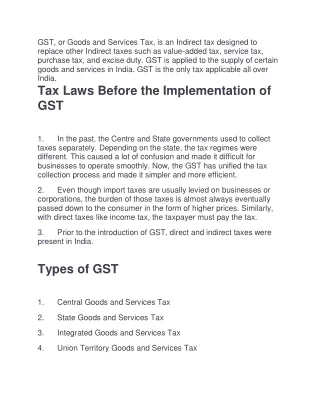
GST, or Goods and Services Tax, is an Indirect tax designed to replace other Indirect taxes such as value-added tax, service tax, purchase tax, and excise duty. GST is applied to the supply of certain goods and services in India. GST is the only tax applicable all over India.

GST law
E N D
Presentation Transcript
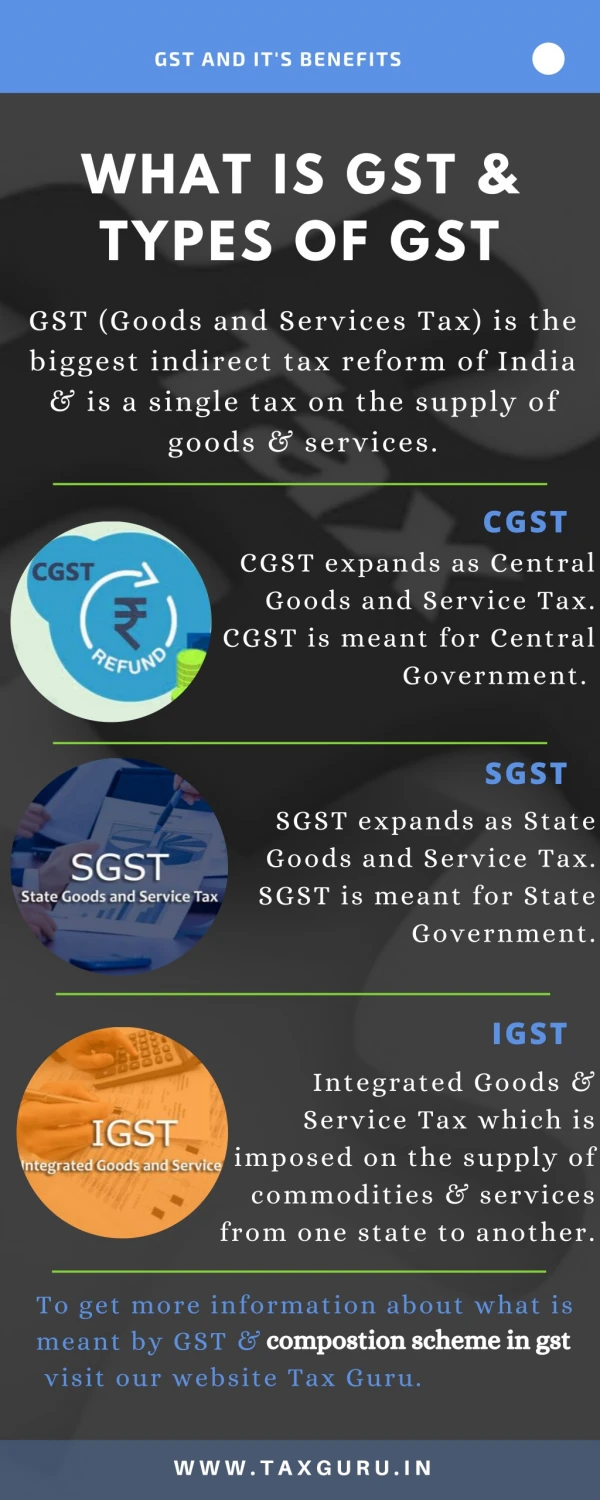
GST, or Goods and Services Tax, is an Indirect tax designed to replace other Indirect taxes such as value-added tax, service tax, purchase tax, and excise duty. GST is applied to the supply of certain goods and services in India. GST is the only tax applicable all over India. Tax Laws Before the Implementation of GST 1. In the past, the Centre and State governments used to collect taxes separately. Depending on the state, the tax regimes were different. This caused a lot of confusion and made it difficult for businesses to operate smoothly. Now, the GST has unified the tax collection process and made it simpler and more efficient. 2. Even though import taxes are usually levied on businesses or corporations, the burden of those taxes is almost always eventually passed down to the consumer in the form of higher prices. Similarly, with direct taxes like income tax, the taxpayer must pay the tax. 3. Prior to the introduction of GST, direct and indirect taxes were present in India. Types of GST 1. Central Goods and Services Tax 2. State Goods and Services Tax 3. Integrated Goods and Services Tax 4. Union Territory Goods and Services Tax
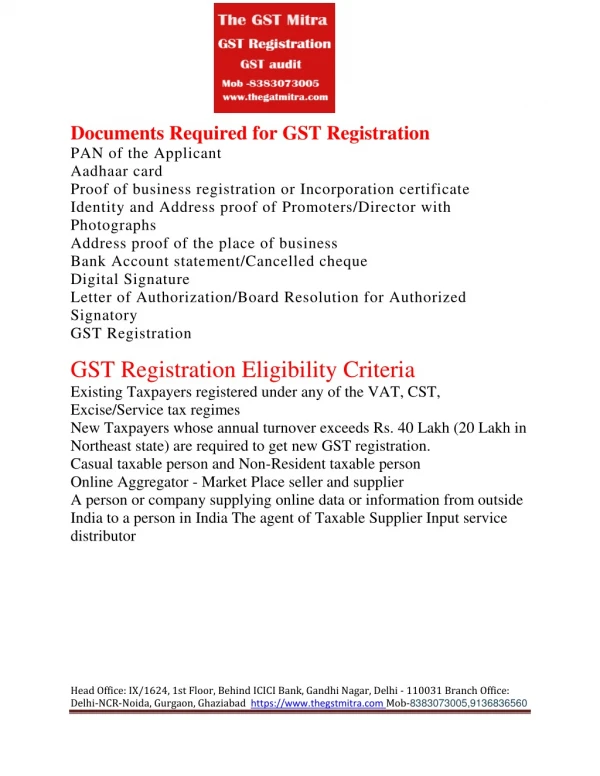
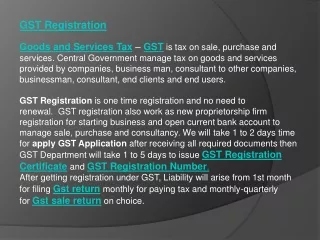
Who is Eligible for GST? 1. E-commerce aggregators 2. People who supply through web based aggregators 3. Individuals who pay tax 4. NRI Individuals who pay tax 5. Business that have a turnover more then limit 6. Individual who registered before GST law Registration of GST Any company must register for GST if it meets the GST eligibility criteria set by the Government of India. The registered companies will be given a unique GSTIN registration number. GST registration is mandatory for all Service providers, buyers, and sellers. A business making a total income of Rs.20 lakhs or more in one financial year must get GST registration. The process takes 2-6 working days. All about GSTIN- GST Identification Number Every taxpayer is given a unique 15-digit code called a GSTIN. This code is based on the state you live in and your PAN number. Some of the main uses for a GSTIN are mentioned below: -Loans can be availed with the help of the number.
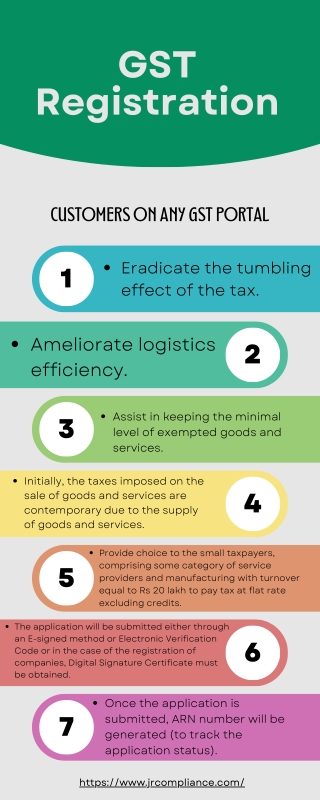
-Refunds can be claimed with the GSTIN. -The verification process is easy with the help of the GSTIN. -Corrections can be made. You can verify a GST Number Online by visiting https://services.gst.gov.in/services/searchtp. Enter the GSTIN mentioned on the invoice in the search box and followed by captcha, Final click "enter" to view the details. Advantages of GST The following are the advantages of GST · Regulation of the unorganized sector · E-commerce operators no longer suffer from differential treatment · Low complications · Composition scheme benefits · Registration and filing of returns are Essay · Higher threshold · Elimination of the cascading tax effect You can also read - Tax Law Firm