Mink
Mink have 34 teeth four of which are prominent canine teeth ... Mink reach sexual maturity around 10 months of age. Breed once per year during the winter ...


Mink
E N D
Presentation Transcript
Mink (Mustela vison) Mink
Classification • Phylum: Chordata • Class: Mammalia • Order: Carnivora • Family: Mustelidae • Genus:Mustela • Species:vison
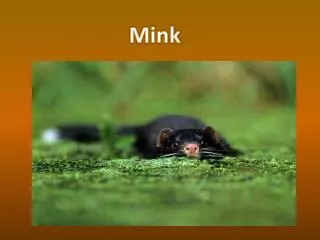
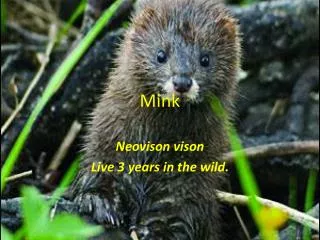
Mink Description • Mink have long slender bodies with short legs • They have slightly webbed feet with 5 toes on each foot • Mink have 34 teeth four of which are prominent canine teeth
Mink Description • Males weigh 0.9-1.6 kilograms and have a body length between 580-700 mm • Females weigh 0.7-1.1 kilograms and have a body length between 460-575 mm • 1/3 of a Mink’s length is its tail • Mink have brown to black fur • They usually have a white fur patch on their chin
Mink Describition • Their fur is soft and thick, with oily guard hairs that make its coat waterproof
Reproduction • Mink reach sexual maturity around 10 months of age • Breed once per year during the winter months • Females will mate with one or more males (promiscuous) • Gestation is 40-75 days • They have 1 to 8 offspring (Kits)
Reproduction • New born kits are 8-10 grams • They are altricial • Young are born with a thin white coat • Young are winged in 1 and ½ months • Mink remain with their parents for 6 to 10 months • Minks live for 3 to 6 years in the wild
Behavior • Mink are mostly solitary and territorial • Home range up to 8 kilometers in diameter • They are active mostly at night (nocturnal) • Mink are skilled climbers and swimmers • They can swim up to 30 meters under water and dive to depths of 5 meters • They can run on land at speeds up to 7-8mph
Behavior • They live in burrows made in the banks of streams, rivers, and lakes • Mink line their burrows with dried grass and leaves • Mink will use old dens from others mammals • They mark their territory with a musky secretions from enlarged anal glands
Communication • Mostly chemical signals • Some visual • Auditory signals • Communication allows them to define boundaries and indicate their reproductive status
Diet • Crayfish • Small frog • Shrews • Mice • Muskrats • Fish • Ducks
Diet • Birds • Salamanders • Eggs • Snakes • Minks frequently kill more than they can eat when hunting is good
Economic Importance • Mink pelts are harvested to make fur coats • 2.94 million pelts where harvested that are valued at $72.9 million dollars
Conservation • Main threat to mink is the fur trade • Controlled Trapping • Establishment of mink ranches
Conservation • Another threat to mink is habitat destruction • Mink depend on aquatic habitat areas • Creating, enhancing, and maintaining these habitats wetlands
PopulationStatus • Secure throughout most of North America • Kentucky population is unknown