Download
1 / 9
0 likes | 2 Views
Discover essential strategies for U.S. companies to effectively engage with offshore engineering teams in the Philippines, enhancing retention, productivity, and cross-cultural collaboration.

E N D
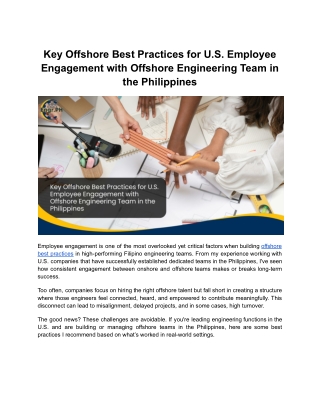
Key Offshore Best Practices for U.S. Employee Engagement with Offshore Engineering Team in the Philippines Employee engagement is one of the most overlooked yet critical factors when building offshore best practices in high-performing Filipino engineering teams. From my experience working with U.S. companies that have successfully established dedicated teams in the Philippines, I've seen how consistent engagement between onshore and offshore teams makes or breaks long-term success. Too often, companies focus on hiring the right offshore talent but fall short in creating a structure where those engineers feel connected, heard, and empowered to contribute meaningfully. This disconnect can lead to misalignment, delayed projects, and in some cases, high turnover. The good news? These challenges are avoidable. If you're leading engineering functions in the U.S. and are building or managing offshore teams in the Philippines, here are some best practices I recommend based on what’s worked in real-world settings.
The Advantages of Prioritizing Engagement with Offshore Engineering Teams in the Philippines In today’s globalized tech landscape, offshoring engineering talent to countries like the Philippines is a proven strategy for U.S. Companies seeking rapid, quality-driven growth benefit from the Philippines’ skilled workforce, cultural alignment, and strong English proficiency. However, simply hiring top talent overseas isn’t enough. The real differentiator lies in how well companies engage their offshore teams. Ideas on employee engagement go beyond daily management; they're about fostering belonging, aligning teams with your company’s mission, and empowering people to contribute meaningfully. Without this, even the most skilled engineers can become disengaged, leading to reduced productivity, lower quality outputs, and costly turnover. On the other hand, companies that invest in meaningful engagement unlock significant business benefits, turning offshore teams into strategic growth engines. From my experience working closely with U.S. companies that have successfully integrated Filipino engineering teams, I’ve seen three critical advantages emerge when engagement is done right: 1. Higher Retention Rates and Reduced Turnover Costs The tech talent market in the Philippines is competitive and dynamic, making retention a top challenge for offshore teams. Engaged employees are significantly less likely to leave. Gallup’s 2023 State of the Global Workplace report shows that organizations with highly engaged teams
experience 59% less turnover. This translates directly to cost savings on hiring, onboarding, and lost productivity. Companies that prioritize engagement reduce attrition by creating a sense of belonging and purpose, which Filipino engineers especially value given the close-knit cultural emphasis on loyalty and community. 2. Improved Productivity and Quality of Work Productivity drives motivation, which directly impacts output quality. According to a McKinsey study, teams that are engaged and feel psychologically safe perform up to 25% better on productivity metrics. When Filipino engineers are empowered through clear communication, recognition, and meaningful involvement, they are more likely to take ownership, innovate, and proactively solve problems. This effect is amplified on engineering sourcing in the Philippines, where workers often go the extra mile for employers they feel connected to, helping U.S. companies achieve faster development cycles and higher product quality. 3. Stronger Cross-Cultural Collaboration and Innovation Engagement breaks down cultural and communication barriers, enabling offshore teams to function as true partners rather than isolated units. The Philippines ranks 27th globally for English proficiency (EF EPI 2024), which supports communication, but cultural nuances still require intentional bridging. Engaged teams participate actively in brainstorming and technical discussions, contributing fresh perspectives that fuel innovation. A study by Deloitte found that diverse and inclusive team traits enhanced by engagement efforts are 1.8 times more likely to be change-ready and innovative, which is critical when working across global engineering hubs. The Engagement Gap: Why Offshore Teams Often Feel Disconnected
Despite the strategic advantages of offshore engineering teams in the Philippines, one of the most common friction points I’ve encountered is the lack of sustained employee engagement. U.S. companies may have top-tier engineers in the Philippines, but if those professionals feel excluded from core decisions, overlooked in recognition, or siloed from the main team, performance and retention take a hit. I’ve spoken with engineering leaders who are frustrated by inconsistent delivery from offshore teams only to realize their internal structure never gave those engineers the same level of investment or inclusion as their onshore peers. Engagement issues don’t arise from talent shortages; they come from organizational blind spots. Bridging this engagement gap isn’t just about better communication, it's about creating a cohesive team culture across borders. Here’s how to make that happen. 1. Offshore Doesn’t Mean Off-the-Radar One of the most common mistakes I see U.S. companies make is unintentionally treating offshore engineers as auxiliary support instead of integral team members. This shows up in subtle ways, offshore engineers are left out of brainstorming sessions, rarely get face time with decision-makers, and often hear about project changes after the fact. This sends the message that they’re not truly part of the team. Over time, it leads to disengagement, reduced initiative, and even higher turnover. According to Gallup’s State of the Global Workplace 2023 report, employees who feel excluded from key decisions are three times more likely to report feeling disconnected from their work and teams. To maintain alignment and
morale, your offshore engineers should be present for key conversations not just the execution phase. 2. Recognition is Uneven and Offshore Teams Notice Recognition plays a huge role in how engaged people feel at work. Unfortunately, many U.S. managers unintentionally overlook offshore teams when it comes to celebrating wins. Whether it’s a quick shoutout in Slack or a formal performance bonus, recognition systems often skew toward the local team because that’s who leaders see daily. Filipino engineers, like any professionals, value acknowledgement. They often go above and beyond, work odd hours to sync with U.S. schedules, and take ownership of complex tasks. If those efforts aren’t seen or rewarded equally, it creates a sense of inequity that kills engagement. A 2022 survey by OC Tanner found that employees who feel undervalued are 43% less likely to stay with a company long-term, and this effect is even stronger in remote or distributed teams. 3. Time Zone Barriers Can Mask Emotional Distance The 12- to 15-hour time difference between the U.S. and the Philippines introduces logistical hurdles, but what’s more damaging is the emotional distance it can create. It’s easy for U.S.-based leaders to assume things are going well offshore simply because they aren’t hearing problems. But silence isn’t always a sign of alignment. In Filipino workplace culture, direct confrontation is often avoided out of respect. So if something feels off, your engineers may not bring it up unless prompted in a safe, structured way. Research from Hofstede Insights shows the Philippines scores high in power distance, meaning employees may defer to authority and avoid questioning leadership even when they disagree. Without proactive engagement, this emotional distance can widen, leading to burnout, misalignment, or quiet disengagement. Top 3 Best Practices Every U.S. Engineering Leader Should Know for Engaging Offshore Teams in the Philippines
Employee engagement isn’t just a soft metric, it's one of the most decisive factors in building a resilient, productive, and innovative engineering organization. I’ve seen firsthand that when U.S. companies scale offshore engineering teams in the Philippines without a clear engagement strategy, they risk friction, underperformance, and turnover. The Philippines continues to be one of the most strategic locations for engineering offshoring, thanks to its strong technical talent pool, high English fluency, and cultural compatibility. But even with those advantages, engagement doesn’t happen automatically. It must be intentionally built. If you're leading engineering functions and collaborating with Filipino engineers offshore, especially as BPO companies continue to rise, here are the top three best offshore engineering practices I’ve seen transform good teams into great ones supported by real-world data and proven outcomes. 1. Treat Offshore Teams as an Extension, Not a Vendor One of the most common pitfalls I see among U.S. companies is treating their offshore engineers as external support instead of full-fledged team members. That mindset unintentionally creates silos and lowers morale. It’s no surprise then that 74% of remote professionals report feeling disconnected from their company’s mission when they’re excluded from decision-making processes (Microsoft’s 2023 Work Trend Index). To combat this, companies that win at engagement make a conscious shift: they treat offshore engineers like their in-house teams.
● Integrate Filipino engineers into core Agile ceremonies like sprint planning, retrospectives, stand-ups, and technical reviews. Involvement builds alignment and accountability. ● Share strategic goals transparently. When engineers understand the “why” behind what they’re building, they stay more motivated. This mirrors findings from McKinsey, which notes that purpose-driven teams are 54% more engaged. ● Empower offshore voices in design and architecture discussions. Trust is a two-way street. Letting your offshore engineers propose solutions or lead initiatives signals that their insights matter. Companies that operate this way consistently report 20–30% higher offshore retention rates, according to the 2023 Everest Group Global Talent Strategy report. 2. Recognize and Celebrate Contributions Publicly and Consistently Recognition is one of the most overlooked levers for offshore engagement. Too often, talented Filipino engineers do exceptional work only to see it acknowledged privately (or not at all). When recognition is missing, so is motivation. Gallup research shows that employees who feel recognized are 4.6x more likely to be actively engaged in their work. From what I’ve observed, the most engaged teams are the ones where leadership goes out of its way to make offshore contributions visible and valued. ● Celebrate wins across the whole organization. If an engineer in Manila closes a critical bug or ships a key feature, make that win part of your team Slack, sprint recap, or even your all-hands deck. ● Introduce peer-to-peer recognition tools (like Bonusly or 15Five) and ensure offshore engineers are fully included in those systems, not just observers. ● Tie recognition to impact. It’s more powerful to say, “Your code stabilized our release pipeline and prevented client downtime,” than just “Good job.” Specificity shows appreciation and understanding. Small gestures like these create massive impact. Visibility builds morale, and morale builds momentum. 3. Build Clear Career Paths, Not Just Contracts
One of the most common reasons Filipino engineers leave isn’t money, it's stagnation. The 2024 ASEAN Engineering Workforce Study found that career advancement is the #1 driver of job satisfaction among engineers under 35 in the Philippines. Despite this, many U.S. companies don’t provide offshore engineers with a clear view of what’s next. If you want your team to be fully engaged, growth pathways need to be visible, accessible, and real. ● Design promotion frameworks and growth plans for offshore roles that mirror your U.S. team’s structure. A title bump or technical level progression should be just as achievable for a Manila-based engineer as it is for someone in Seattle. ● Assign stretch assignments and leadership trials. Give high-potential engineers a chance to lead small projects, mentor peers, or take on cross-functional initiatives. Challenge is a catalyst for growth. ● Discuss career aspirations directly. Don’t rely on offshore vendors to have these conversations. Show up. Ask what your engineers want long term and align your support accordingly. By giving engineers room to grow, you’re not just retaining them, you're building a talent pipeline that scales with your business. Conclusion
Leading engineering operations that span multiple time zones and cultural boundaries present unique challenges and opportunities. Engagement is not just a nice-to-have perk; it is a strategic imperative that directly impacts productivity, innovation, and retention. Filipino engineers bring a remarkable combination of technical expertise, cultural adaptability, and a strong work ethic. However, without deliberate and ongoing engagement efforts from U.S. leadership, these valuable assets risk being underutilized or, worse, lost to turnover. If your goal is to build an engineering team that is unified across borders, capable of driving innovation, and equipped to meet today’s complex challenges, then embracing these three best practices is essential. They provide a strong foundation for lasting success and a competitive edge in the increasingly global tech landscape.