Download
1 / 9
0 likes | 4 Views
Click Here: https://codexoxo.com/microsoft-dynamics-365-vs-oracle-erp/<br>Microsoft Dynamics 365 and Oracle ERP are top-tier, cloud-based ERP systems, with D365 offering superior integration, flexibility, and a familiar, user-friendly interface for SMBs. Oracle ERP provides deeper functional strength, robust, complex, and highly controlled capabilities, making it ideal for large-scale, enterprise-level, global operations. <br>

E N D
Microsoft Dynamics 365 vs Oracle ERP codexoxo.com
What is Oracle ERP Oracle Cloud ERP is a comprehensive, AI-driven, SaaS suite designed to automate core business processes—including finance, procurement, and supply chain—for over 10,000 global organizations. It provides real-time analytics, quarterly updates, and improved decision-making capabilities to enhance organizational agility and growth.
Key features and benefits of Oracle ERP • Comprehensive Modules: Covers financials, project management, procurement, risk management, supply chain, and manufacturing. • AI and Machine Learning: Uses AI to automate manual processes (e.g., expenses, invoice processing) and detect anomalies • Cloud-Native & Scalable: Designed for cloud deployment, facilitating faster implementation times (measured in weeks or months). • Real-time Insights: Oracle Fusion ERP Analytics offers over 1,000 pre-built KPIs for monitoring business performance. • Target Audience: Suitable for large-scale, modern enterprises looking for a complete, integrated system.
Microsoft Dynamics 365 vs Oracle ERP Key Comparisons: • Target Market: Dynamics 365 suits mid-market to enterprise-level firms, while Oracle is geared toward large enterprises. • Flexibility vs. Functionality: D365 is highly configurable and customizable, making it adaptable. Oracle focuses on "configuration over customization" to support robust, out-of-the-box, standardized processes. • Integration: D365 excels with native integration into the Microsoft ecosystem (Office 365, Power BI, Azure). • Cost: Dynamics 365 generally has a lower entry cost, starting around $95 per user/month, compared to Oracle's often higher-priced enterprise solutions. • Implementation: Dynamics 365 implementations can be longer, sometimes requiring significant change management.
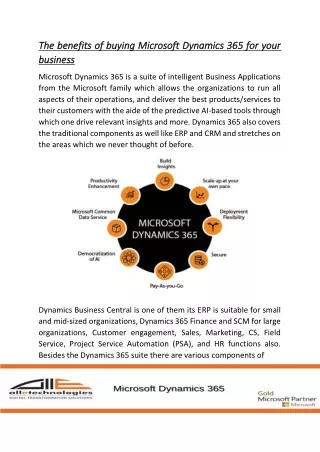
What is Microsoft Dynamics 365 Microsoft Dynamics 365 is a cloud-based, AI-powered suite of intelligent business applications combining CRM and ERP capabilities to streamline operations, enhance customer engagement, and improve productivity. It enables organizations to unify data, automate workflows, and integrate with Microsoft 365, Azure, and Power Platform. Key solutions include Sales, Finance, Supply Chain, and Business Central.
Components and Functionality of Microsoft Dynamics 365 • ERP (Enterprise Resource Planning): Covers finance, supply chain management, human resources, and operations to manage, for example, inventory and production. • CRM (Customer Relationship Management): Manages sales, customer service, marketing, and field service to improve customer experiences. • Dynamics 365 Business Central: A comprehensive, all-in-one ERP solution tailored for small and medium-sized businesses. • AI and Automation: Integrates Microsoft Copilot for automating tasks like record summarization, email generation, and data analysis.
When to Choose Which: • Choose Microsoft Dynamics 365 if: You need agility, work within the Microsoft 365 ecosystem, or are a mid-sized business looking to grow incrementally. • Choose Oracle ERP if: You are a large organization with complex requirements,, need extensive out-of-the-box functionality, and have a higher budget for a robust, long-term solution.
Conclusion Microsoft Dynamics 365 is generally better for mid-sized firms prioritizing flexibility, ease of use, and seamless Microsoft 365 integration, while Oracle ERP Cloud is superior for large enterprises needing deep, complex global operational functionality. Dynamics 365 offers faster, modular deployment, whereas Oracle is more robust but has a steeper learning curve.