Microsoft 365 vs Dynamics 365
Microsoft 365 and Dynamics 365 are complementary, not competing, tools: Microsoft 365 provides essential productivity and communication tools (Office, Teams, Email) for day-to-day work, while Dynamics 365 serves as the intelligent, cloud-based business management platform for specialized CRM and ERP functions.


Microsoft 365 vs Dynamics 365
E N D
Presentation Transcript
Microsoft 365 vs Dynamics 365 codexoxo.com
What is Microsoft 365 Microsoft 365 is a cloud-powered subscription service from Microsoft that includes premium productivity apps (Word, Excel, PowerPoint, Outlook), 1 TB of OneDrive cloud storage, and AI-powered tools (Copilot). Formerly known as Office 365, it provides constant updates and is designed for individuals, families, and businesses to enhance collaboration across devices. codexoxo.com
Key Features of Microsoft 365 • Productivity Apps: Access to the latest versions of Word, Excel, PowerPoint, Outlook, OneNote, and, depending on the plan, Publisher and Access. • Cloud Services: 1 TB of OneDrive storage per user for file sharing, syncing, and security. • Communication Tools: Includes Microsoft Teams for chat, video meetings, and collaboration. • AI Integration: Copilot is integrated into apps to assist with drafting, designing, and data analysis. • Cross-Device Support: Installable on Windows PCs, Macs, iOS, and Android devices. codexoxo.com
What is Dynamics 365 Dynamics 365 is a cloud-based, AI-powered suite of intelligent business applications from Microsoft that combines Customer Relationship Management (CRM) and Enterprise Resource Planning (ERP) capabilities. It streamlines operations, improves customer engagement, and automates workflows by connecting data across sales, service, finance, and supply chain, working alongside Microsoft 365 and Azure. codexoxo.com
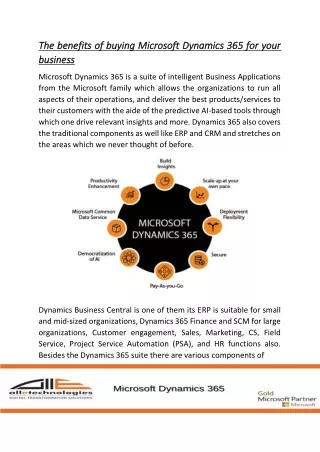
Key Aspects of Dynamics 365 • Modular Applications: Businesses can choose and deploy specific apps (e.g., Sales, Marketing, Customer Service, Field Service, Finance, Supply Chain) based on their needs, rather than adopting a monolithic system. • CRM & ERP Integration: It merges customer-facing functions (CRM) with back-office operations (ERP) onto a single, unified platform. • AI-Powered Insights: Features like Copilot (AI) are integrated to provide suggestions, automate tasks, and deliver predictive insights for better decision-making. • Ecosystem Integration: Works seamlessly with Microsoft 365 (Outlook, Teams, Excel), Azure, and Microsoft Power Platform for further customization and automation. • Scalability & Flexibility: Designed to grow with a business, it offers tailored solutions for small-to-medium businesses (e.g., Business Central) and large enterprises. codexoxo.com
How Microsoft 365 and Dynamics 365 Work Together Microsoft 365 (productivity apps) and Dynamics 365 (business applications) work together by deeply integrating to unify data, automate workflows, and boost productivity within a single ecosystem. Key integrations include tracking Dynamics records in Outlook, collaborating on customer data in Teams, and analyzing data with Excel/Power BI. codexoxo.com
Conclusion Microsoft 365 and Dynamics 365 are complementary, not competing, tools: Microsoft 365 provides essential productivity and communication tools (Office, Teams, Email) for day-to-day work, while Dynamics 365 serves as the intelligent, cloud-based business management platform for specialized CRM and ERP functions. M365 improves team collaboration, whereas D365 optimizes complex operations like sales, finance, and HR. codexoxo.com