
presentation
E N D
Presentation Transcript
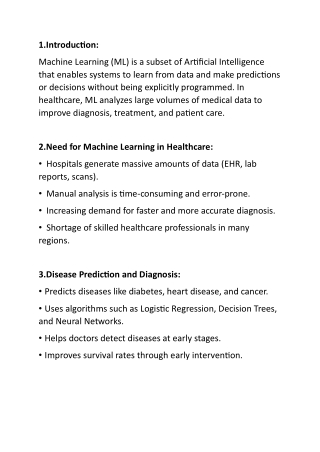
1.Introduction: Machine Learning (ML) is a subset of Artificial Intelligence that enables systems to learn from data and make predictions or decisions without being explicitly programmed. In healthcare, ML analyzes large volumes of medical data to improve diagnosis, treatment, and patient care. 2.Need for Machine Learning in Healthcare: • Hospitals generate massive amounts of data (EHR, lab reports, scans). • Manual analysis is time-consuming and error-prone. • Increasing demand for faster and more accurate diagnosis. • Shortage of skilled healthcare professionals in many regions. 3.Disease Prediction and Diagnosis: • Predicts diseases like diabetes, heart disease, and cancer. • Uses algorithms such as Logistic Regression, Decision Trees, and Neural Networks. • Helps doctors detect diseases at early stages. • Improves survival rates through early intervention.
4.Medical Image Analysis: • ML models analyze X-rays, CT scans, and MRI images. • Detects tumors, fractures, and abnormalities. • Convolutional Neural Networks (CNNs) are widely used. • Reduces human error and increases diagnostic accuracy. 5.Drug Discovery and Development: • Identifies potential drug compounds faster. • Predicts drug effectiveness and side effects. • Reduces time and cost compared to traditional methods. 6.Personalized Medicine:
• Provides customized treatment plans. • Uses patient history, genetics, and lifestyle data. • Improves treatment effectiveness and reduces risks. 7.Benefits of ML in Healthcare: • Faster diagnosis • Improved accuracy • Reduced healthcare costs • Better patient monitoring • Efficient hospital management 8.Challenges: • Data privacy and security issues • High implementation cost • Requirement of large and high-quality datasets • Ethical and regulatory concerns 9.Future Scope: • AI-powered smart hospitals • Remote patient monitoring through wearable devices • Early disease outbreak prediction • Integration with IoT and robotics
10.Conclusion: Machine Learning is transforming healthcare by enabling faster diagnosis, personalized treatments, and improved patient outcomes. With proper data security and ethical practices, ML will play a major role in the future of medicine.







![Introduktion til Presentation [presentation]](https://cdn3.slideserve.com/5539771/introduktion-til-presentation-presentation-dt.jpg)