Download
1 / 4
0 likes | 4 Views
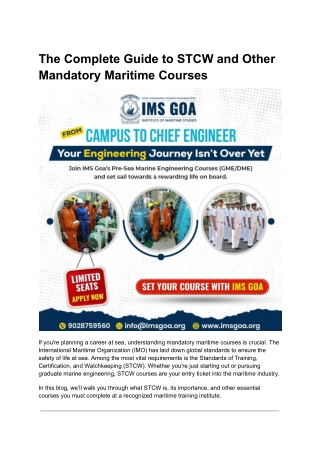
If you're planning a career at sea, understanding mandatory maritime courses is crucial. The International Maritime Organization (IMO) has laid down global standards to ensure the safety of life at sea. Among the most vital requirements is the Standards of Training, Certification and Watchkeeping (STCW).

E N D
The Complete Guide to STCW and Other Mandatory Maritime Courses If you're planning a career at sea, understanding mandatory maritime courses is crucial. The International Maritime Organization (IMO) has laid down global standards to ensure the safety of life at sea. Among the most vital requirements is the Standards of Training, Certification, and Watchkeeping (STCW). Whether you're just starting out or pursuing graduate marine engineering, STCW courses are your entry ticket into the maritime industry. In this blog, we’ll walk you through what STCW is, its importance, and other essential courses you must complete at a recognized maritime training institute.
What Is STCW? STCW stands for the International Convention on Standards of Training, Certification, and Watchkeeping for Seafarers. Established in 1978 and amended over the years (most notably in 1995 and 2010), STCW aims to standardize maritime training and ensure that seafarers around the world meet minimum safety and competency standards. If you're planning to work on any seagoing vessel beyond national waters, you must complete STCW courses from an approved maritime training institute. Basic STCW Courses Every Seafarer Must Complete STCW Basic Safety Training (BST) is mandatory for all seafarers and typically includes the following components: 1. Personal Survival Techniques (PST) This module teaches survival skills at sea, including life raft usage, water entry, and emergency response. 2. Fire Prevention and Fire Fighting (FPFF) Covers fire hazards, fire-fighting techniques, and the use of safety equipment like breathing apparatus. 3. Elementary First Aid (EFA) Provides basic first aid knowledge and life-saving techniques applicable onboard. 4. Personal Safety and Social Responsibilities (PSSR) Introduces seafarers to working conditions onboard, emergency procedures, teamwork, and communication. These courses are essential whether you're a deck cadet or pursuing graduate marine engineering. They form the foundation of safety awareness and emergency preparedness. Additional Mandatory Courses Beyond the basic STCW training, there are advanced modules based on your job role and vessel type: 1. Advanced Fire Fighting (AFF)
Required for officers and crew responsible for firefighting duties. It goes deeper into fire control and safety management. 2. Proficiency in Survival Craft and Rescue Boats (PSCRB) Teaches how to operate survival craft like lifeboats and rescue boats other than fast rescue boats. 3. Medical First Aid & Medical Care A requirement for officers assigned medical responsibilities on board. 4. Tanker Familiarization Courses Specialized training for those working on oil, chemical, or gas tankers. Choosing a reputable maritime training institute ensures you receive certified and practical training that complies with STCW codes. Why STCW Matters for Graduate Marine Engineering Students If you are pursuing or planning to enroll in Graduate Marine Engineering (GME), STCW certification is non-negotiable. These courses are often embedded into the GME curriculum by top maritime training institutes. As a marine engineer, you’ll not only operate and maintain ship machinery but also play a vital role in shipboard safety. Hence, understanding fire control, first aid, and emergency protocols is crucial. Additionally, your STCW certification will be evaluated during job placements, interviews, and flag-state endorsements. How to Choose the Right Maritime Training Institute When selecting a maritime training institute, ensure it is: ● Approved by DG Shipping (India) or equivalent international authority ● Equipped with simulators and live training environments ● Staffed with experienced marine faculty ● Offering placement support for Graduate Marine Engineering and other courses
Institutes with high training standards ensure you're not only STCW-compliant but also job-ready. Final Thoughts STCW and other mandatory maritime courses form the backbone of a seafarer’s training. Whether you're taking your first steps into the maritime world or pursuing Graduate Marine Engineering, enrolling in a certified maritime training institute is the smartest move for your future. These courses not only fulfill legal requirements but also empower you with life-saving skills, confidence, and the professionalism expected in global waters.