Airline Scheduling
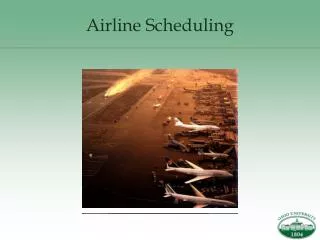
Airline Scheduling. Airline Scheduling. Significance of airline scheduling Flight scheduling Aircraft scheduling Crew scheduling Facilities scheduling Coordinating the flight schedule Problems in executing the schedule. Significance of Airline Scheduling.

Airline Scheduling
E N D
Presentation Transcript
Airline Scheduling • Significance of airline scheduling • Flight scheduling • Aircraft scheduling • Crew scheduling • Facilities scheduling • Coordinating the flight schedule • Problems in executing the schedule
Significance of Airline Scheduling • Over 2000 highly interconnected flights per day • Strategic (marketing) significance: profits • Operational challenge: safety & efficiency
Flight Scheduling • Basic elements: airports served, departure times, arrival times • Types of route structure: point-to-point, hub-&-spoke • Basic resources: aircraft, maintenance, crew, ground facilities • Flight schedule planning • Making flight schedule available (e.g. CRS) • Schedule Planning Division (Marketing Department)
Types of Route Structure • Point-to-point • Hub-and-spoke
Flight Schedule Planning • Internal factors • External factors
Internal Factors • Aircraft routing and maintenance requirements • Crew scheduling and training requirements • Ground facilities constraints • Marketing factors
Marketing Factors • Marketing analysis • Passengers • Competition • Financial impact • Traffic flow • Schedule salability • Time of day • Type of flight: non-stop, direct, connecting • Schedule adjustments • Time-zones • Station personnel • Turn-around time • Chain reaction effect • Load factor leverage • Cost is independent of load factor • Revenue varies in direct proportion to changes in load factor
External Factors • Airport/runway constraints • ATC/airspace constraints • Seasonal weather patterns • Travel agents • Hotel operators • Local community
Aircraft Scheduling • Aircraft routing • Maintenance scheduling • Maintenance Operations Control (Maintenance Department)
Aircraft Maintenance Typical Maintenance Schedule for a Jet Aircraft Check Description Interval Duration En-route visual inspection each stop 30 min. Overnight ad hoc repairs 8 hrs up to 8 hrs A-check primary examination 125 hrs 8 hrs B-check intermediate inspection 750 hrs overnight C-check detailed inspection 3,000 hrs 5 days D-check major overhaul 20,000 hrs 15-30 days
Netjets 7 on 7 off • 8-21 05 • CMH – EUS 1.1 • EUS – SUN 2.8 • SUN- APC 1.4 • APC – PHX 1.7
Day two • PHX – ASE 1.3 • ASE – SFO 2.2 • SFO – TRM 1.2 • TRM APA 1.7
Day three • APA BFM 2.4 • BFM – PDK 1.2 • PDK – CYYZ 1.7 • CYYZ – EWR 1.6
Day four • EWR – CGF 1.4 • CGF – ADS 2.3 • ADS – MMU 3.0 • MMU PHL .7
Day five • PHL – SOP 1.3 • SOP – PVD 1.7 • PVD – SFO 5.3 • SFO – SJC .7
Day 6 • SJC – MEM 3.6 • Airline home • I quit!
Crew Scheduling • Regular and reserve crews • Crew flight schedule • Crew training schedule • Crew Scheduling Division (Flight Operations Department) • Flight Attendants (Marketing Department)
Crew Flight Schedule • Line schedule • Bidding • Pairing
Duty/Rest Time Regulations FAR Part 121.481 • Maximum 8 flight hours between required rest periods • Maximum 30 flight hours per week, 100 flight hours per month, 1000 flight hours per year • 9-11 hours rest per day (depending on flight duty) • Release from all duty 24 hours during each 7-consecutive-day period
Crew Training Schedule • Base training • Flight academy • Initial, recurrent, transitional • Ground school, procedure trainer, flight simulator, aircraft • Line training • Revenue flights • Initial, recurrent, transitional • Check pilot on jump-seat
Facilities Scheduling • Types of flight • Origin • Thru • Turn-around • Termination • Ground facilities • Passenger services: ticket counter, gate, baggage claim • Ramp services: baggage, food service, water, fuel • Ground Services Division (Marketing Department)
Ramp Services Chocks in: 11:04 Passengers out: 11:05 Baggage out: 11:08 Food service truck: 11:08 Fuel truck: 11:30 Water truck: 11:45 More baggage out: 11:45 Mail out: 12:00 Baggage in: 12:05 Mail in: 12:15 Copilot walks-around: 12:15 Passengers in: 12:20 Doors locked: 12:48 Chocks out: 12:49 Turn-around: 1 hr 45 min
Schedule Coordination • Flight Schedule • Marketing Department • Aircraft Routing and Maintenance Schedule • Maintenance Department • Flight Crew Schedule (pairing and training) • Flight Operations Department • Cabin Crew Schedule (pairing and training) • Marketing Department • Passenger Services Schedule (counters, gates, baggage claim) • Marketing Department • Ramp Services Schedule (gates, baggage, food, water, fuel) • Marketing Department
Problems in the Execution of Schedule • Conflicts of interest • Schedule disruptions • Limited resources • Inherent limitations of hub-and-spoke system
Conflicts of Interest • Maintenance/service time versus aircraft utilization • Schedule efficiency (maximum resource utilization) versus schedule flexibility (slack use of resources and availability of spare resources) • Customer service versus economic/operational considerations • Solution:optimal balance (tradeoff) between conflicting factors
Schedule Disruptions • Can cost 2-3% of annual revenues • Role of SOC in disruption management & recovery • Types of disruption: delay, cancellation, diversion • Causes of disruption: weather, airport/airspace congestion, ATC equipment failure, aircraft problem, ground equipment problem • Chain reaction/multiplier effects • Impact of poor public relations/customer service • Solutions: optimal balance between schedule efficiency and schedule flexibility; collaborative decision making (CDM)
Limited Resources • Aircraft limitations • Crew limitations • Facility limitations • Solution: slack use of resources and availability of spare resources
Inherent Limitations of Hub-and-Spoke System • Uneven spoke length • Congestion at peak times • Idle between peak times • Multiplier effects of schedule disruptions