Bootesnull Salon App Development
This document provides an overview of salon app development, explaining the complexity behind building digital platforms for salons, including customer expectations, real-time booking updates, and smooth interaction between frontend and backend systems. It covers common salon industry challenges and their solutions, core app features, different user roles, the development process, and the key challenges involved in creating reliable salon applications.

Bootesnull Salon App Development
E N D
Presentation Transcript
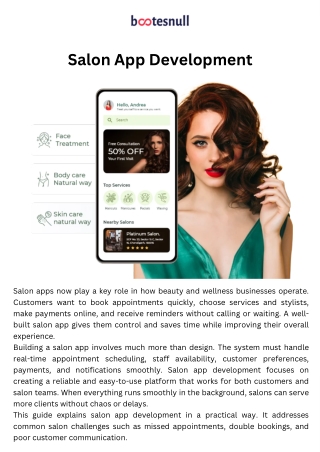
Salon App Development Salon apps now play a key role in how beauty and wellness businesses operate. Customers want to book appointments quickly, choose services and stylists, make payments online, and receive reminders without calling or waiting. A well- built salon app gives them control and saves time while improving their overall experience. Building a salon app involves much more than design. The system must handle real-time appointment scheduling, staff availability, customer preferences, payments, and notifications smoothly. Salon app development focuses on creating a reliable and easy-to-use platform that works for both customers and salon teams. When everything runs smoothly in the background, salons can serve more clients without chaos or delays. This guide explains salon app development in a practical way. It addresses common salon challenges such as missed appointments, double bookings, and poor customer communication.
Bootesnull: Company Overview Bootesnull approaches digital products by first understanding how people actually use them. This overview does not focus on selling services. Instead, it explains how everyday applications, such as salon apps, work behind the scenes and why their structure matters in real business environments. Most users open a salon app to book an appointment, check availability, or make a payment. What they don’t see is the coordination required to keep schedules accurate, staff aligned, and customers informed. A single action often triggers multiple processes, which makes salon platforms a useful example for understanding modern application design. Salon apps support multiple users simultaneously. Customers expect speed and simplicity. Stylists depend on clear schedules and service details. Owners and managers need control over operations, staff, and performance data. Designing a single system that serves all these needs demonstrates how multi-role platforms operate in practice. Timing plays a major role in salon software. Bookings, cancellations, reminders, and payments must update instantly to avoid conflicts. Real-time data ensures everyone sees the same information at the same moment. This requirement highlights how live systems operate in real-world applications. Salon workflows rarely follow a straight path. Appointments change, clients arrive late, or services run longer than planned. Software must handle these situations smoothly without breaking the experience. This flexibility explains why modern apps focus on adaptability instead of rigid rules. What appears simple on the screen relies on a strong technical foundation. User interfaces connect to backend systems that manage data, logic, and security. This connection keeps the platform stable, accurate, and responsive. This overview serves as an educational reference. Using salon applications as a practical example, it helps explain how modern digital systems prioritize usability, reliability, and trust in everyday business operations.
Introduction to Salon Apps Salon apps solve everyday problems that both customers and salon teams face. To understand salon app development clearly, it helps to look at real situations that happen inside salons every day. Below are common salon challenges with practical, real-world examples and how a salon app handles them: Problem 1: “Booking an appointment takes too long.” Real example: A customer calls a salon during lunch hours. No one answers because the staff are busy with clients. The customer tries again later or books somewhere else. How the app helps: The app shows available time slots and stylists instantly. The customer books in seconds and receives immediate confirmation. Problem 2: “Stylists forget client preferences.” Real example: A returning customer visits after three months. The stylist doesn’t remember the hair color used last time or the preferred haircut length. How the app helps: The app stores service history, notes, and product details so the stylist can deliver a consistent experience every visit.
Problem 3: “Double bookings and schedule confusion.” Real example: A walk-in client arrives while another appointment is already scheduled for the same stylist, causing delays and frustration. How the app helps: The app updates schedules in real time and blocks unavailable slots, keeping staff and customers aligned. Problem 4: “Clients miss appointments.” Real example: A customer forgets their evening appointment after a busy workday. The stylist waits, and the slot goes unused. How the app helps: Automated reminders and notifications alert customers before their appointment, reducing no-shows. Problem 5: “Customers hesitate to choose a salon or stylist.” Real example: A new customer wants a haircut but feels unsure about pricing, stylist skills, or service quality. How the app helps: The app displays stylist profiles, service details, pricing, and reviews, helping customers book with confidence. Core Features of Salon App Modern salon apps are built to make booking, payments, and follow-ups easy for customers while helping salons manage daily operations smoothly. 1. Salon & Service Search with Appointment Booking Real scenario: A customer wants a haircut and beard grooming for the weekend, but doesn’t want to call multiple salons. The app helps by: Showing nearby salons Listing available services and prices Displaying real-time staff availability Offering flexible time slots The customer selects a salon, chooses services, and books an appointment in minutes.
2. Stylist Selection Real scenario: A regular customer prefers the same stylist every time. The app allows users to: View stylist profiles and experience Check the availability of preferred stylists Book directly with a specific professional This improves trust and customer satisfaction. 3. Digital Bills & Service History Real scenario: After the visit, the customer wants to know what services were done last time. The app stores: Digital invoices Past service history Applied for offers or packages This helps customers repeat services easily, and salons track client preferences. 4. Notifications & Reminders Real scenario: A customer often forgets appointments or arrives late. The app sends reminders for: Upcoming appointments Special offers or packages Loyalty points or membership expiry This reduces no-shows and improves customer retention.
5. Payments & Security Real scenario: A customer pays in advance to confirm a weekend slot. The system supports: UPI, cards, and wallet payments Secure and encrypted transactions Easy refunds for cancellations This ensures smooth and safe transactions. 6. Ratings & Reviews Real scenario: After the service, the customer leaves feedback. This helps: New users choose the right salon Salons improve service quality Build transparency and trust
Admin & User Panel Functionalities Salons' ecosystems involve multiple user roles: Customer Stylist Salon Owner Admin Each panel solves different problems. Customer Panel – Managing Salon Visits Easily Key functions include: Account creation and profile management Salon and service search Appointment booking and rescheduling Stylist selection Service history access Digital bills and payments Example: A customer wants to book the same stylist for a haircut they took last month. Using past service history, they quickly rebook the appointment without searching again.
Stylist Panel – Handling Daily Appointments Key functions include: Viewing assigned bookings Managing availability and working hours Checking customer preferences Updating service status (in progress / completed) Real example: A stylist checks the app in the morning to see the day’s schedule and prepares services accordingly. Salon Owner Panel – Business & Staff Management Key functions include: Managing services and pricing Assigning staff to appointments Tracking daily bookings and revenue Managing offers, memberships, and loyalty programs Real example: A salon owner notices peak weekend bookings and adjusts staff schedules to reduce waiting time. Admin Panel – Full System Control Key functions include: Managing salons, users, and staff accounts Monitoring bookings and transactions Handling disputes and refunds Ensuring data security and system performance Real example: An admin resolves a payment issue and ensures the booking status is updated correctly for both the customer and salon.
Salon App Development Process A salon app is built through clear and structured stages to ensure smooth booking, reliable payments, and a good user experience for both customers and salon owners. 1. Research & Planning This stage includes analyzing: Customer booking behavior Salon staff workflows Peak hours and service duration Market competition and feature gaps 2. UI/UX Design Key priorities include: Simple and quick navigation Clear service and pricing display Easy booking flow Staff-friendly dashboards 3. Backend & Frontend Development Backend includes: User authentication Appointment and slot management logic Service and staff data storage Payment processing Real-time booking updates Frontend includes: Customer, stylist, and admin screens Interactive booking elements Responsive layouts for all devices
Challenges & Educational Insights Salon app development teaches how to handle: 1.Data Security & Privacy 2.Appointment Accuracy 3. Scalability 4.Real-Time Updates 5.Payment Reliability 6.User Trust These challenges help developers understand how service-based applications operate in real business environments. Conclusion & Key Takeaways Salon applications combine technology with everyday business operations and customer expectations. Understanding their structure helps in learning about: Multi-role system design (Customer, Stylist, Salon Owner, Admin) Secure data and payment handling Real-time booking and communication systems User-centric interface design Scalable application architecture This guide provides a complete overview of how salon applications are planned, developed, and maintained to support modern salon businesses. www.bootesnull.com | info@bootesnull.com