Bootesnull Healthcare App Development
This document provides an overview of healthcare app development from the perspective of a web development company New York, explaining the complexity behind these platforms, including patient needs, real-time updates, and the interaction between frontend and backend systems. It outlines common healthcare challenges and their solutions, core features, different user roles, the development process, and the key challenges involved in building healthcare applications. The guide serves as an educational resource for understanding the structure and operation of modern healthcare platforms.

Bootesnull Healthcare App Development
E N D
Presentation Transcript
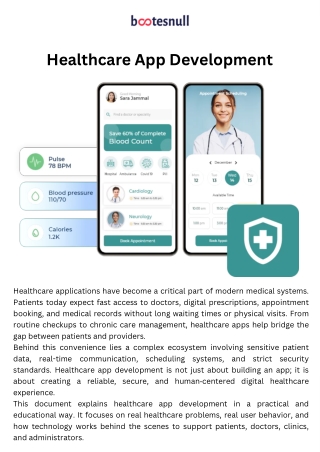
Healthcare App Development Healthcare applications have become a critical part of modern medical systems. Patients today expect fast access to doctors, digital prescriptions, appointment booking, and medical records without long waiting times or physical visits. From routine checkups to chronic care management, healthcare apps help bridge the gap between patients and providers. Behind this convenience lies a complex ecosystem involving sensitive patient data, real-time communication, scheduling systems, and strict security standards. Healthcare app development is not just about building an app; it is about creating a reliable, secure, and human‑centered digital healthcare experience. This document explains healthcare app development in a practical and educational way. It focuses on real healthcare problems, real user behavior, and how technology works behind the scenes to support patients, doctors, clinics, and administrators.
Bootesnull: Company Overview BootesNull works on many types of digital projects, but this section is not meant to promote anything. The goal here is to explain how healthcare apps work in a practical and easy-to-understand way. Most people use healthcare apps without thinking about the systems running behind them. Using healthcare as an example helps explain how large, real-world applications actually function. A healthcare app is never a single system. It is a combination of multiple smaller systems working together. Patients want quick appointments and easy access to reports. Doctors need tools to manage schedules, consultations, and prescriptions. Clinics and labs depend on accurate data and smooth workflows. Because each role uses the same platform differently, healthcare apps clearly show how multi-role systems are designed. Healthcare apps rely heavily on real-time updates. Patients expect instant confirmation for appointments. Doctors need live access to patient history. Reports, prescriptions, and notifications must update without delay. This constant data exchange between devices and servers explains what real-time systems mean in practical software development. Then there is the healthcare workflow itself. A single consultation moves through booking, confirmation, consultation, prescription, reports, and follow-ups. Any delay, cancellation, or data issue can affect patient care. This makes healthcare apps a strong example of how software must adapt to real-life situations instead of following fixed rules. Behind every simple screen lies a strong connection between frontend and backend systems. What looks easy on a phone, buttons, forms, video calls, and reports- runs on APIs, databases, and secure logic. Understanding this connection helps explain how complex healthcare platforms run smoothly and safely. Overall, this content works as a learning guide. Healthcare is a familiar and important example. It helps students and developers understand how modern applications are structured and why reliability, accuracy, and user trust matter so much in real-world software.
Introduction to Healthcare Apps Healthcare apps help millions of people solve everyday medical problems. To understand healthcare app development, it is essential to first understand the real challenges faced by patients and providers. Below are common healthcare problems and how a well‑designed healthcare app addresses them: Problem 1: “Booking a doctor appointment is time‑consuming.” Patients often struggle with long queues and manual appointment processes. Solution: Digital appointment scheduling, doctor availability calendars, and automated confirmations. Problem 2: “I cannot access my medical records easily.” Paper records and scattered reports create confusion. Solution: Secure digital health records, cloud storage, and patient dashboards. Problem 3: “Consulting a doctor remotely is difficult.” Many patients cannot visit hospitals frequently. Solution: Telemedicine features include video calls, chat, and remote consultations.
Problem 4: “I forget my medicines or follow‑ups.” Medication adherence is a common challenge. Solution: Automated reminders, alerts, and prescription tracking. Problem 5: “I am unsure which doctor or clinic to trust.” Patients need transparency before choosing healthcare providers. Solution: Doctor profiles, patient reviews, ratings, and verified credentials. Understanding these problems helps developers build healthcare apps that genuinely improve patient care. Core Features of Healthcare Apps Modern healthcare applications include features that cover the entire patient journey, from discovery to treatment and follow‑up. 1. Doctor Search & Appointment Booking Real Scenario: A patient wants to consult a specialist within the next 24 hours. The app considers: Doctor availability Location or online consultation Specialization Consultation fees The system then displays suitable options with time slots. 2. Telemedicine & Online Consultation Real Scenario: A patient consults a doctor through a video call for a follow‑up. This requires: Secure video/audio communication Appointment‑based access Encrypted data transfer
3. Digital Prescriptions & Reports Doctors upload prescriptions and reports digitally. Patients can view or download them anytime. 4. Notifications & Reminders The app sends reminders for: Appointments Medicines Lab tests Follow‑ups 5. Payments & Security Healthcare payments must be reliable and secure. The system supports: Multiple payment gateways Secure transactions Refund handling Data encryption 6. Ratings & Feedback System Patients can review doctors and services. This feedback helps improve care quality and transparency.
Admin & User Panel Functionalities Healthcare ecosystems involve multiple user roles: Patient Doctor Clinic/Lab Admin Each panel solves different problems. Patient Panel – Supporting Daily Health Needs Key functions include: Account creation Doctor search Appointment booking Teleconsultation Medical history access Prescription tracking Example: A patient quickly books a follow‑up appointment using past records.
Doctor Panel – Managing Medical Practice Doctors use this panel to: Manage schedules View patient history Conduct online consultations Upload prescriptions Track earnings Clinic/Lab Panel – Operational Efficiency Clinics manage: Test bookings Report uploads Appointment flow Patient data Admin Panel – Central Control System Admins manage: Users and providers Platform configurations Reports and analytics Compliance and security settings
Healthcare App Development Process Healthcare apps are built through structured stages. 1. Research & Planning Developers analyze: Patient behavior Doctor workflows Compliance requirements Market competition 2. UI/UX Design Design focuses on: Simple navigation Accessibility Patient‑friendly interfaces Doctor workflow efficiency 3. Backend & Frontend Development Backend includes: Authentication Appointment logic Data storage Payment processing Real‑time communication Frontend includes: App screens Interactive elements Responsive layouts 4. Testing & Quality Assurance Apps are tested for: Data security Performance Usability Device compatibility
5. Deployment & Maintenance Post‑launch includes: Bug fixes Feature updates Server monitoring Compliance updates Technology Stack FRONTEND BACKEND DATABASES APIS & CLOUD SECURITY PAYMENT, HEALTH INTEGRATIONS, VIDEO CALLING POSTGRESQ L REACT ENCRYPTION NODE.JS TOKEN-BASED AUTHENTICATI ON AWS AZURE FLUTTER MONGODB PYTHON REACT NATIVE JAVA
Challenges & Educational Insights Healthcare app development teaches how to handle: 1.Data Security & Privacy: Protecting sensitive health information. 2.Regulatory Compliance: Meeting healthcare standards and policies. 3.Scalability: Handling growing users and data. 4.Real‑Time Communication: Stable video and messaging systems. 5.Accuracy: Avoiding errors in medical data. 6.User Trust: Building confidence through transparency and reliability. These challenges help developers understand how critical applications operate in real life. Conclusion & Key Takeaways Healthcare apps combine technology with real‑world medical responsibility. Understanding their structure helps in learning about: Multi‑role system design Secure data handling Real‑time communication User‑centric design Scalable architecture This guide provides a complete overview of how healthcare applications are conceptualized, built, and maintained in modern digital healthcare systems. www.bootesnull.com | info@bootesnull.com