Data Analytics Tools
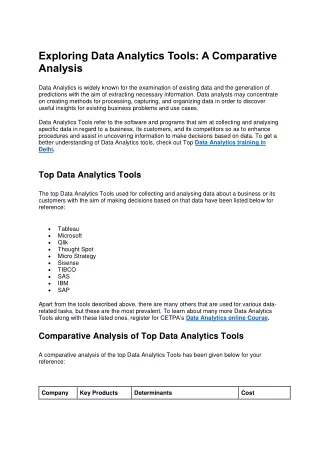
Data analytics tools are vital for converting raw data into meaningful insights. They include visualization platforms like Tableau and Power BI, which create interactive charts and dashboards, and statistical software such as R and SAS for advanced data analysis and modeling. For data handling, SQL and Python libraries like Pandas and NumPy are key for data cleaning, querying, and preparation.


Data Analytics Tools
E N D
Presentation Transcript
Data Analytics Tools Harnessing Technology for Data- Driven Insights
01 - Introduction Analyzing data enables informed decision-making Data analytics tools are essential software applications designed to help organizations manage, analyze, and interpret data. These tools facilitate the extraction of actionable insights from complex and vast datasets, which can significantly enhance decision-making and operational efficiency. They serve various purposes, including data visualization, statistical analysis, data manipulation, and predictive modeling.
02 - Data Visualization Tools 1. Tableau: Creates interactive and shareable dashboards, allowing users to explore data visually and identify trends. 2. Power BI: Offers interactive reports and dashboards with integration across Microsoft products, enabling real-time data insights. 3.Qlik Sense: Provides self-service data exploration and visualization with an associative data model for intuitive analysis. 4. Google Data Studio: Facilitates easy creation of customizable reports and dashboards, integrating with various data sources. These tools help in translating complex data into visual formats, making it easier to understand and communicate insights.
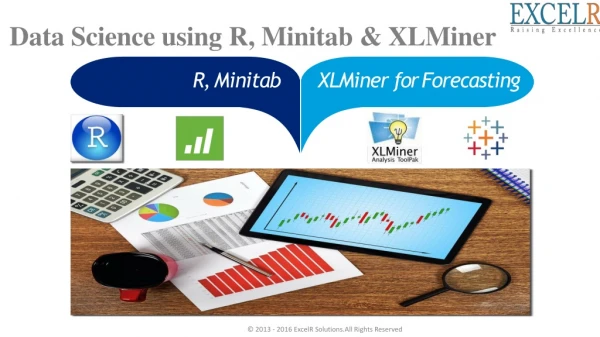
03 - Statistical Analysis Software Statistical techniques play a crucial role in data analysis R: An open-source programming language and environment used for statistical computing and graphics. R provides a vast array of packages for complex data analysis, modeling, and visualization, making it highly versatile for research and advanced analytics. SAS (Statistical Analysis System): A comprehensive suite for advanced analytics, business intelligence, and data management. SAS offers powerful tools for statistical analysis, predictive modeling, and data manipulation, widely used in industries for in-depth analytics and decision support.
04 - Data Manipulation Tools 1. SQL: A standard language used for managing and querying relational databases. SQL is essential for retrieving, updating, and manipulating structured data efficiently. 2. Pandas (Python Library): A Python library for data manipulation and analysis. It provides data structures like Data Frames for handling and cleaning large datasets, making it ideal for data wrangling. 3. NumPy (Python Library): A Python library for numerical computations. It offers support for large, multi-dimensional arrays and matrices, along with a collection of mathematical functions to operate on these arrays. These tools are crucial for organizing, cleaning, and transforming data to prepare it for analysis.
05 -Business Intelligence Platforms IBM Cognos: Provides comprehensive reporting, analysis, and data visualization capabilities. It integrates data from multiple sources to generate detailed and interactive reports. Qlik Sense: Offers self-service data discovery and interactive visualizations. Its associative model allows users to explore data intuitively and uncover insights through dynamic dashboards. Data analysis allows for identifying trends and patterns within datasets. Microsoft Power BI: Facilitates the creation of interactive reports and dashboards with seamless integration across Microsoft products. It enables real-time data analysis and sharing of insights.
06 - Machine Learning Tools TensorFlow: An open-source framework for building and deploying machine learning models, especially for deep learning and neural networks. It supports complex computations and scalable model training. Scikit-learn: A Python library for machine learning that provides simple and efficient tools for data mining and data analysis. It includes algorithms for classification, regression, clustering, and more. Keras: A high-level neural networks API, running on top of TensorFlow, that simplifies the process of building and training deep learning models with a user-friendly interface. Data analysis helps uncover valuable insights from complex datasets
07 - Big Data Technologies Apache Hadoop: An open-source framework that enables distributed storage and processing of large datasets across clusters of computers. It uses HDFS (Hadoop Distributed File System) for scalable storage and MapReduce for parallel data processing. Cloudera: Provides a comprehensive platform for managing and analyzing big data. Cloudera’s suite includes tools for data ingestion, storage, processing, and analytics, built on top of Hadoop and Spark, with enterprise features for security and governance. Google BigQuery: A fully-managed, serverless data warehouse on Google Cloud Platform. It allows for fast SQL queries on large datasets using Google’s infrastructure, providing real-time insights with high-speed analytics capabilities.
08 - Conclusions Data analysis helps in identifying outliers or anomalies in the data Data analytics tools encompass a range of software designed to manage and analyze data effectively. Data visualization tools, such as Tableau and Power BI, create interactive charts and dashboards to make complex information more accessible. Statistical analysis software like R and SAS offers advanced capabilities for in-depth data modeling and hypothesis testing. Data manipulation tools, including SQL and Python libraries like Pandas and NumPy, assist in cleaning, querying, and preparing data for analysis. Business intelligence platforms, such as IBM Cognos and Qlik Sense, provide integrated reporting and comprehensive data analysis by combining information from various sources. Data analysis facilitates predictive modeling and forecasting
Thanks Data Analytics Tools https://iimskills.com/data- analytics-tools/

![5 Big Data Analytics tools [2020]](https://cdn5.slideserve.com/9947551/session-1-dt.jpg)