
Caesarean section
Pdf about Caesarean section <br>
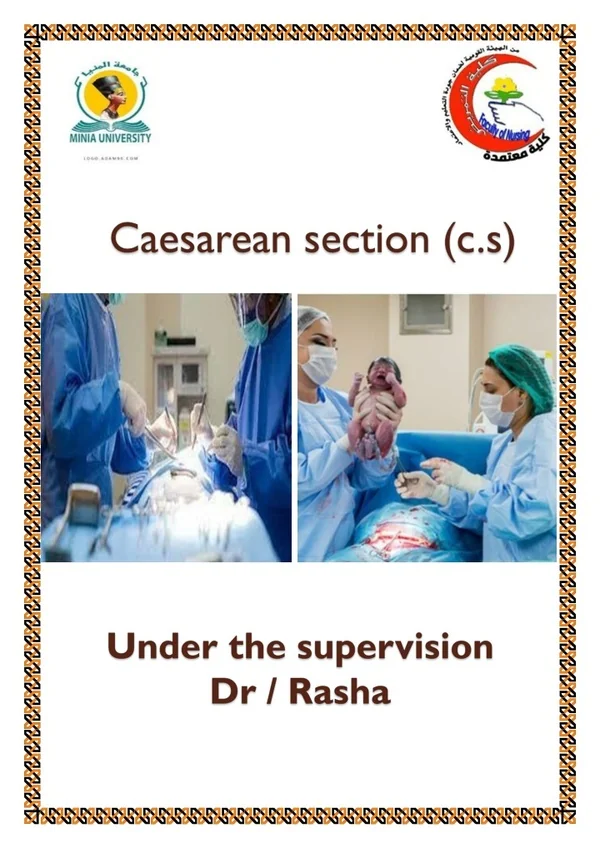

Caesarean section
E N D
Presentation Transcript
THE OUTLINES-: - INTRODUCTION - DEFINITION - INCIDENCE - INVESTIGATION - INDICATION 1. Maternal Indication for cesarean 2. Uterine / anatomic Indication for cesarean 3. Fetal Indication for cesarean - TYPES - CONTRAINDICATION - RISK FACTOR ASSOCIATED WITH CESAREAN - COMPLICATION - NURSING INTERVENTION
Introduction : - Cesarean section is a fetal delivery through an open abdominal incision (laparotomy) and an incision in the uterus (hysterotomy). The first cesarean documented occurred in 1020 AD, and since then, the procedure has evolved tremendously.[1] It is now the most common surgery performed in the United States, with over 1 million women delivered by cesarean every year.[2] Though there are continuing efforts to reduce the rate of cesarean sections, experts do not anticipate a significant drop for at least a decade or two.[3] While it confers risks of both immediate and long-term complications, for some women, cesarean delivery can be the safest or even Incidence:- - the only way to deliver a healthy newborn. ●Over the years; global caesarian section (CS) rates have significantly increased from around 7% in 1990 to 21% today surpassing the ideal acceptable CS rate which is around 10%–15% according to the WHO. However, currently, not all CS are done for medical reasons with rapidly increasing rate of non medically indicated CS and the so‐called “caesarian on maternal request.” These trends are projected to continue increasing over this current decade where both unmet needs and overuse are expected to coexist with the projected global rate of 29% by 2030. ●According to the data by the Central Agency for Public Mobilisation and Statistics (CAPMAS) on the Health of the Egyptian Family (HEF) in late August, C-section births increased to 72 percent in 2021, up from 52 percent in 2014.
Definition : - Caesarean section, also known as C-section or caesarean delivery, is the surgical procedure by which one or more babies are delivered through an incision in the mother's abdomen, often performed because vaginal delivery would put the baby or mother at risk. Investigation : - - 140 ℅ Indications:- or should not, be delivered vaginally.[5][6] Some of these indications are inflexible, as a vaginal birth would be dangerous in certain clinical scenarios. For example, a cesarean delivery is often the recommended approach if the patient has had a prior classical cesarean scar or previous uterine rupture. However, due to the potential complications of cesarean delivery (see below), much study has been done looking for ways to reduce the cesarean rate.
esarean Delivery,” authors addressed the most commonly documented indications for first-time cesarean deliveries (labor dystocia, abnormal fetal heart rate pattern, malpresentation of the fetus, multiple gestations, and suspected fetal macrosomia) and mitigation of how these factors.[7] Maternal Indication for cesarean :- accrete( -thickness myomectomy iscence
Uterine / anatomic Indication for cesarean:- full- Genital tract obstructive mass Fetal Indication for cesarean : - s abnormal umbilical cord Doppler study) or abnormal fetal heart tracing
Types of Cesarean Section:- -Classical Cesarean Section : - A midline vertical incision on the abdomen and the uterus is made to deliver the baby. Owing to a large number of complications associated with the technique, it is hardly practiced any longer. Advantages : The fetus can be delivered quickly and gently with minimal risk of forcing delivery which may result in intracranial hemorrhage in a preterm case. And the bladder injuries are extremely rare compared with cases with a low transverse incision. Disadvantages : Excessive bleeding from the myometrialverssels. The women who have classical c-section should not attempt a VBAC, because of the higher risk of uterine rupture during childbirth. In case of classical c-section, the doctor may make a bikini cut on the uterus, because the side to side incision of the uterus are generally safer. -Lower Segment Cesarean Section (LSCS:) It is the most commonly preferred method wherein a horizontal or transverse incision is made on the lower part of the abdomen
to deliver the baby. It involves less blood loss and is easier to repair than other incisions employed for the purpose. The incision also is low so cosmetically more acceptable. Advantages: It heals and look better,less pain after surgery and it’s less likely to cause problems in future pregnan -Emergency C Section: When there is suspected danger to the mother’s or baby’s condition an emergency section is resorted to. -Elective Cesarean Section (Planned C-Section): The Cesarean is planned and done on a specific date chosen by the patient and the doctor after assessing the maturity of the baby. -Cesarean Hysterectomy It is a life-saving procedure in which the uterus is removed after delivering the baby through a cesarean section. It is performed when bleeding cannot be controlled or when the placenta adheres to the uterine wall and it is not possible to separate it.
Contraindications : - There are no true medical contraindications to the cesarean section. A cesarean is an option if the pregnant patient is dead or dying or if the fetus is dead or dying. While there are ideal conditions for cesarean, such as the availability of anesthesia and antibiotics, and appropriate equipment, the absence of these is not a contraindication if the clinical scenario dictates. Ethically, a cesarean is contraindicated if the pregnant patient refuses. Adequate education and counseling are crucial for informed consent. However, if the pregnant patient does not consent to have surgery performed upon her body, ultimately, it is her right as an autonomous patient. There are some clinical scenarios in which a cesarean delivery may not be the preferred option. One could consider these relative contraindications. For example, a pregnant patient may have severe coagulopathy, which makes surgery extremely dangerous. In that case, vaginal delivery may be preferable. Alternatively, a patient with an extensive history of abdominal surgery may also be a poor surgical candidate. In the event of fetal demise, performing a cesarean exposes the pregnant patient to the risks of cesarean without any fetal benefit. The same considerations apply if the fetus has severe anomalies that are incompatible with life.
Risk factors associated with cesarean section - : ) maternal age over 28 years). 1 ) previous cesarean section). 2 ) complicated pregnancy). 3 ) fetal suffering; cephalopelvic disproportion, deficient prenatal care, fetal podalic version, oxytocin administration, abnormal amniotic fluid, double- or triple-circle umbilical cord. 4 ) patient attended by a gynecologist with more than 16 years of experience. 5 ) by a resident; and medical care in evening shift. There was no association with age, menarche, beginning of sexual relationships, body mass index, smoking, or addictions. 6 Conclusions: Risk factors associated with cesarean section were: previous cesarean section and patient attended by a gynecologist with more than 16 years of experience and by a resident.
Nursing Interventions 1 - Preoperative Pregnancy and the process of childbirth and new motherhood require major physical and psychological adaptations for a woman. In addition, the pathway of development from embryo to fetus to neonate to infant has the potential to exert critical influences on the mental and physical health of the new individual throughout their life. Psychology has generated new understandings of these processes that are relevant to the mental health of both mothers and their children. PREPARATION: 1 - equipment. 2 - environment. 3 - maternal. PREPARATION FOR MATERNAL - Take personal history. - Medical and surgical history. - Details of previous pregnancy and delivery. - Obstetrical history. PREOPERATIVE PREPARATION
The usual preoperative preparation is observed - that is, an anesthetic chart/preoperative assessment, weight, and observations of blood pressure, pulse and temperature - which serve as a baseline. Gowning and removal of make-up and jewelry (or taping of rings) will be carried out. The woman is visited by the anesthetist preoperatively and assessed. Results of any blood tests that have been requested are obtained and a full blood count is carried out. Blood is grouped and saved. In the case of pre-eclampsia, urea and electrolyte levels will be examined and clotting factors acquired. The woman will have fasted and have taken the prescribed antacid therapy. Attitudes and practices vary regarding public shaving. The woman may prefer to be catheterized in the theatre under epidural or general anesthetic, but it may be more private to do this in her room, before entering the operating theatre where others are present Positioning of the woman. As the woman will need to lie flat it is essential that a wedge or cushion is used, or the table is tilted, to direct the weight of the gravid uterus away from the inferior vena cava. Supine hypotensive syndrome is thus avoided. ⮊ Make sure that the mother is fasting at least 8 hours before the operation. ⮊ Ensure stopping anticoagulant drugs at last 72 hours preoperative. ⮊ Preparing labs investigations. ⮊ Health education about protein diet to fast healing of wound.
Nursing Assessment 1- Assess knowledge of procedure. - 2 Monitor maternal and fetal vital signs. 3- Determine maternal blood type and Rh. 4- Determine last time the woman ate. - 5 Identify drug allergies. - 6 Inspection for any scar in abdomen 7- Abdominal examination. Nursing Diagnoses A. Anxiety related to cesarean delivery B. Pain related to surgical procedure C. Risk for Infection related to traumatized tissue D. Risk for Altered Parenting related to interruption in bonding process. (Especially) Explain all procedures before doing them. nursing care includes: 1-The abdominal skin is prepared. A Foley catheter is inserted into the bladder to ensure that it is empty.
Elastic stockings are often put on the woman’s leg to reduce peripheral blood pooling and hypotension. 2-The fetal heart rate is recorded with electronic monitoring until the infant is delivered. 3- Preoperative Nursing Management: Patient Education: * Teaching deep breathing and coughing exercises. * Encouraging mobility and active body movement. e.g. Turning (change position), foot and leg exercise. * Explaining pain management. * Teaching cognitive coping strategies. 4- Preoperative Nursing Management: Managing nutrition and fluids. − The major purpose of withholding food and fluid before surgery is to prevent aspiration. − A fasting period of 8hours or more is recommended for a meal that includes fried or fatty foods or meat * Preparing the bowel for surgery. − Enema is not commonly ordered, unless the patient is undergoing abdomen or pelvic surgery * Preparing the skin. −The goal of preoperative skin preparation is to decrease bacteria without injury to the skin. 5- Immediate preoperative nursing intervention: Administering preanesthetic medication. Maintaining the preoperative record. e.g., Final checklist, consent form, identification.
- 6 IV- Relieving pain and anxiety: Opioid analgesic. V- Assessing and managing the surgical site: The surgical site is observed for bleeding, type and integrity of dressing and drains. VI- Assessing and managing gastrointestinal function: Nausea and vomiting are common after anesthesia. Check of peristalsis movement. - 7 Assessing and managing voluntary voiding: −Urine retention after surgery can occur for a verity of reasons. Opioids and anesthesia interfere with the perception of bladder fullness. - Abdominal, pelvic, hip may increase the like hood of retention secondary to pain. - 8 VIII- Encourage activity: −Most surgical are encouraged to be out of bed as soon as possible. Early ambulation reduces the incidence of post operative complication as, atelectasis, pneumonia, gastrointestinal discomfort and circulatory problem - 9 Pain medication usually is ordered every 3 to 4 hours: Lately care includes perineal care, breast care, and routine vaginal care, including showering after the dress been removed. During each shift the nurse should check the vital signs, the incision,
fundus, and lochia. Sounds, bowel sounds, Homan’s sign, and urinary elimination. 10- Answer any questions the woman and her support person may have regarding a cesarean delivery. 11- Allow the support person to attend the birth. Psychology Anticipating childbirth can be daunting, especially given the 'horror stories' that are commonly told. Each woman brings her own expectations, fears, past experiences, and concerns to an impending birth. Anticipation of the unknown can be stressful, and some women hold a particularly fearful narrative of childbirth which can be associated with negative messages received from their own mothers (or other people), knowing someone who has experienced a traumatic birth, having had a previous traumatic experience, or having had a high-risk pregnancy. Other factors can be at play that contribute to high levels of anxiety around birth. Psychologists at the Antenatal and Postnatal Psychology Network assist women (and their partners) to deal with fear surrounding childbirth, and to prepare mentally for childbirth in a more positive way. Pre-Surgery Psychological support, as the date of the surgical procedure approaches, patients may well start to become increasingly anxious. This can be due to fear of pain
both during and after the surgery, fear of losing control, fear that something may go wrong and fear of the needle that will be used to give the anesthetic injection. Many people do not want to admit their fears to friends and family because they are worried about looking weak. 1-Provide specifically targeted emotional care for women from early in the pregnancy. We need to maximize the psychological well-being of women in pregnancy. 2-Facilitate the transition to motherhood and attachment during pregnancy through providing an opportunity to think and talk about the self as a mother. 3- Facilitate the transition to motherhood and attachment during pregnancy through providing an opportunity to think and talk about the self as a mother. 4-Facilitate available support in the natural environment –don’t forget the dads. This principle applies at all stages of pregnancy, childbirth and the postnatal period. 5-Maximize opportunity for, and understanding of, mother– infant bonding. 6- Recognize the range of postnatal distress and ensure appropriate care is available
Intraoperative ●Begins when patient is transferred to operating room table ●Provide for patient safety. ●Maintain aseptic environment. ●Provide surgeon with supplies and instruments Nursing management in the post anesthesia care unit: 1- Assessing the patient: Frequent assessment of the patient oxygen saturation, pulse volume and regularity, depth and nature of respiration, skin color, depth of consciousness. - 2 II- Maintaining a patent airway: The primary objectives are to maintain pulmonary ventilation and prevent hypoxia and hypercapnia. The nurse applies oxygen, and assesses respiratory rate and depth, oxygen saturation. III-Maintaining cardiovascular stability The nurse assesses the patient's mental-GCS scale status, vital signs, cardiac rhythm, skin temperature, color and urine output. - Central venous pressure, arterial lines and pulmonary artery pressure.
- The primary cardiovascular complications include hypotension, shock, hemorrhage, hypertension and dysrhythmias. - 3 Encourage mother-child bonding as soon as possible. Intraabdominal irrigation with normal saline before abdominal closure has been evaluated. - The rate of intraoperative nausea was significantly increased with intraabdominal irrigation. (INTRAOPERATIVECONTRACEPTION) - If patient has been counselled and consented prior to the procedure, contraception may be instituted, e.g:. 1- An IUD can be placed prior to the repair of the hysterotomy. 2-A Levonorgestrel subdermal implant can be placed in the patient's arm at this time. 3- A sterilization can be performed e.g. bilateral tubal ligation. 3-Postoperative Immediate care Observations: The blood pressure and pulse should be recorded every quarter hour in the immediate recovery period. The temperature should be recorded every 2 hours. The wound must be inspected every half hour to detect any blood loss. The lochia should also be inspected, and drainage should be small initially.
Following general anesthesia, the woman is nursed in the left lateral or 'recovery' position until she is fully conscious, since the risks of airway obstruction or regurgitation and silent aspiration of stomach contents are still present. Analgesia. This is prescribed and is given as required. If the mother intends to breastfeed, the baby should be put to the breast as soon as possible. This can usually be achieved with minimal disturbance to the mother. Postoperative analgesia may be given in a variety of ways: - An epidural opioid - Rectal analgesia, such as diclofenac (this is contraindicated if there is continuing bleeding, poor urine output, a history of sensitivity to NSAIDs, or peptic ulcer) - Intramuscular analgesia (though this is never given in conjunction with epidural opioids because of the risk of cumulative effects) - oral drugs (e.g., dihydrocodeine, paracetamol). - Antiemetics (e.g., cyclizine; prochlorperazine) are usually prescribed by the anesthetist.
Complication of caesarean section A caesarean section is generally a very safe procedure, but like any type of surgery it does carry a risk of complications.The level of risk will depend on things such as whether the procedure is planned or carried out as an emergency, and your general health.If there's time to plan your caesarean, your doctor or midwife will talk to you about the potential risks and benefits of the procedure. Risks Some of the main risks to you of having a caesarean include: ⮊ infection of the wound (common) causing redness, swelling, increasing pain and discharge from the wound. ⮊ infection of the womb lining (common) symptoms include a fever, tummy pain, abnormal vaginal discharge and heavy vaginal bleeding . ⮊ excessive bleeding (uncommon) – this may require a blood transfusion in severe cases, or possibly further surgery to stop the bleeding. ⮊ deep vein thrombosis (DVT) (rare)
– a blood clot in your leg, which can cause pain and swelling, and could be very dangerous if it travels to the lungs (pulmonary embolism) connect the kidneys and bladder (rare) – this may require further surgery which should mean infections become much( less common) ⮊ SURGICAL COMPLICATION 1. Delayed healing 2. Adhesion formation: Adhesion formation is another risk associated with having a cesarean section. Adhesions are bands of scar tissue that can form between organs or tissues that are not normally connected. They can develop during the healing process of the surgical incision and can cause organs or tissues to stick together. Adhesions can lead to chronic pain, bowel obstructions, and fertility issues in some cases. Surgical intervention may be required to remove or separate the adhesions if they cause significant symptoms or complications. 3. Epidermoid (Implantation) cyst: - It is a cyst that is lined by stratified squamous epithelium & filled with keratin ⮊ -It is formed as a result of trapping of epidermal cells in the depth of the wound ⮊ 4. Chronic ulcer:
-It is persistent discontinuity of the surface epithelium. It occurs either due to persistent infection which destroys the granulation tissue or due to excess collagen deposition at the ⮊ edges of the wound without filling the whole wound. ⮊ Incisional hernia due to the presence of weak scar ⮊ Keloid formation It is a large protuberant (bulging) scar which is covered by thin stretched epidermis. - It is formed due to excess collagen formation leading to raising of the epidermis at the site of the wound. -It may be formed due to foreign body reaction caused by inclusion of hair, keratin, debris, etc in the wound. - It may occur in healing of burns and healing by second intention. People with dark skin are more susceptible. It has a hereditary tendency. It recurs after surgical removal but it shrinks by irradiation. Women who have a caesarean usually have no problems with future pregnancies.Most women who have had a caesarean section can safely have a vaginal delivery for their next baby, known as vaginal birth after caesarean (VBAC).But sometimes another caesarean may be necessary. Although uncommon, having a caesarean can increase the risk of certain problems in future pregnancies, including: ● the scar in your womb opening up ● the placenta being abnormally attached to the wall of the womb leading to difficulties delivering the placentastillbirth
- Berghella V, Baxter JK, Chauhan SP. Evidence-based surgery — for cesarean delivery. Am J Obstet Gynecol. 2005 Nov;193(5):1607-17. [PubMed] [Reference list] — - ACOG Practice Bulletin No. 205: Vaginal Birth After Cesarean Delivery. Obstet Gynecol. 2019 Feb;133(2):e110-e127. [PubMed] [Reference list] — - Clapp MA, Barth WH. The Future of Cesarean Delivery Rates in the United States. Clin Obstet Gynecol. 2017 Dec;60(4):829-839. [PubMed] [Reference list] — - Barber EL, Lundsberg LS, Belanger K, Pettker CM, Funai EF, Illuzzi JL. Indications contributing to the increasing cesarean delivery rate. Obstet Gynecol. 2011 Jul;118(1):29-38. [PMC free article] [PubMed] [Reference list] — - Boyle A, Reddy UM, Landy HJ, Huang CC, Driggers RW, Laughon SK. Primary cesarean delivery in the United States. Obstet Gynecol. 2013 Jul;122(1):33-40. [PMC free article] [PubMed] [Reference list] — - Barber EL, Lundsberg LS, Belanger K, Pettker CM, Funai EF, Illuzzi JL. Indications contributing to the increasing cesarean delivery rate. Obstet Gynecol. 2011 Jul;118(1):29-38. [PMC free article] [PubMed] [Reference list] — - Boyle A, Reddy UM, Landy HJ, Huang CC, Driggers RW, Laughon SK. Primary cesarean delivery in the United States. Obstet Gynecol. 2013 Jul;122(1):33-40. [PMC free article] [PubMed] [Reference list] — https://www.ncbi.nlm.nih.gov/books/NBK546707/