Polyols Market
0 likes | 4 Views
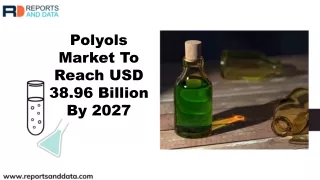
The Polyols Market involves the production and use of polyols, which are key chemical components in creating polyurethane foams, coatings, adhesives, sealants, and elastomers. Polyols are widely used in industries such as construction, automotive, furniture, and textiles due to their versatility, durability, and energy efficiency.


Polyols Market
E N D
Presentation Transcript
+1 217 636 3356 +44 20 3289 9440 sales@mobilityforesights.com Your Cart 0 Company Market Reports Consumer Research Advisory Services Exports - Imports Careers Contact Us Blog Your cart is empty Your Name Return to Shop Business Email Global Polyols Market 2024-2030 Country Phone Number +1 Single User License : $ 3,950 Company Name Corporate User License : $ 6,000 Your message Request Sample By submitting this form, you are agreeing to the Terms of Use and Privacy Policy. BUY NOW I'm not a robot reCAPTCHA Privacy - Terms DOWNLOAD SAMPLE DESCRIPTION TABLE OF CONTENTS POLYOLS MARKET INTRODUCTION Polyols, commonly referred to as sugar alcohols, are a diverse class of organic molecules with important uses in numerous sectors of the economy. These substances have a special chemical structure that combines the characteristics of both sugars and alcohols. They are generated from carbohydrates. Polyols are crucial components in the food and beverage, pharmaceutical, cosmetic, and industrial industries because of their widespread use as sweeteners, low calorie content, and functional qualities. Polyols are recognized in the world of nutrition for their capacity to offer sweetness without triggering the same surge in blood sugar levels as conventional sugars. They are suitable for people with diabetes or those on low-carb diets because of this property. The polyols erythritol, xylitol, sorbitol, and maltitol are frequently utilized. In addition to candies, chewing gum, baked goods, and beverages, these ingredients help produce foods that are low in calories and sugar. POLYOLS MARKET SIZE AND FORECAST We use cookies to understand site usage and improve content and offerings on our site. To learn more, refer to our Privacy Policy. By continuing to use this site, or closing this box, 0 Learn more you consent to our use of cookies. Got it! The polyols accounted for $XX Billion in 2023 and is anticipated to reach $XX Billion by 2030, registering a CAGR of XX% Send message Continue Shopping from 2024 to 2030. POLYOLS MARKET RECENT PRODUCT DEVELOPMENT AND INNOVATION New grades of two basic polyols with 100% renewable, mass-balanced carbon content have been introduced by specialty chemicals pioneer Prester. The products at the Prester gate will have a negative carbon footprint2 when accounting for the biogenic CO2 uptake1 from the renewable raw materials. Nature N100 (neopentyl glycol) and Veyron T100 (trimethylolpropane), both of which are based on a traceable mass-balance principle, are intended to help sustainably source raw materials that are renewable and recycled while also reducing the carbon footprint across the whole value chain. Polyether polyols made from bio-circular feedstock are now also available from Covestro. The company can provide both essential raw material components for the production of polyurethane (PU) foams based on alternative raw materials, including renewable1 toluene diisocyanate (TDI) and climate-neutral methylene diphenyl diisocyanate (MDI). Similar to TDI and MDI, the polyols are made utilizing the mass balance approach and renewable precursors, such as biowaste and leftover materials, which are calculated to be assigned to the products. The more environmentally friendly polyether polyols and isocyanates can be used as drop-in replacements by customers, allowing for quick and simple integration of the raw materials into current manufacturing processes without the need for technical modifications. POLYOLS MARKET COMPANY PROFILE Repsol Huntsman International LLC Covestro AG The Dow Chemical Company Royal Dutch Shell Plc ANSWER FOLLOWING QUESTIONS 1. How many polyols are manufactured per annum globally? Who are the sub-component suppliers in different regions? 2. Cost breakup of a Global polyols and key vendor selection criteria 3. Where is the polyols manufactured? What is the average margin per unit? 4. Market share of Global polyols market manufacturers and their upcoming products 5. Cost advantage for OEMs who manufacture Global polyols in-house 6. key predictions for next 5 years in Global polyols market 7. Average B-2-B polyols market price in all segments 8. Latest trends in polyols market, by every market segment 9. The market size (both volume and value) of the polyols market in 2023-2030 and every year in between? 10. Production breakup of polyols market, by suppliers and their OEM relationship RELATED REPORTS MARKET REPORTS CONSUMER RESEARCH INFORMATION ADVISORY SERVICES CONTACT INFORMATION 172/1, 2nd Floor, 5th Main, 9th Cross Rd, Opposite to Kairalee Nikethan
Education Trust, Indira Nagar 1st Stage, Bengaluru, Karnataka 560038, INDIA +1 217 636 3356, +44 20 3289 9440 sales@mobilityforesights.com Working Hours: Mon - Fri (9 AM - 9 PM IST) Connect with us © Copyright 2017-2023. Mobility Foresights. All Rights Reserved.