Download

1 / 10
0 likes | 3 Views
Discover leading anchor bolt manufacturers known for producing high-quality, durable anchor bolts designed to meet stringent industry standards for all construction projects.

E N D
Anchor Bolt Manufacturers: An Overview Exploring the essential fastening solutions that hold our built environment together with strength and precision.
What Are Anchor Bolts? Anchor bolts are heavy-duty fastening devices embedded into concrete or masonry to create a secure connection point for structural elements. These essential components provide the crucial stability needed to fasten equipment, columns, walls, and other structural members to foundations. Their robust design ensures reliable load transfer and long-term structural integrity across diverse construction, infrastructure, and industrial applications worldwide.
Manufacturing Methods Thread Rolling Thread Cutting Material Selection Employs machine or hand-cutting techniques to remove material and form threads. Whilst more flexible for custom specifications, this method typically produces threads with less strength than rolled alternatives. The choice of base materials significantly impacts the final product's strength characteristics, corrosion resistance, temperature tolerance, and overall performance in specific environmental conditions. Utilises plastic deformation to create exceptionally strong, durable threads with superior fatigue resistance and surface finish. This cold-forming process compresses the metal fibres, enhancing structural integrity.
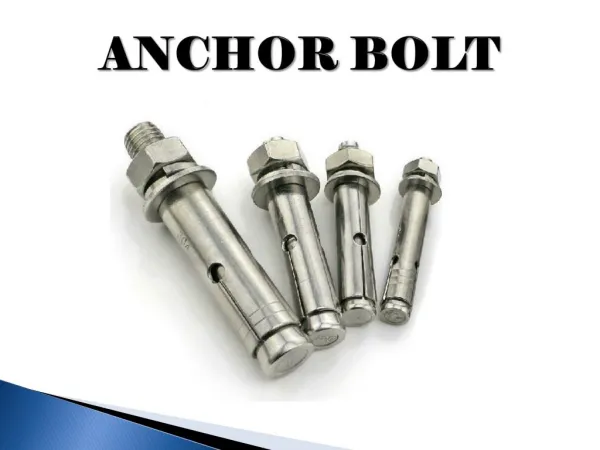
Common Types of Anchor Bolts Internally Threaded Anchor Features no surface protrusion, making it ideal for applications requiring flush installations. Widely adopted across construction projects for its clean aesthetic and reliable holding power. Adhesive (Chemical) Anchor Utilises high-strength resin capsules or injectable compounds to create a powerful chemical bond with the base material, offering excellent load distribution and versatility. Welded Anchor Directly welded to the structural object, providing a compact, permanent connection solution. Particularly effective where space constraints limit traditional fastening methods. Grip and Board Anchors Specially engineered for concrete applications and hollow structural walls, offering reliable fastening in substrates where traditional anchors may not perform optimally.
Typical Anchor Bolt Designs Standard Configurations Bent Rods: Simple yet effective L-shaped or U-shaped designs for basic anchoring needs Hook Bolts (J Bolts): Feature a curved hook end for enhanced pullout resistance Sleeve Bolts: Include protective sleeves for adjustable positioning Swaged Bolts: Cold-worked ends provide superior grip strength High-Performance Options Wedge Anchors: Deliver exceptional holding power through wedge-shaped expansion mechanisms Machine Screw Anchors: Perfectly suited for shallow installations with precise threading requirements
Materials and Durability Steel and Carbon Steel Galvanised Bolts Stainless Steel The industry standard for anchor bolt manufacturing, offering outstanding tensile strength, excellent formability, and cost-effectiveness for demanding structural applications. Feature a protective zinc coating that significantly enhances corrosion resistance, extending service life in moderately corrosive environments and outdoor installations. Premium material choice for harsh environments, offering superior corrosion resistance, exceptional high-temperature performance, and longevity in marine or chemical exposure conditions.
Applications Across Industries Building Construction Anchor bolts secure critical structural components including walls, columns, steel frameworks, and heavy equipment such as HVAC systems, ensuring buildings withstand dynamic loads and environmental stresses. Infrastructure Projects Essential for bridges, tunnels, highway systems, and transportation networks, providing the foundational connections that enable large-scale civil engineering projects to achieve design specifications and safety standards. Energy and Marine Sectors From offshore oil rigs to power generation facilities and maritime structures, anchor bolts deliver the robust, corrosion-resistant fastening solutions required in demanding, high-consequence environments.
Engineering Principles Load Resistance Design Anchor bolts are meticulously engineered to withstand multiple force vectors simultaneously, including shear forces (lateral movement), tensile forces (pullout), and combined loading scenarios that occur during normal operation and extreme events. Critical Calculations Engineers carefully determine embedment depth, material thickness, edge distances, and spacing based on anticipated loads, substrate properties, and safety factors. These calculations ensure adequate performance under worst-case conditions. Seismic Considerations Modern earthquake-resistant designs incorporate ductility, energy dissipation capabilities, and controlled failure modes to maintain structural integrity during seismic events, protecting both property and lives.
Market Trends and Growth $34B+ 6.8% Projected Market Value Annual Growth Rate Global anchor bolt market expected to exceed $34 billion by 2031 Steady expansion driven by infrastructure investment worldwide Key Growth Drivers Innovation Focus Areas Manufacturers are investing in research and development to produce anchor bolts with higher strength-to-weight ratios, enhanced corrosion resistance, simplified installation procedures, and improved performance in extreme environmental conditions.
The Backbone of Structural Safety Critical Safety Component Continuous Innovation Leading manufacturers invest in advanced materials, manufacturing processes, and testing protocols to meet evolving industry standards and increasingly demanding performance requirements. Anchor bolts serve as the fundamental connection ensuring secure, durable construction that protects occupants and assets across all building types and infrastructure projects. Informed Selection Choosing the appropriate anchor bolt type, material grade, and installation method ensures long-term structural stability, cost-effectiveness, and compliance with engineering specifications.