Download
1 / 9
0 likes | 0 Views
give me with images and background

E N D
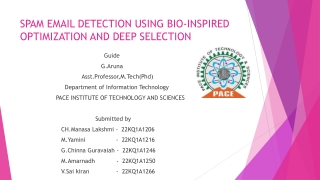
SPAM EMAIL DETECTION USING BIO-INSPIRED OPTIMIZATION AND DEEP SELECTION Guide G.Aruna Asst.Professor,M.Tech(Phd) Department of Information Technology PACE INSTITUTE OF TECHNOLOGY AND SCIENCES Submitted by CH.Manasa Lakshmi - 22KQ1A1206 M.Yamini - 22KQ1A1216 G.ChinnaGuravaiah - 22KQ1A1246 M.Amarnadh - 22KQ1A1250 V.Saikiran - 22KQ1A1266
CONTENT OF PRESENTATION • Introduction • Literature Survey • Existing Method • Disadvantages of Existing Method • Proposed Method • Advantages of Proposed Method
INTRODUCTION • Email communication has become an essential part of daily personal and professional activities. • However, the rapid growth of email usage has also led to an increase in spam and phishing attacks. • Spam emails are unwanted messages that waste time and resources. • Phishing emails are more dangerous as they attempt to steal sensitive information like passwords, bank details, and personal data. • Traditional spam filters are not effective against modern phishing techniques that use advanced tricks and hidden links. • To overcome these challenges, this project proposes an efficient email spam and phishing detection system using deep feature selection and bio-inspired optimization techniques.
LITERATURE SURVEY • Old methods like Naïve Bayes and SVM can catch simple spam emails, but fail on phishing emails. • Deep learning models (CNN, LSTM) can find hidden patterns in emails. They are more accurate but slower. • Feature selection helps pick the important parts of emails. Old methods sometimes miss key information. • Bio-inspired optimization (like GA or PSO) automatically chooses the best features, making detection better. • Gap: Very few systems combine deep learning + bio-inspired optimization for phishing detection.
EXISTING METHOD • Collect emails: spam, phishing, and normal emails. • Preprocess the emails: clean text, remove stop words, convert to lowercase, and tokenize. • Extract features from emails: -> Bag of Words ->Email headers (like sender info, subject line) • Classify emails using traditional machine learning: -> Naïve Bayes -> SVM -> Logistic Regression
DISADVANTAGES OF EXISTING METHOD • Cannot detect smart phishing emails effectively. • High false positives – sometimes good emails are marked as spam. • Uses too many features, which makes the system slower. • Deep learning-only models are slow and heavy. • No intelligent feature selection, so some important features are missed.
PROPOSED METHOD • Collect and preprocess emails: remove unwanted words, clean text, analyze headers. • Use deep learning (CNN/LSTM) to extract important features from email content and headers. • Apply bio-inspired optimization (like GA or PSO) to select the best features automatically. • Feed the selected features into a classifier to detect emails as: -> Legitimate -> Spam -> Phishing
ADVANTAGES OF PROPOSED METHOD • Higher accuracy in detecting spam and phishing emails. • Fewer mistakes (reduces false positives and false negatives). • Efficient because only important features are used. • Can handle large email datasets easily. • Detects new types of phishing emails effectively. • Faster and more reliable than existing methods.