Polymers in Low Friction Applications
0 likes | 1 Views
This comprehensive technical document provides an in-depth exploration of polymeric materials used in low-friction applications. It covers fundamental tribology principles, detailed analysis of major polymer types including PTFE, UHMWPE, POM, PEEK, and Nylon, with their friction coefficients, temperature ranges, and performance characteristics.<br>The guide includes comparative performance tables, filler and additive systems, material selection criteria, design guidelines, and testing methodologies. It also explores emerging technologies such as nanocomposites and biomimetic approaches, along wit


Polymers in Low Friction Applications
E N D
Presentation Transcript
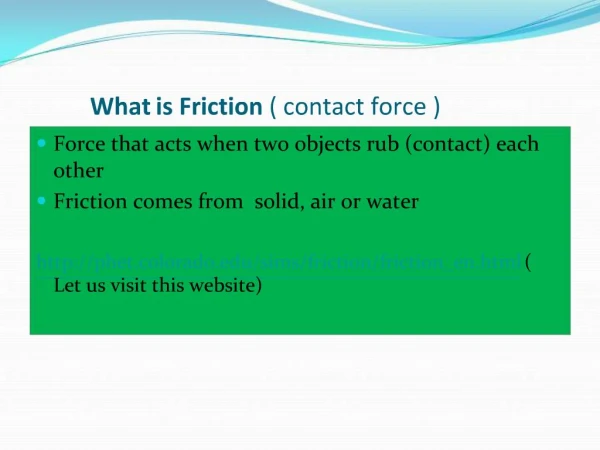
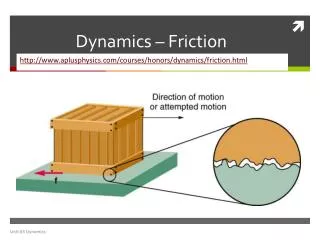
12/11/25, 3:28 PM Polymers in Low Friction Applications Polymers in Low Friction Applications Comprehensive Guide to Tribological Performance and Material Selection 1. Introduction Polymeric materials have become increasingly important in low friction applications due to their unique combination of properties including low coefficient of friction, self- lubricating capabilities, chemical resistance, and lightweight characteristics. These materials play a crucial role in modern engineering applications where reduced friction, wear resistance, and maintenance-free operation are essential requirements. The development of advanced polymer systems has revolutionized industries ranging from automotive and aerospace to medical devices and consumer electronics. Understanding the tribological behavior of polymers and their proper selection for specific applications is fundamental to achieving optimal performance and longevity in mechanical systems. 2. Fundamental Principles of Polymer Tribology 2.1 Friction Mechanisms in Polymers The friction behavior of polymers is fundamentally different from metals due to their viscoelastic nature and molecular structure. Polymer friction involves several mechanisms including adhesion, deformation, and plowing components. The coefficient of friction in polymers typically ranges from 0.05 to 0.5, depending on the polymer type, surface characteristics, and operating conditions. Key Factors Affecting Polymer Friction: Molecular weight and chain structure Crystallinity and orientation Surface roughness and texture Contact pressure and sliding velocity Temperature and environmental conditions Presence of additives and fillers file:///C:/Users/PavansekharRai/Downloads/Polymers_in_Low_Friction_Applications.html 1/7
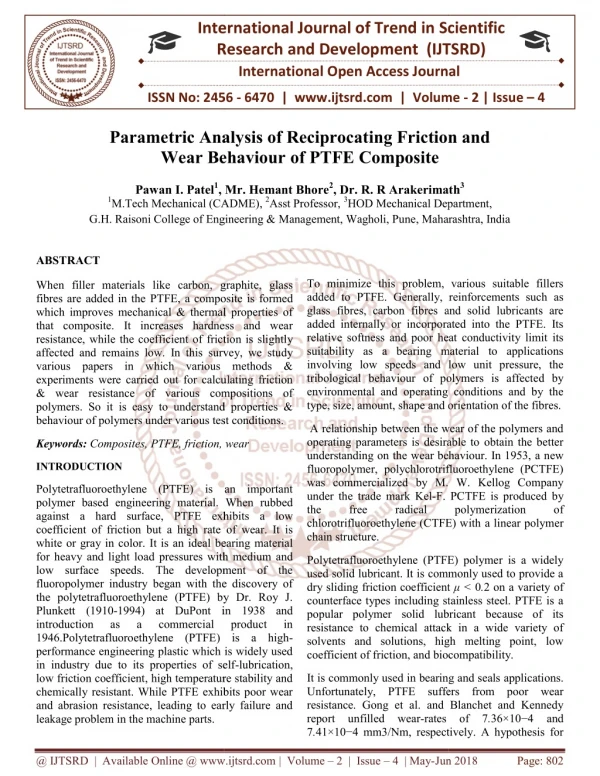
12/11/25, 3:28 PM Polymers in Low Friction Applications 2.2 Wear Mechanisms Polymer wear occurs through various mechanisms including adhesive wear, abrasive wear, fatigue wear, and chemical degradation. Understanding these mechanisms is essential for predicting service life and optimizing material selection. The wear rate of polymers is often expressed using the dimensionless wear coefficient K, which relates wear volume to load, sliding distance, and hardness. 3. Major Polymer Types for Low Friction Applications 3.1 Polytetrafluoroethylene (PTFE) PTFE, commonly known by the trade name Teflon, exhibits one of the lowest coefficients of friction among solid materials (0.05-0.10). Its exceptional low friction properties result from its unique molecular structure featuring strong C-F bonds and a helical chain configuration that allows easy molecular slippage. PTFE is chemically inert, operates across a wide temperature range (-200°C to 260°C), and maintains its properties in harsh environments. However, pure PTFE has limitations including high wear rates and cold flow under load. These drawbacks are typically addressed through the addition of fillers such as glass fibers, carbon, bronze, or graphite, which can reduce wear rates by orders of magnitude while maintaining the low friction characteristics. 3.2 Ultra-High Molecular Weight Polyethylene (UHMWPE) UHMWPE possesses exceptional wear resistance combined with low friction properties. With molecular weights exceeding 3 million g/mol, this material exhibits outstanding toughness, impact resistance, and chemical stability. The coefficient of friction typically ranges from 0.10 to 0.20, making it suitable for demanding applications. UHMWPE finds extensive use in medical implants, particularly in orthopedic joint replacements, due to its biocompatibility and excellent wear performance. Industrial applications include conveyor components, chute liners, and bearing materials where abrasion resistance is critical. 3.3 Polyoxymethylene (POM/Acetal) POM offers an excellent balance of low friction, high stiffness, dimensional stability, and fatigue resistance. With a coefficient of friction around 0.20-0.35, it provides superior mechanical properties compared to PTFE while maintaining good tribological file:///C:/Users/PavansekharRai/Downloads/Polymers_in_Low_Friction_Applications.html 2/7
12/11/25, 3:28 PM Polymers in Low Friction Applications performance. POM exhibits excellent resistance to wear and maintains its properties across a broad temperature range. The material is particularly suitable for precision gears, bearings, and sliding components where dimensional accuracy and mechanical strength are required alongside low friction operation. 3.4 Polyetheretherketone (PEEK) PEEK is a high-performance engineering thermoplastic that combines excellent mechanical properties with good tribological performance. It exhibits high temperature resistance (continuous use up to 250°C), exceptional chemical resistance, and maintains dimensional stability under load. The coefficient of friction ranges from 0.25 to 0.40 for unfilled grades. When filled with appropriate additives such as PTFE, graphite, or carbon fiber, PEEK can achieve significantly enhanced wear resistance and reduced friction, making it suitable for demanding aerospace, automotive, and industrial applications. 3.5 Polyamides (Nylons) Polyamides, particularly nylon 6 and nylon 66, offer good friction and wear characteristics combined with high mechanical strength and toughness. The coefficient of friction typically ranges from 0.20 to 0.40. Self-lubricating grades incorporating oil or solid lubricants provide enhanced tribological performance. These materials are cost-effective and widely used in gears, bearings, rollers, and sliding components. However, their moisture absorption characteristics must be considered in design applications. 4. Comparative Performance Table Coefficient of Friction Temperature Range (°C) Typical Applications Polymer Key Advantages Lowest friction, Seals, gaskets, PTFE 0.05 - 0.10 -200 to 260 chemical inert bearings Excellent wear Medical UHMWPE 0.10 - 0.20 -200 to 80 resistance implants, liners file:///C:/Users/PavansekharRai/Downloads/Polymers_in_Low_Friction_Applications.html 3/7
12/11/25, 3:28 PM Polymers in Low Friction Applications Coefficient of Friction Temperature Range (°C) Typical Applications Polymer Key Advantages High stiffness, dimensional POM (Acetal) Gears, precision parts 0.20 - 0.35 -40 to 100 stability High temperature resistance Aerospace, automotive PEEK 0.25 - 0.40 -50 to 250 Cost-effective, strong General bearings, gears Nylon 0.20 - 0.40 -40 to 120 5. Filler and Additive Systems 5.1 Solid Lubricant Fillers Solid lubricants such as graphite, molybdenum disulfide (MoS₂), and PTFE particles are commonly added to polymer matrices to reduce friction and wear. These additives form transfer films on counterface surfaces, creating a protective boundary layer that reduces direct polymer-metal contact. Typical concentrations range from 5% to 40% by weight, depending on the base polymer and application requirements. 5.2 Reinforcing Fillers Glass fibers, carbon fibers, and aramid fibers are used to enhance mechanical strength, stiffness, and dimensional stability. While these fillers may slightly increase the coefficient of friction, they dramatically improve wear resistance and load-bearing capacity. The synergistic combination of reinforcing and lubricating fillers often provides optimal tribological performance. 5.3 Internal Lubricants Oil-impregnated polymers and internally lubricated systems provide sustained lubrication through controlled release mechanisms. These systems are particularly valuable in applications where external lubrication is impractical or where contamination must be avoided. 6. Application Considerations and Design Guidelines 6.1 Material Selection Criteria file:///C:/Users/PavansekharRai/Downloads/Polymers_in_Low_Friction_Applications.html 4/7
12/11/25, 3:28 PM Polymers in Low Friction Applications Critical Factors for Material Selection: 1. Operating Environment: Temperature range, chemical exposure, humidity conditions 2. Loading Conditions: Contact pressure, velocity, duty cycle 3. Performance Requirements: Friction coefficient targets, wear life expectations 4. Mechanical Requirements: Strength, stiffness, dimensional stability 5. Economic Considerations: Material costs, processing complexity, maintenance needs 6.2 Surface Engineering Surface treatments and modifications can significantly enhance the tribological performance of polymers. Techniques include plasma treatment for improved adhesion, surface texturing for lubricant retention, and coating applications for specific performance enhancement. The synergy between bulk material properties and surface characteristics is crucial for optimal performance. 6.3 Thermal Management Frictional heating is a critical consideration in polymer tribology. Excessive temperatures can lead to softening, accelerated wear, and premature failure. Design considerations must include heat dissipation mechanisms, appropriate materials for thermal conditions, and operational limits to prevent thermal degradation. 7. Emerging Technologies and Future Trends 7.1 Nanocomposite Polymers The incorporation of nanoparticles such as nano-clay, carbon nanotubes, and graphene into polymer matrices represents a frontier in tribological materials. These nanofillers can provide exceptional improvements in mechanical properties and wear resistance at very low loading levels (typically 1-5% by weight), while maintaining or even reducing friction coefficients. 7.2 Biomimetic Approaches file:///C:/Users/PavansekharRai/Downloads/Polymers_in_Low_Friction_Applications.html 5/7
12/11/25, 3:28 PM Polymers in Low Friction Applications Nature-inspired design principles are being applied to develop advanced low-friction polymer systems. Surface texturing patterns derived from biological systems, hierarchical structures, and adaptive lubrication mechanisms offer promising avenues for next- generation tribological materials. 7.3 Smart and Adaptive Materials Research into self-healing polymers, stimuli-responsive materials, and adaptive tribological systems promises to extend component life and improve reliability. These materials can respond to environmental changes or damage, maintaining performance across varying operational conditions. 8. Testing and Characterization Methods Proper evaluation of polymer tribological performance requires standardized testing methodologies. Common approaches include pin-on-disk testing (ASTM G99), reciprocating wear testing (ASTM G133), and thrust washer testing (ASTM D3702). These methods provide quantitative data on friction coefficients, wear rates, and material compatibility under controlled conditions. Advanced characterization techniques such as scanning electron microscopy (SEM), atomic force microscopy (AFM), and surface profilometry enable detailed analysis of wear mechanisms, surface topography, and transfer film formation. Such analyses are essential for understanding failure modes and optimizing material selection. 9. Industry-Specific Applications 9.1 Automotive Industry Polymer bearings, bushings, and sliding components are extensively used in automotive applications including steering systems, suspension components, and engine peripherals. The trend toward electric vehicles has increased demand for low-friction polymers that operate without traditional lubrication systems. 9.2 Medical Devices Biocompatible low-friction polymers are critical in medical implants, surgical instruments, and drug delivery systems. UHMWPE remains the gold standard for orthopedic joint replacements, while other specialized polymers find use in catheters, guidewires, and minimally invasive surgical tools. file:///C:/Users/PavansekharRai/Downloads/Polymers_in_Low_Friction_Applications.html 6/7
12/11/25, 3:28 PM Polymers in Low Friction Applications 9.3 Aerospace Applications High-performance polymers such as PEEK, polyimides, and advanced composites are essential in aerospace applications where weight reduction, reliability, and performance under extreme conditions are paramount. These materials are used in flight control systems, landing gear components, and engine applications. 10. Conclusion Polymers in low friction applications represent a dynamic and evolving field that combines materials science, mechanical engineering, and surface chemistry. The proper selection and application of these materials requires comprehensive understanding of tribological principles, material properties, and operational requirements. As technology advances, the development of nanocomposites, smart materials, and biomimetic systems continues to expand the capabilities and applications of low-friction polymers. Success in implementing these materials depends on careful consideration of the interplay between bulk properties, surface characteristics, environmental factors, and loading conditions. The future of polymer tribology promises continued innovation, with emerging technologies offering enhanced performance, sustainability, and reliability across diverse industrial sectors. Ongoing research and development efforts will undoubtedly yield new materials and solutions that push the boundaries of what is achievable in low-friction applications. This document provides comprehensive technical information about polymers in low friction applications. Generated: 12/11/2025 file:///C:/Users/PavansekharRai/Downloads/Polymers_in_Low_Friction_Applications.html 7/7