Heat class 7
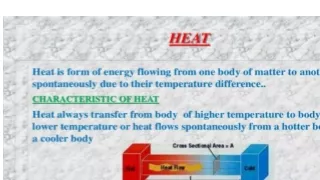
If you have studied the heat chapter, you can do this quiz. It covers key concepts related to heat, including temperature, heat transfer, and states of matter.

Heat class 7
E N D
Presentation Transcript
Class 7 Heat chapter - 3 science Multiple Choice Questions What is the powerhouse of the cell? A. Nucleus B. Mitochondria C. Ribosome D. Chloroplast Answer: Mitochondria 1. Which of the following is not a state of matter? A. Solid B. Liquid C. Gas D. Plasma E. Energy Answer: Energy 1. What is the chemical formula for water? A. CO₂ B. H₂O C. O₂ D. NaCl Answer: B. H₂O 1. Which planet is known as the Red Planet? A. Earth B. Mars C. Jupiter D. Venus Answer: Mars 1. What gas do plants absorb from the atmosphere during photosynthesis?
A. Oxygen B. Nitrogen C. Carbon Dioxide D. Hydrogen answer: Carbon Dioxide True or False 1. The boiling point of water is 100 degrees Celsius. True False ANSWER: TRUE 2. Friction is a force that slows down moving objects. True False 3. Sound travels faster in air than in water. True False ANSWER: True 4. A hypothesis is a scientific guess. True False ANSWER: False 5. Light travels in straight lines. True False ANSWER: True
Short Answer 1. What is the main function of the roots in a plant? Answer: The main function of roots is to absorb water and nutrients from the soil, anchor the plant in the ground, and store food. 2. What is an ecosystem? Answer: An ecosystem is a community of living organisms and their physical environment, interacting as a system. 3. Explain the process of photosynthesis. Answer: Photosynthesis is the process by which green plants and some other organisms use sunlight to synthesize foods with the help of chlorophyll. It involves the intake of carbon dioxide and water, and the release of oxygen and glucose. 4. Name three types of rocks and briefly describe how they are formed. Answer: Igneous rocks are formed from the cooling and solidification of molten lava or magma. Sedimentary rocks are formed by the accumulation and compaction of sediments. Metamorphic rocks are formed by the alteration of existing rock types in the earth’s crust through heat, pressure, or chemical processes. 5. What is the difference between a food chain and a food web? Answer: A food chain is a linear sequence of organisms where each is eaten by the next member in the chain. A food web is a complex network of interconnected food chains in an ecosystem.