Agile Testing_ A Software Testing Practice Comprehensive Guide
Agile Testing is a software testing practice that follows the principles of Agile software development.


Agile Testing_ A Software Testing Practice Comprehensive Guide
E N D
Presentation Transcript
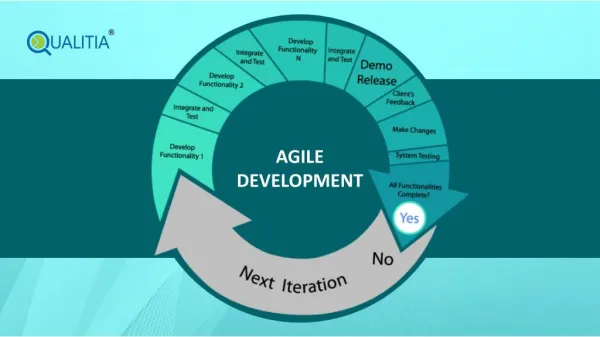
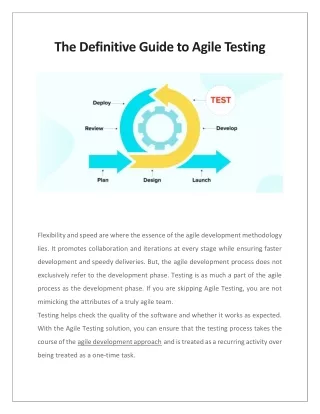
Agile Testing: A Software Testing Practice Comprehensive Guide Agile Testing is a software testing practice that follows the principles of Agile software development. Unlike traditional testing methodologies, Agile Testing is an iterative and incremental approach that integrates testing throughout the development lifecycle. This ensures that the software is continuously tested and improved, leading to high-quality deliverables. Principles of Agile Testing Agile Testing is based on the following key principles: 1. Continuous Testing: Testing is performed early and frequently to identify defects as soon as possible. 2. Collaboration: Developers, testers, and business stakeholders work together to ensure software meets user requirements. 3. Customer-Centric Approach: Testing is focused on delivering value to the end user. 4. Flexibility and Adaptability: Agile Testing adapts to changes in requirements, even late in development. 5. Test-Driven Development (TDD): Writing tests before writing code to ensure functionality meets the requirements. 6. Automated and Manual Testing: A combination of both approaches to ensure e?ciency and thorough validation. Agile Testing Lifecycle The Agile Testing lifecycle follows an iterative and incremental model and is typically divided into the following phases: 1. Test Planning: Identifying testing objectives, tools, and resources needed. 2. Test Design: Creating test cases and scenarios based on user stories. 3. Test Execution: Running tests and reporting defects in each iteration. 4. Defect Retesting & Regression Testing: Ensuring fixes do not introduce new issues. 5. Release Readiness Testing: Final validation before deployment. 6. Production Testing & Feedback: Gathering user feedback for continuous improvement. Agile Testing Methods
Several testing methods are commonly used in Agile environments: 1. Behavior-Driven Development (BDD): Focuses on collaboration between developers, testers, and business stakeholders to define test cases in a human-readable format. 2. Acceptance Test-Driven Development (ATDD): Tests are written before the development begins, ensuring that the software meets acceptance criteria. 3. Exploratory Testing: Testers explore the application dynamically, finding defects beyond scripted tests. 4. Automated Testing: Automating repetitive tests to improve e?ciency and reduce manual e?ort. 5. Regression Testing: Ensuring new changes do not break existing functionalities. Tools for Agile Testing Several tools help facilitate Agile Testing, including: ● Test Management: JIRA, TestRail, Zephyr ● Automation Testing: Selenium, Cypress, TestNG ● Performance Testing: JMeter, LoadRunner ● Continuous Integration/Continuous Deployment (CI/CD): Jenkins, GitLab CI/CD, CircleCI Challenges in Agile Testing Agile Testing comes with its set of challenges, including: ● Frequent requirement changes that impact test cases. ● Need for high collaboration between teams. ● Balancing manual and automated testing. ● Ensuring adequate test coverage within short development cycles. Best Practices for Agile Testing To successfully implement Agile Testing, consider the following best practices: ● Involve Testers from the Beginning: Ensure testers are part of requirement discussions and sprint planning. ● Adopt Test Automation: Automate repetitive test cases to save time and e?ort. ● Frequent Communication: Encourage continuous collaboration between developers, testers, and stakeholders.
● Focus on User Experience: Prioritize testing from the user's perspective to enhance satisfaction. ● Leverage CI/CD Pipelines: Integrate automated testing into CI/CD for rapid and reliable releases. Ending Thought Agile Testing is a vital aspect of Agile software development, enabling teams to deliver high-quality software faster and more e?ciently. By integrating testing throughout the development process, organizations can enhance collaboration, reduce risks, and improve overall product quality. Adopting the right tools, methodologies, and best practices can significantly enhance the e?ectiveness of Agile Testing, making it an indispensable approach in modern software development.