Multiplication Tables 1
Learning math multiplication tables 1 to 20 are necessary to solve all complex and simple mathematical problems. Here are a few tips and points to memorize the math tables by heart.

Multiplication Tables 1
E N D
Presentation Transcript
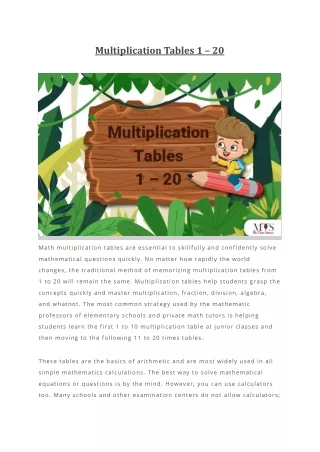
Multiplication Tables 1 – 20 Math multiplication tables are essential to skillfully and confidently solve mathematical questions quickly. No matter how rapidly the world changes, the traditional method of memorizing multiplication tables from 1 to 20 will remain the same. Multiplication tables help students grasp the concepts quickly and master multiplication, fraction, division, algebra, and whatnot. The most common strategy used by the mathematic professors of elementary schools and private math tutors is helping students learn the first 1 to 10 multiplication table at junior classes and then moving to the following 11 to 20 times tables. These tables are the basics of arithmetic and are most widely used in all simple mathematics calculations. The best way to solve mathematical equations or questions is by the mind. However, you can use calculators too. Many schools and other examination centers do not allow calculators;
that is why learning multiplication tables from 1 to 20 by heart is necessary. In today’s blog, you will discover a full 1 to 20 tables chart and tips to memorize them. Stick around and get ready to be a multiplication pro! Multiplication Tables 1 to 3 Table of 1 Table of 2 Table of 3 1 x 1 = 1 2 x 1 = 2 3 x 1 = 3 1 x 2 = 2 2 x 2 = 4 3 x 2 = 6 1 x 3 = 3 2 x 3 = 6 3 x 3 = 9 1 x 4 = 4 2 x 4 = 8 3 x 4 = 12 1 x 5 = 5 2 x 5 = 10 3 x 5 = 15 1 x 6 = 6 2 x 6 = 12 3 x 6 = 18 1 x 7 = 7 2 x 7 = 14 3 x 7 = 21 1 x 8 = 8 2 x 8 = 16 3 x 8 = 24 1 x 9 = 9 2 x 9 = 18 3 x 9 = 27 1 x 10 = 10 2 x 10 = 20 3 x 10 = 30 Multiplication Tables 4 to 6 Table of 4 Table of 5 Table of 6 4 x 1 = 4 5 x 1 = 5 6 x 1 = 6 4 x 2 = 8 5 x 2 = 10 6 x 2 = 12 4 x 3 = 12 5 x 3 = 15 6 x 3 = 18 4 x 4 = 16 5 x 4 = 20 6 x 4 = 24 4 x 5 = 20 5 x 5 = 25 6 x 5 = 30 4 x 6 = 24 5 x 6 = 30 6 x 6 = 36 4 x 7 = 28 5 x 7 = 35 6 x 7 = 42 4 x 8 = 32 5 x 8 = 40 6 x 8 = 48 4 x 9 = 36 5 x 9 = 45 6 x 9 = 54 4 x 10 = 40 5 x 10 = 50 6 x 10 = 60
Multiplication Tables 7 to 9 Table of 7 Table of 8 Table of 9 7 x 1 = 7 8 x 1 = 8 9 x 1 = 9 7 x 2 = 14 8 x 2 = 16 9 x 2 = 18 7 x 3 = 21 8 x 3 = 24 9 x 3 = 27 7 x 4 = 28 8 x 4 = 32 9 x 4 = 36 7 x 5 = 35 8 x 5 = 40 9 x 5 = 45 7 x 6 = 42 8 x 6 = 48 9 x 6 = 54 7 x 7 = 49 8 x 7 = 56 9 x 7 = 63 7 x 8 = 56 8 x 8 = 64 9 x 8 = 72 7 x 9 = 63 8 x 9 = 72 9 x 9 = 81 7 x 10 = 70 8 x 10 = 80 9 x 10 = 90 Multiplication Tables 10 to 12 Table of 10 Table of 11 Table of 12 10 x 1 = 10 11 x 1 = 11 12 x 1 = 12 10 x 2 = 20 11 x 2 = 22 12 x 2 = 24 10 x 3 = 30 11 x 3 = 33 12 x 3 = 36 10 x 4 = 40 11 x 4 = 44 12 x 4 = 48 10 x 5 = 50 11 x 5 = 55 12 x 5 = 60 10 x 6 = 60 11 x 6 = 66 12 x 6 = 72 10 x 7 = 70 11 x 7 = 77 12 x 7 = 84 10 x 8 = 80 11 x 8 = 88 12 x 8 = 96 10 x 9 = 90 11 x 9 = 99 12 x 9 = 108 10 x 10 = 100 11 x 10 = 110 12 x 10 = 120 Importance of Memorizing Multiplication Tables 1 to 20
These building blocks of arithmetic are a quick and easy way to solve any multiplication query or mathematical question. Academic institutes focus on memorizing maths multiplication tables as it lets the students use their heads to visualize answers for questions instead of rushing for alternatives. The possibilities of using multiplication tables are endless. Following are a few importance of memorizing multiplication table from 2 to 20: •They develop and polish students’ problem-solving skills. •Makes questions easy to learn and solves problems quickly. •Boost the self-confidence of students. •Recalling multiplication tables for no matter what reason improves transferable skills such as memory skills. •Sharpens mathematical and logical reasoning skills. •Solving multiplication problems improves the perception ability of a child’s brain.
•Helps break down concepts and complex problems into easy chunks. •Students do not struggle with math problems. Knowledge of basic multiplication tables helps them to avoid mistakes. •The knowledge of multiplication tables is used frequently in everyday life, whether solving exam queries, doubling recipes, buying products, or splitting bills. Multiplication Tables 13 to 15 Table of 13 Table of 14 Table of 15 13 x 1 = 13 14 x 1 = 14 15 x 1 = 15 13 x 2 = 26 14 x 2 = 28 15 x 2 = 30 13 x 3 = 39 14 x 3 = 42 15 x 3 = 45 13 x 4 = 52 14 x 4 = 56 15 x 4 = 60 13 x 5 = 65 14 x 5 = 70 15 x 5 = 75 13 x 6 = 78 14 x 6 = 84 15 x 6 = 90 13 x 7 = 91 14 x 7 = 98 15 x 7 = 105 13 x 8 = 104 14 x 8 = 112 15 x 8 = 120 13 x 9 = 117 14 x 9 = 126 15 x 9 = 135 13 x 10 = 130 14 x 10 = 140 15 x 10 = 150 Multiplication Tables 16 to 18 Table of 16 Table of 17 Table of 18 16 x 1 = 16 17 x 1 = 17 18 x 1 = 18 16 x 2 = 32 17 x 2 = 34 18 x 2 = 36 16 x 3 = 48 17 x 3 = 51 18 x 3 = 54 16 x 4 = 64 17 x 4 = 68 18 x 4 = 72 16 x 5 = 80 17 x 5 = 85 18 x 5 = 90 16 x 6 = 96 17 x 6 = 102 18 x 6 = 108 16 x 7 = 112 17 x 7 = 119 18 x 7 = 126 16 x 8 = 128 17 x 8 = 136 18 x 8 = 144
16 x 9 = 144 17 x 9 = 153 18 x 9 = 162 16 x 10 = 160 17 x 10 = 170 18 x 10 = 180 Multiplication Tables 19 and 20 Table of 19 Table of 20 19 x 1 = 19 20 x 1 = 20 19 x 2 = 38 20 x 2 = 40 19 x 3 = 57 20 x 3 = 60 19 x 4 = 76 20 x 4 = 80 19 x 5 = 95 20 x 5 = 100 19 x 6 = 114 20 x 6 = 120 19 x 7 = 133 20 x 7 = 140 19 x 8 = 152 20 x 8 = 160 19 x 9 = 181 20 x 9 = 180 19 x 10 = 190 20 x 10 = 200 Tips for Memorizing Multiplication Time Tables 1 to 20 Sometimes it’s become a daunting task for math tutors or teachers to make students memorize the maths multiplication tables 1 to 20 because learning or memorizing them demands tricks. There are certain tricks to help students learn multiplication times tables on their fingertips. Unfortunately, or surprisingly, each multiplication table requires a different strategy or trick to learn or memorize. You must find this fact confusing. So, everyone does. Don’t worry about your head. Following are a few tips to memorize multiplication times table 1 t0 20. We have enlisted the easiest tricks for you or your child; give them a try.
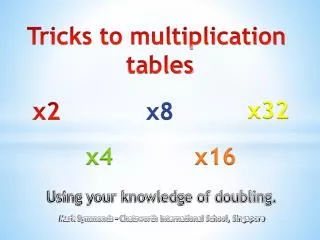
•Use your knowledge of adding numbers. For example, to memorize the table of 4, simply add the number 4 to the previous product, and it will give you the answer to the following number. This is how it works: As 4 x 2 = 8 then 4 x 3 would be 8+4=12. Hence, 4 x 3 = 13 •You can use the same addition method for all multiplication times tables. It is time-consuming and not a good practice for solving multiplication questions in a limited duration or during exams. •To memorize the table of 2, know that its number doubles when multiplied by 2 or is increased by 2 times. For example, 2 x 5 = 10 means 5 is doubled, so the result of the product of 2 with 5 is 10. Take a deeper glance over 2 times tables’ multiples to understand this trick effectively. As 2, 4, 6, 8, 10, 12, 14, 16, 18, 20.
•Some tables have a pattern, such as the multiplication table of 9 and 5. •A number gives a square when it is multiplied by itself. You can calculate the square of the number; in case you forgot the table. •The pattern of the 5 times table is that it ends with either 0 or at 5. Keep this trick in mind while writing down or memorizing the multiplication table of 5. Here are the multiples of 5: 5, 10, 15, 20, 25, 30, 35, 40, 45, 50, 55, 60, 65, 70, 75, … •Learning tables improves with practice. one must repeatedly read, write and recite multiplication tables. •The multiplication table of 9 also has a pattern, but it’s a bit unique and interesting. The multiples of the 9 times table are 09, 18, 27, 36, 45, 54, 63, 72, 81, 90. Note that the unit place digit of this table has decreasing order from 9 to 0, and the tens place numbers go in increasing order from 0 to 9. •Putting a zero next to the number multiplied by 10 makes it the multiple of 10. For example, 10 times 4 is 40. It is one of the easy tricks of memorizing 10 multiplication tables. •Multiplying the number with n gives the same answer as adding any number n times. For example, Adding 5 ten times gives 50 (5+5+5+5+5+5+5+5+5+5 = 50), Multiplying 5 by ten gives 50 (5 x 10 = 50) •The math tutors must well versed the multiplication times table in a tone that encourages students to concentrate and learn. •Whether you are a school teacher, private math tutor, or a mom, it is prescribed to make kids learn maths tables one by one, with the pattern. Ask frequent questions, go over plenty of multiplication examples or practice questions and participate in table recitation competitions.
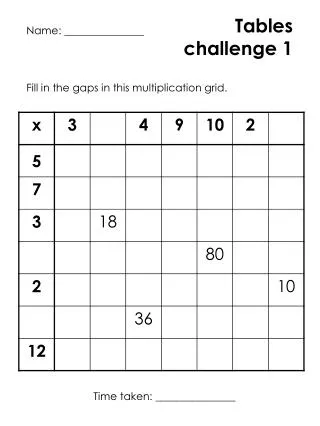
Multiplication Tables Charts Multiplication Chart 1 to 5 x 1 2 3 4 5 6 7 8 9 10 1 1 2 3 4 5 6 7 8 9 10 2 2 4 6 8 10 12 14 16 18 20 3 3 6 9 12 15 18 21 24 27 30 4 4 8 12 16 20 24 28 32 36 40 5 5 10 15 20 25 30 35 40 45 50 Multiplication Chart 6 to 10 x 1 2 3 4 5 6 7 8 9 10 6 6 12 18 24 30 36 42 48 54 60 7 7 14 21 28 35 42 49 56 63 70 8 8 16 24 32 40 48 56 64 72 80 9 9 18 27 36 45 54 63 72 81 90 10 10 20 30 40 50 60 70 80 90 100 Multiplication Chart 11 to 15 x 1 2 3 4 5 6 7 8 9 10 11 11 22 33 44 55 66 77 88 99 110 12 12 24 36 48 60 72 84 96 108 120 13 13 26 39 52 65 78 91 104 117 130 14 14 28 42 56 70 84 98 112 126 140 15 15 30 45 60 75 90 105 120 135 150 Multiplication Chart 16 to 20 x 1 2 3 4 5 6 7 8 9 10 16 16 32 48 64 80 96 112 128 144 160 17 17 34 51 68 85 102 119 136 153 170
18 18 36 54 72 90 108 126 144 162 180 19 19 38 57 76 95 114 133 152 171 190 20 20 40 60 80 100 120 140 160 180 200 Games to Learn Multiplication Tables 1 to 20 All multiplication tables are fundamental like, tables from 1 to 10 helps to solve simple arithmetic operations whereas, tables from 11 to 20 helps in calculating complex problems. If you find traditional methods of learning hard, then we would suggest you try learning tables through a practical approach; fun and exciting games: •Multiplication Cards •Tap the Number Game •Competition Questions •Race to Answer
•M&M Fun Conclusion People good with basic multiplication tables 2 to 20 end up loving math. With our online and private math tutor, you can learn easy and fun methods to study math, memorize all the multiplication tables by heart, familiarize your skills, build a strong foundation of all mathematical concepts, feel confident, and bring better results.