Download
1 / 13
130 likes | 146 Views
Are you taking your IELTS speaking test anytime soon? Learn about the common phrases for different situations with us. Visit ebritishielts.com now!

E N D
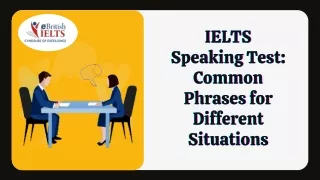
IELTS IELTS IELTS Speaking Test: Speaking Test: Speaking Test: Common Common Common Phrases for Phrases for Phrases for Different Different Different Situations Situations Situations
If you want to fulfill your international work or study dreams, IELTS is a necessary criterion for you. The IELTS test mainly consists of four modules – Reading, Writing, Listening and Speaking. Out of all these, candidates mostly struggle in the last one. The main reason for this may be the fact that you have to carry out a face-to-face conversation here. Therefore, to ace the IELTS Speaking test, you need to ensure that you have an adequate vocabulary, and know the right phrases that you can use to explain yourself during your test. Thus, throughout your IELTS test preparation, make sure that you learn all of this.
Here are some interview phrases that you must know for getting that perfect score in your IELTS Speaking test.
Phrase 1: How are you? As a kid, your answer to this question would definitely have been – I'm fine, thank you. And you? However, this may sound too robotic to native speakers. Think of it as how a foreigner would speak your language in a pure form. I'm sure you get it now. Therefore, instead of using "How are you?" use the following: What have you been up to? What did you get up to? Or, you can simply use: What's new? What's up?
Phrase 2: I'm fine, thank you. And you? Now, as earlier mentioned, this would be the answerer that you would have been taught for "How are you?" – while this response is technically correct for your IELTS speaking test, it is a bit generic. Therefore, instead of it, you can go for: Great! Awesome! Excellent! Pretty good. You can use these when your entire day has been fantastic, and you may want to share something about it. For a little neutral answer, you can say Same as always. Can't complain.
Phrase 3: Thank you. This phrase is quite common in the English language. Here are some other substitutions that you can use for it to improve your English skills: Thanks. I appreciate it. I owe you one. This last one shows the person that you are ready to return the favor since they helped you out.
Phrase 4: You're Welcome. When someone thanks you, the use of this phrase as a response is common. You can also use the following to say it: Don't mention it. My pleasure. No problem. No worries.
You say this when you are not sure about something that the other person is asking. So, when the examiner asks you something similar in your IELTS Speaking test, you can use the following: Phrase 5: I don't know. I am not sure. I have no idea. Beats me!
Phrase 6: I agree. Again, "I agree" appears a bit monotonous. Some natural phrases that you can use in its place are: Exactly. That's so true. Absolutely. That's for sure. I couldn't agree more. I agree 100%. These show that you are on the same page as the speaker.
Phrase 7: I disagree. Phrase 8: I'm tired. While explaining how tired you are, it is okay to be a bit dramatic. If you just say 'I'm tired,' it may sound a bit basic. Therefore, you can use the following: Now when "I agree" appears a bit mechanical, "I disagree" can sound a bit too strong. And the speaker may get offended. Thus, instead of saying this straight away, you can use some polite phrases. For instance: I'm dead tired. I'm exhausted. I can hardly keep my eyes open. I'm not so sure about that. Not necessarily.
Phrase 9: It's expensive/It's cheap. For this phrase, in your IELTS Speaking test, you can use the following: It costs a fortune. That's a bit pricey. That's a rip-off. These are all the phrases that are meant for "it's costly." For "it's cheap," you can say: That's quite reasonable. It's dirt cheap. That's a good deal.
Phrase 10: I'm hungry/I'm not hungry. The last phrase we will introduce to you is, "I'm hungry." Here is what you can use in its place: I'm starving. I'm famished. These show that you would like to eat soon. On the other hand, if you have eaten too much, you can say: I'm stuffed. I've had so much; I feel bloated.
Contact Us https://www.facebook.com/ ebritishielts/ https://www.ebritishielts.com/ https://www.instagram. com/ebritish_ielts/ https://twitter.com/ebritishielts/ https://in.pinterest.com/ebritishielts/ boards/ 91-8197881978, +91-8054363621