Download
1 / 31
330 likes | 1.01k Views
0. The Cycles of the Moon. The phases of the moon The tides Lunar eclipses Solar eclipses. 0. The Phases of the Moon . From Earth, we see different portions of the Moon’s surface lit by the sun , causing the phases of the Moon . 0. The Phases of the Moon. 27.32 days.

E N D
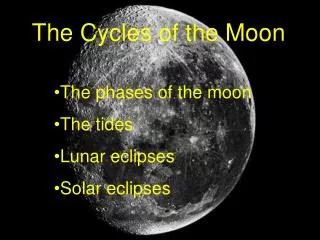
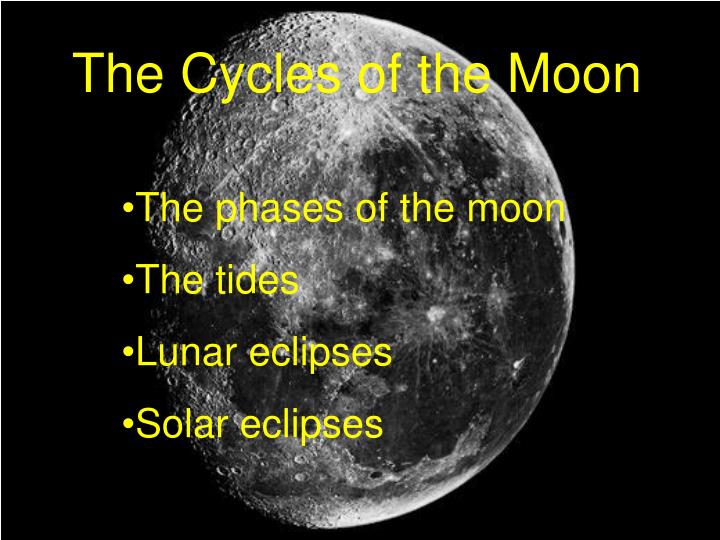
0 The Cycles of the Moon • The phases of the moon • The tides • Lunar eclipses • Solar eclipses
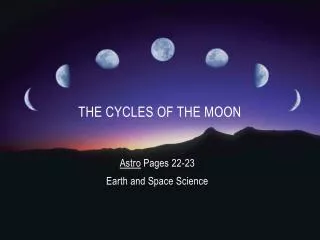
0 The Phases of the Moon From Earth, we see different portions of the Moon’s surface lit by the sun, causing the phases of the Moon.
0 The Phases of the Moon 27.32 days • The Moon orbits Earth in a sidereal period of 27.32 days. Moon Earth Fixed direction in space
Is the moon going to show the same lunar phase after one sidereal period? • Yes. • No, it will not have completed a full cycle of phases. • No, it will have completed more than a full cycle of phases.
0 The Phases of the Moon Fixed direction in space 29.53 days Earth Moon Earth orbits around Sun => Direction toward Sun changes! • The moon’s synodic period (to reach the same position relative to the sun) is 29.53 days (~ 1 month).
The moon orbits counterclockwise around Earth (viewed from the North). => It appears to move eastward against the background of the stars. => The waxing crescent is visible • in the morning sky. • in the evening sky. • the whole night, from sunset to sunrise. • only around midnight. • never.
0 The Phases of the Moon New Moon → First Quarter → Full Moon Evening Sky
0 The Phases of the Moon Full Moon → Third Quarter → New Moon Morning Sky Waning
0 The Tides • The tides are caused by thedifferenceof the Moon’s gravitational attraction on the water on Earth • Between thenear side and the center of the Earth • Between the center and the far side of the Earth • → 2 tidal maxima • → 12-hour cycle
On the day of full moon, high tides occur … • around noon and 6 p.m. • around noon and midnight. • around 6 a.m. and 6 p.m. • around 6 p.m. and midnight. • Impossible to tell. The times of tides are not correlated with the phases of the moon.
0 Spring and Neap Tides • The Sunis also producing tidal effects, about half as strong as the Moon. • NearFull and New Moon, those two effects add up to causespring tides • Near first and third quarter, the two effects work at a right angle w.r.t. each other, causingneap tides. Spring tides Neap tides
0 The Tidally Locked Orbit of the Moon The Earth also exerts tidal forces on the Moon’s rocky interior. → It is rotating with the same period around its axis as it is orbiting Earth (tidally locked). → We always see the same side of the moon facing Earth.
A total lunar eclipse … • is a high-performance moon vehicle built by Mitsubishi. • occurs when the moon disappears behind the sun. • occurs when the moon becomes invisible because it is too close to the sun. • occurs when the moon moves through Earth’s shadow. • occurs when the moon disappears behind Mars.
0 Lunar Eclipses The Earth’s shadow consists of a zone offull shadow,the Umbra,and a zone ofpartial shadow,the Penumbra. If the Moon passes through theUmbra, we see alunar eclipse. If the entire surface of the Moon enters the Umbra, the lunar eclipse is total.
0 A Total Lunar Eclipse (I)
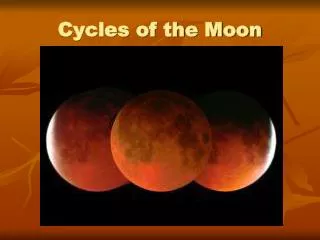
0 A Total Lunar Eclipse (II) A total lunar eclipse can last up to1 hour and 40 min. During a total eclipse, the moon has afaint, red glow,reflectingsun light scattered in the Earth’s atmosphere.
0 Typically, 1 or 2 lunar eclipses per year.
0 Solar Eclipses The Sun has approx. the sameangular diameter of ~ 0.50as the Moon. Thus, when the Moon passes in front of the Sun, it can cover it completely, causing a totalsolar eclipse.
Total Solar Eclipse 0 Chromosphere and Corona Prominences
0 Diamond Ring Effect
If the sun and the moon have the same angular diameter on the sky, does that mean that the sun and the moon actually have about the same size? • Yes. • No because the sun is much farther away, but also much larger than the moon. • No, because the sun is much farther away, but also much smaller than the moon. • No because the moon is much farther away, but also much larger than the sun. • No, because the moon is much farther away, but also much smaller than the sun.
0 Earth’s and Moon’s orbits are slightly elliptical: Apogee = position furthest away from Earth Earth Perihelion = position closest to the sun Moon Perigee = position closest to Earth Sun Aphelion = position furthest away from the sun (Eccentricities greatly exaggerated!)
What do you expect to see if at the time of asolar eclipsethe moon is nearapogee,and the Earth is nearperihelion? • A regular total solar eclipse. • No solar eclipse at all. • A partial solar eclipse with a crescent appearance. • A partial solar eclipse with a ring-like appearance of un-occulted parts of the sun. • A lunar eclipse.
0 Annular Solar Eclipses The angular sizes of the Moon and the Sun vary, depending on their distance from Earth. Perigee Apogee Aphelion Perihelion When the Earth is near perihelion, and the Moon is near apogee, we see an annular solar eclipse.
0 Almost total, annular eclipse of May 30, 1984
If the moon was orbiting around the Earth exactly in the plane of the ecliptic, … • lunar and solar eclipses would occur once every day. • lunar and solar eclipses would occur once a week. • lunar and solar eclipses would occur once a month. • lunar and solar eclipses would occur once a year. • lunar and solar eclipses would never occur.
0 Conditions for Eclipses (I) The Moon’s orbit is inclined against the ecliptic by ~ 50. A solar eclipse can only occur if the Moon passes a node near New Moon. A lunar eclipse can only occur if the Moon passes a node near Full Moon.
0 Conditions for Eclipses (II) Eclipses occur in a cyclic pattern. → Saros cycle: 18 years, 11 days, 8 hours
0 Approximately 1 total solar eclipse per year