Download
1 / 13
200 likes | 3.29k Views
Federal and Unitary Systems of Government. A2 Comparative Government and Politics Taylor Carey. Aims. To COMPARE and CONTRAST federal and unitary systems of government in CONSTITUTIONAL TERMS To assess the strengths and weaknesses of Federalism and Nationalism

E N D
Federal and Unitary Systems of Government A2 Comparative Government and Politics Taylor Carey
Aims • To COMPARE and CONTRAST federal and unitary systems of government in CONSTITUTIONAL TERMS • To assess the strengths and weaknesses of Federalism and Nationalism • To COMPARE and CONTRAST systems of government in the USA and the UK
Introduction • Constitution Lecture • http://www.youtube.com/watch?v=zMc6_EDwW7E
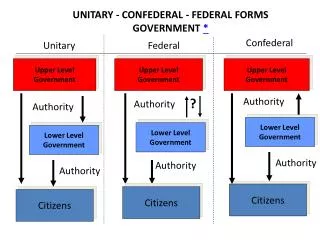
Federal and unitary systems KEY DEFINITIONS • FEDERALISM: the theory of government by which political power is divided between a national government and state governments, each having their own area of substantive jurisdiction. Key principles include DECENTRALISATION, wherein governmental and political power is vested not only in the federal government, but also in the state government.
Federal and unitary systems • NATIONALISM (UNITARY GOVERNMENT): the theory of government wherein power is reserved for central government. Although certain powers may be devolved, central government remains more powerful.
Constitutional significance • FEDERAL GOVERNMENT: • The constitution divides powers between state and national government. • Enumerated powers of states/federal government (Amendment X, 1791) • The constitution specifies the limits of these powers • This establishes a federal/state relationship
Constitutional significance • FEDERAL/STATE RELATIONSHIP • This is a dynamic relationship, relying on political context and contributing factors: • Historical events: westward expansion, population growth, industrialisation, improvements in communication, the Great Depression. Foreign policy events (e.g. WWII) • Supreme court interpretation (1937-1980 strengthening of federal power) • Constitutional amendments (e.g. XIVth amendment, XVIth amendment) • US has gone through different phases of federalism (Dual, Cooperative and New)
Constitutional significance • UNITARY GOVERNMENT: • The constitution vests ultimate power in central government (though devolution can occur, e.g. UK, devolved branches of government). • UK does not have a written constitution – does this strengthen the power of the national government?
Comparison: Federal and Unitary systems • A comparison of the US and UK constitutions...
Pros and cons • FEDERALISM
Pros and cons • Nationalism