Download
1 / 29
290 likes | 906 Views
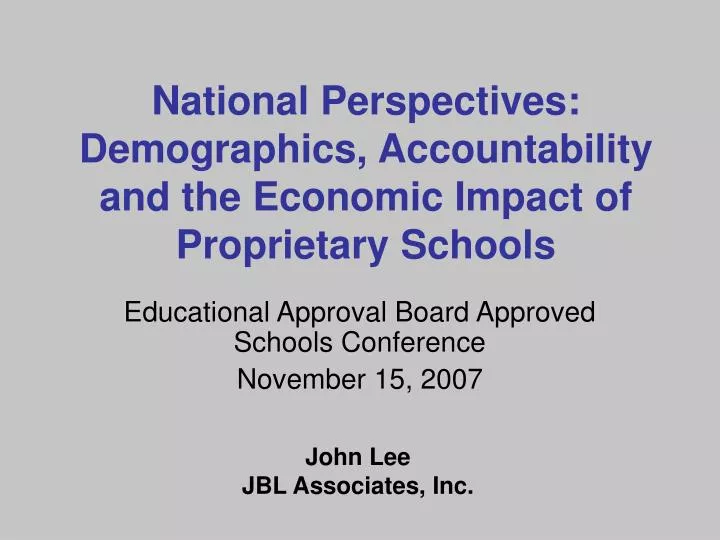
National Perspectives: Demographics, Accountability and the Economic Impact of Proprietary Schools. Educational Approval Board Approved Schools Conference November 15, 2007. John Lee JBL Associates, Inc. Proprietary School Accountability. Consideration of student academic achievement

E N D
National Perspectives: Demographics, Accountability and the Economic Impact of Proprietary Schools Educational Approval Board Approved Schools Conference November 15, 2007 John LeeJBL Associates, Inc.
Proprietary School Accountability JBL Associates
Consideration of student academic achievement Retention rates Course and program completion Passing state licensing examinations Job placement rates H.R. 3746, the “College Access and Opportunity Act of 2007 JBL Associates
First Morrill Act authorized public land grants to the states for the establishment and maintenance of agricultural and mechanical colleges, 1852 Smith-Hughes Act provided for grants to states for support of vocational education 1917 Changing Missions JBL Associates
Veterans made up 49 percent of U.S. college enrollment in 1947 7.8 million veterans trained at colleges, trade schools and in business and agriculture training programs. 1952 veterans of the Korean War 1966 veterans of the Vietnam War ended in 1989 Servicemen's Readjustment Act 1944 JBL Associates
The Higher Education Act of 1965 and the National Vocational Student Loan Insurance Act 1972 Amendments to the Higher Education Act Pell Grant Recognition of proprietary schools as equal partners Higher Education Act JBL Associates
AICS (Association of Independent Colleges and Schools) 1912 NACCAS (the National Accrediting Commission of Cosmetology Arts and Sciences) 1924 NATTS (the National Association of Trade and Technical Schools) 1965 Major Associations JBL Associates
Elimination of eligibility to participate in federal student loan programs for any college with a default rate of 25% or more for three consecutive years (or 40% or more in a single year) Higher Education Amendments, 1992 JBL Associates
The 90/10 (formerly 85/15) Rule: federal financial assistance is limited to no more than 90 percent. Limits on Student Aid for Schools that Offer Predominantly Correspondence and Telecommunications Courses Minimum Instructional Time Requirements Minimum Completion and Job Placement Rate Requirements Prohibit commissions, bonuses, and other incentive payments to school employees and recruiters Limited Loan Forgiveness for Victims of Fraud Higher Education Amendments, 1992 JBL Associates
Economic Impact of Proprietary Schools JBL Associates
30 years ago, 28% of the workers between the ages of 30 and 59 had at least some postsecondary education Today, more than 60% of the age group have some education beyond high school The Knowledge Economy JBL Associates
Manufacturing jobs have dropped from 32% of all jobs in 1959 to 17% today Big increases in: office jobs—30% to 39% health care—10% to 16% technical jobs—3.5% to 7% Low skilled service jobs—20% to 20% Changing Job Market JBL Associates
Proprietary School’s Contribution JBL Associates
The BLS projects a 14 percent increase in job opportunities requiring a vocational certificate from 2004 through 2014, a 19 percent increase in jobs requiring an associate’s degree over the same period of time Growth in Demand JBL Associates
Health Services/Allied Health/Health Sciences Personal and Culinary Services Business, Management, Marketing & Related Support Services Computer and Information Sciences Most Commonly Pursued Occupations for Career College Graduates JBL Associates
Degrees Awarded JBL Associates
The lifetime earnings for associate’s degree holders total $1.6 million, or $337,127 higher than that of high school graduates The average career college graduate paid an estimated $4,363 in federal taxes Proprietary School Graduates Receive Higher Salaries JBL Associates
Proprietary schools include 2,694 Title IV eligible institutions 39 percent of all Title IV postsecondary institutions in the nation Serving over 2.1 million students annually Enrollment increased by 17 percent since 2003-2004 Proprietary Schools are Growing JBL Associates
Career colleges reported total revenues of approximately $14.6 billion last year Of nearly 500,000 career college completions in 2005, 76%(376,560) are employed directly following graduation The average income earned by career college graduates is $39,546 Economic Impact JBL Associates
Demographics JBL Associates
6 % for White, non-Hispanic; 27 % for Black, non-Hispanic; 42 % for Hispanic; 28 % for Asian or Pacific Islanders; 30 % for American Indian or Alaska Native 34 % for nonresident aliens Projected Enrollment Increase 2004 to 2014 JBL Associates
Proprietary Schools Enroll and Graduate Minority Students JBL Associates
We must increase educational achievement if we are to remain competitive in the world economy That is going to be made difficult given that the generation entering postsecondary age will pose greater educational challenges Implications JBL Associates
Market responsive Must provide effective education Other providers will continue to be critical Limit aggressive marketing Document job placement Transparent accounting Proprietary Schools Will be an Important Part of the Solution JBL Associates
Can we prove value added by our education? Employability is partially a function of “soft skills” Can we teach those skills? Do we add to the cultural capital of our students? We can only be accountable for what can be measured, but that may not be enough Cautions and Questions JBL Associates
Federal government State government Accrediting agencies Directly to students To Whom Should we be Accountable? JBL Associates
John LeeJBL Associates, Inc.6900 Wisconsin Ave., #606Bethesda, MD 20815301-654-5154jbl@jblassoc.com JBL Associates