Download
1 / 5
110 likes | 2.44k Views
THE SOCIAL CONSTRUCTIVIST IR THEORY. Concept and theoretical propositions Social ontology and holistic epistemology Core concepts: identities, interests and socialization. Foci: ideas and power; international socialization; and the process of social construction.

E N D
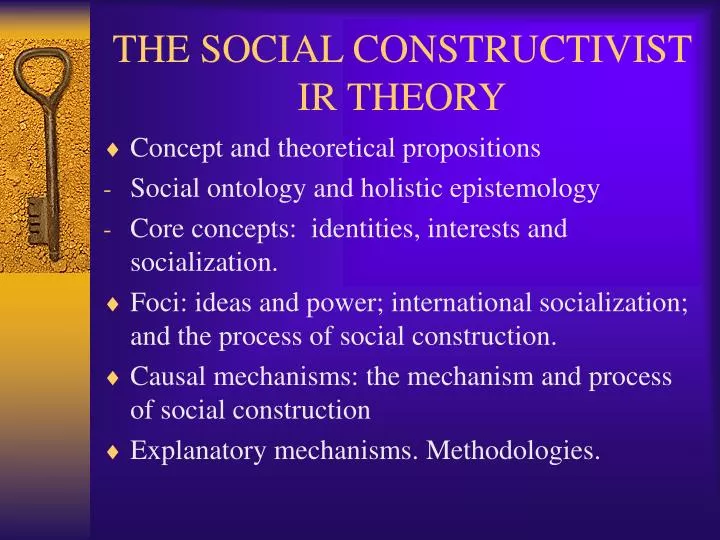
THE SOCIAL CONSTRUCTIVIST IR THEORY • Concept and theoretical propositions • Social ontology and holistic epistemology • Core concepts: identities, interests and socialization. • Foci: ideas and power; international socialization; and the process of social construction. • Causal mechanisms: the mechanism and process of social construction • Explanatory mechanisms. Methodologies.
Constructivist theoretical propositions and concepts • Theoretical propositions: • ideal (social) nature of the world system; international system and states are thought of as structures of beliefs and knowledge; • Ideational properties of the political actor are produced and reproduced in a cognitive and intersubjective process of interaction; • Core constructivist concepts • Identities: issue-specific, relatively stable understandings and expectations about self; • Interests: ideas about the means for preservation and reproduction of identity; • Socialization: a process of interaction, where political actors’ identities and interests get constructed and reconfigured.
Constructivist foci • Interplay of ideas and power: ideas although key explanatory variables, are not autonomous from power: rhetorical action; arguing and bargaining; and framing and shaming. • Global norms versus local effects: international socialization- the effect of systemic norms on domestic politics; the role of the international institutions; the role of the domestic context. • Mechanisms and processes of social construction: norm diffusion, learning, argumentation and coercion.
Mechanisms and processes of social construction- norm transfer and internalization • Norm diffusion: occurs on the public arena, politicized process • Learning: takes place within private (organizational) settings, non-political process • Argumentative mode of social construction: argumentation, persuasion, and deliberation • Coercion
Argumentative mode of socialization Socialization process Instrumental rationality Utility calculations Argumentative rationality: Deliberation Persuasion Argumentation Normative rationality Rule-governed behaviour