Download
1 / 16
160 likes | 274 Views
This article explores the optimization of SQL queries through techniques like predicate pushdown and grouping. It discusses finding the maximum age of sailors who reserved boats, leveraging filtering to reduce join sizes, and utilizing views for improved query performance. The article also delves into nested queries and the importance of efficient join orders to enhance query execution plans. By implementing transformation rules specific to grouping and aggregation operators, significant performance improvements can be achieved, especially in complex decision support applications.

E N D
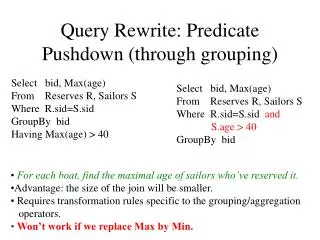
Query Rewrite: Predicate Pushdown (through grouping) Select bid, Max(age) From Reserves R, Sailors S Where R.sid=S.sid GroupBy bid Having Max(age) > 40 Select bid, Max(age) From Reserves R, Sailors S Where R.sid=S.sid and S.age > 40 GroupBy bid • For each boat, find the maximal age of sailors who’ve reserved it. • Advantage: the size of the join will be smaller. • Requires transformation rules specific to the grouping/aggregation • operators. • Won’t work if we replace Max by Min.
Example Sailors: We don’t need the tuples with age less than 40.
Query Rewrite:Pushing predicates up Sailing wizz dates: when did the youngest of each sailor level rent boats? Select sid, date From V1, V2 Where V1.rating = V2.rating and V1.age = V2.age Create View V1 AS Select rating, Min(age) From Sailors S Where S.age < 20 GroupBy rating Create View V2 AS Select sid, rating, age, date From Sailors S, Reserves R Where R.sid=S.sid Can’t push any predicates down.
Query Rewrite: Predicate Move-around Sailing wizz dates: when did the youngest of each sailor level rent boats? Select sid, date From V1, V2 Where V1.rating = V2.rating and V1.age = V2.age, age < 20 First, move predicates up the tree. Create View V1 AS Select rating, Min(age) From Sailors S Where S.age < 20 GroupBy rating Create View V2 AS Select sid, rating, age, date From Sailors S, Reserves R Where R.sid=S.sid
Query Rewrite: Predicate Move-around Sailing wizz dates: when did the youngest of each sailor level rent boats? Select sid, date From V1, V2 Where V1.rating = V2.rating and V1.age = V2.age, andV1.age < 20 First, move predicates up the tree. Then, move them down. Create View V1 AS Select rating, Min(age) From Sailors S Where S.age < 20 GroupBy rating Create View V2 AS Select sid, rating, age, date From Sailors S, Reserves R Where R.sid=S.sid, and S.age < 20.
SELECT S.sname FROM Sailors S WHERE EXISTS (SELECT * FROM Reserves R WHERE R.bid=103 AND R.sid=S.sid) Nested Queries • Nested block is optimized independently, with the outer tuple considered as providing a selection condition. • Outer block is optimized with the cost of `calling’ nested block computation taken into account. • Implicit ordering of these blocks means that some good strategies are not considered. The non-nested version of the query is typically optimized better. Nested block to optimize: SELECT * FROM Reserves R WHERE R.bid=103 AND S.sid= outer value Equivalent non-nested query: SELECT S.sname FROM Sailors S, Reserves R WHERE S.sid=R.sid AND R.bid=103
Query Rewrite Summary • The optimizer can use any semantically correct rule to transform one query to another. • Rules try to: • move constraints between blocks (because each will be optimized separately) • Unnest blocks • Especially important in decision support applications where queries are very complex.
Plans for Single-Relation Queries(Prep for Join ordering) • Task: create a query execution plan for a single Select-project-join-group-by block. • Key idea: consider each possible access path to the relevant tuples of the relation. Choose the cheapest one. • The different operations are essentially carried out together (e.g., if an index is used for a selection, projection is done for each retrieved tuple, and the resulting tuples are pipelined into the aggregate computation).
SELECT S.sid FROM Sailors S WHERE S.rating=8 Example • If we have an Index on rating: • (1/NKeys(I)) * NTuples(R) = (1/10) * 40000 tuples retrieved. • Clustered index: (1/NKeys(I)) * (NPages(I)+NPages(R)) = (1/10) * (50+500) pages are retrieved (= 55). • Unclustered index: (1/NKeys(I)) * (NPages(I)+NTuples(R)) = (1/10) * (50+40000) pages are retrieved. • If we have an index on sid: • Would have to retrieve all tuples/pages. With a clustered index, the cost is 50+500. • Doing a file scan: we retrieve all file pages (500).
D D C C D B A C B A B A Determining Join Order • In principle, we need to consider all possible join orderings: • As the number of joins increases, the number of alternative plans grows rapidly; we need to restrict the search space. • System-R: consider only left-deep join trees. • Left-deep trees allow us to generate all fully pipelined plans:Intermediate results not written to temporary files. • Not all left-deep trees are fully pipelined (e.g., SM join).
Enumeration of Left-Deep Plans • Enumerated using N passes (if N relations joined): • Pass 1: Find best 1-relation plan for each relation. • Pass 2: Find best way to join result of each 1-relation plan (as outer) to another relation. (All 2-relation plans.) • Pass N: Find best way to join result of a (N-1)-relation plan (as outer) to the N’th relation. (All N-relation plans.) • For each subset of relations, retain only: • Cheapest plan overall, plus • Cheapest plan for each interesting order of the tuples.
Enumeration of Plans (Contd.) • ORDER BY, GROUP BY, aggregates etc. handled as a final step, using either an `interestingly ordered’ plan or an additional sorting operator. • An N-1 way plan is not combined with an additional relation unless there is a join condition between them, unless all predicates in WHERE have been used up. • i.e., avoid Cartesian products if possible. • In spite of pruning plan space, this approach is still exponential in the # of tables. • If we want to consider all (bushy) trees, we need only a slight modification to the algorithm.
Sailors: B+ tree on rating Hash on sid Reserves: B+ tree on bid sname sid=sid rating > 5 bid=100 Sailors Reserves Example • Pass 1: (essentially, access-path selection) • Sailors: B+ tree matches rating>5, and is probably cheapest. However, if this selection is expected to retrieve a lot of tuples, and index is unclustered, file scan may be cheaper. • Still, B+ tree plan kept (tuples are in rating order). • Reserves: B+ tree on bid matches bid=100; cheapest. • Pass 2:We consider each plan retained from Pass 1 as the outer, and consider how to join it with the (only) other relation. • e.g., Reserves as outer: Hash index can be used to get Sailors tuples that satisfy sid = outer tuple’s sid value.
Cost Estimation • For each plan considered, must estimate cost: • Must estimate costof each operation in plan tree. • Depends on input cardinalities. • Must estimate size of result for each operation in tree! • Use information about the input relations. • For selections and joins, assume independence of predicates. • We’ll discuss the System R cost estimation approach. • Very inexact, but works ok in practice. • More sophisticated techniques known now.
Statistics and Catalogs • Need information about the relations and indexes involved. Catalogstypically contain at least: • # tuples (NTuples) and # pages (NPages) for each relation. • # distinct key values (NKeys) and NPages for each index. • Index height, low/high key values (Low/High) for each tree index. • Catalogs updated periodically. • Updating whenever data changes is too expensive; lots of approximation anyway, so slight inconsistency ok. • More detailed information (e.g., histograms of the values in some field) are sometimes stored.
Size Estimation and Reduction Factors SELECT attribute list FROM relation list WHEREterm1AND ... ANDtermk • Consider a query block: • Maximum # tuples in result is the product of the cardinalities of relations in the FROM clause. • Reduction factor (RF) associated with eachtermreflects the impact of the term in reducing result size. Resultcardinality = Max # tuples * product of all RF’s. • Implicit assumption that terms are independent! • Term col=value has RF 1/NKeys(I), given index I on col • Term col1=col2 has RF 1/MAX(NKeys(I1), NKeys(I2)) • Term col>value has RF (High(I)-value)/(High(I)-Low(I))