Download
1 / 41
700 likes | 4.01k Views
BILINGUALISM AND DIGLOSSIA IN SPAIN. Defining Individual Bilingualism. What is bilingualism? Definitions: Weinreich (1968) “The practise of alternately using two languages will be called bilingualism, and the person involved, bilingual.” Diebold (1964) “Incipient bilingualism”

E N D
Defining Individual Bilingualism • What is bilingualism? • Definitions: • Weinreich (1968) “The practise of alternately using two languages will be called bilingualism, and the person involved, bilingual.” • Diebold (1964) “Incipient bilingualism” • Bloomfield (1933) “In the cases where this perfect foreign-language learning is not accompanied by loss of the native language, it results in ‘bilingualism’, native like control of two languages.” • Mackey (1970) “It seems obvious that if we are to study the phenomenon of bilingualism we are forced to consider it as something entirely relative…We shall therefore consider bilingualism as the alternate use of two or more languages by the same individual.” • Factors to take into account (Mackey): • Degree, function, alternation, interference.
Examples 1. A 2yo who is beginning to talk, speaking English to one parent and Welsh to the other. 2. A Danish immigrant in New Zealand who has not had contact with Danish for the last 40 years. 3. A schoolchild from an Italian immigrant family in the USA who increasingly uses English both at home and outside but whose older relatives address him in Italian only. 4. A young graduate who has been studying French for eleven years. 5. A personal interpreter of an important public figure. 6. The Turkish wife of a Turkish immigrant in Germany who can converse orally in German but cannot read or write it. 7. A Japanese airline pilot who uses English for most of his professional communication. 8. A fervent Catalanist who uses Catalan at home and work, but is exposed to Spanish in the media etc and is fully conversant in both. • Bilingualism as a CONTINUUM
Describing Individual Bilingualism • AGE • Early bilingualism, late bilingualism • CONTEXT • Natural/ascribed bilingualism, achieved/secondary bilingualism • RELATIONSHIP BETWEEN SIGN AND MEANING • Coordinated bilingualism, subordinate bilingualism, compound bilingualism • ORDER AND CONSEQUENCE • Incipient and ascendant bilingualism, recessive bilingualism • COMPETENCE • Maximalist/minimalist views, semilingualism • USE/FUNCTION • ATTITUDE • Consciousness of Bilingualism
Societal Multilingualism • Historical Factors: • Military conquest, occupation, annexation • Political marriages and succession arrangements • Colonisation • Migrations and immigration • Federation • Contemporary Factors • Neo-colonialism • Present-day Immigration • Language Promotion • Internationalisation
Societal Bilingualism Cont. • Horizontal Bilingualism • Territorial monolingualism • Territorial bilingualism • Instability
Diglossia & Charles Ferguson Charles A. Ferguson (Word, 1959) – created English word ‘diglossia’ from French ‘diglossie’ (no English word before this to separate diglossia from standard bilingualism) • FERGUSON’S CHARACTERISTIC FEATURES OF DIGLOSSIA • FUNCTION: • Which language is used when • High language (‘H’) – e.g. Church sermon, political speech, news broadcast • Low language (‘L’) – e.g. conversations amongst family/friends, cartoon strip • Mixing up the uses speaker becomes object of ridicule. • PRESTIGE: • H seen as superior (more beautiful & logical) maybe as religious texts were written in it • Can lead to snobbery. Contemporary writers use words of old H to sound intellectual Diglossia – basic definition: Use of two languages/varieties of a language in one speech community but in different situations.
Acquisition: • L taught at home – mother tongue • H is taught in formal education – superposed • children can speak L better than H and write H better than L! Before standardisation at least, H has dictionaries, vocabulary guides and a set grammar; L has no unified grammar and may have lots of varieties within it • Grammar &vocabulary range of H, even after standardisation = more complex Stability of Diglossia: • With illiteracy in society, diglossia can live for centuries / forever • Widespread literacy can lead to unification of the 2 languages problem - which one to choose as base?
DIGLOSSIA: ‘a relatively stable language situation in which, in addition to the primary dialects of the language (which may include a standard or regional standards), there is a very divergent, highly codified (often grammatically more complex) superposed variety, the vehicle of a large and respected body of written literature, either of an earlier period or in another speech community, which is learned largely by formal education and is used for most written and formal spoken purposes but is not used by any sector of the community for ordinary conversation’ Charles A. Ferguson
Other Theorists’ views / Types of Diglossia Ferguson’s ideas mainly still stand some outdated and have been expanded • Joshua Fishman • biglossia – diglossia involving two completely separate languages • digraphia – H is for written use, L is for conversational use • Pauwels • interlingual diglossia - 2 different languages • intralingual diglossia - both derived from same language • diglossia as a ‘continuum’ – ranging from rigid diglossia (clearly defined codes/situations for use) to fluid diglossia (lots of overlapping of use) • Fasold • Double-nested diglossia – two Hs, one L (‘lower’ H acts as H and L) • Polyglossia – more than 2 languages • (Code-switching – 2 languages used in one situation/sentence)
Language Choice and Domains (Ferguson would argue this is ‘societal bilingualism’ and not diglossia) LANGUAGE CHOICE: • GROUP – age, religion, sex… • SITUATION – formality-informality, status equality-inequality… • ROLE RELATIONS – e.g. mother-daughter (both as speaker & listener) • TOPIC – can overrule the 3 factors above • DOMAINS: • e.g. family, playground and street, school, church, military (Schmidt-Rohr) • LANGUAGE SHIFT: • can occur with socio-political changes over time
RELATIONSHIP BETWEEN BILINGUALISM & DIGLOSSIA(Joshua Fishman) BILINGUALISM AND DIGLOSSIA: • occurs when definite roles (of prestige) are established in a society • everyone understands both (generally) DIGLOSSIA WITHOUT BILINGUALISM: • in past or in less developed countries with great social divide • each group doesn’t fully understand the other but have no need to BILINGUALISM WITHOUT DIGLOSSIA: • in societies with social unrest or change (e.g. immigrant influx in Western society during industrialization era) • taught native language for work – this used at home and their native language bought to work • ‘pidgin’ versions of both languages; inevitable language shift NEITHER BILINGUALISM NOR DIGLOSSIA: • in small, isolated communities (but rare) with no social hierarchy or immigration • still words people don’t recognize (e.g. words used by young people to old people)
Galician History • 12th – 14th century ‘Golden Years’, present in all formal domains • 16th – 18th century ‘ Dark Ages’, entirely absent from formal domains • 19th century Renaissance, won back some areas of formal use • 1983 Statute of Autonomy and Law of Linguistic Normalisation, officially present alongside Spanish in all formal domains
Galician Speakers • Highly proficient • Galician the language of preference • Only in oral communication • Written communication improving through education • Old, lower classes, rural, less educated • Negative image • Less social success
Galician Usage • Code change • Education • Professional/economic interest • Respect/courtesy • Social prestige • Informal/unofficial social contexts • Classic diglossic situation
Education, Church, Media • Education • Increased Galician language proficiency • Degalicianise Galician speakers • Though important for status and survival • Church • Prestige and influence • Mass predominantly taken in Spanish
Media • Reflect and condition sociolinguistic behaviour • State-owned TV/radio Spanish • Local TV/radio Galician • Daily press Spanish • Advertising Spanish
Conclusion • Classic example Diglossia • Legal provisions → ↑ proficiency and positive attitude • Galician still seen as the low language (L) and Spanish the high language (H) • Sociolinguistic inequality • Outlook bleak
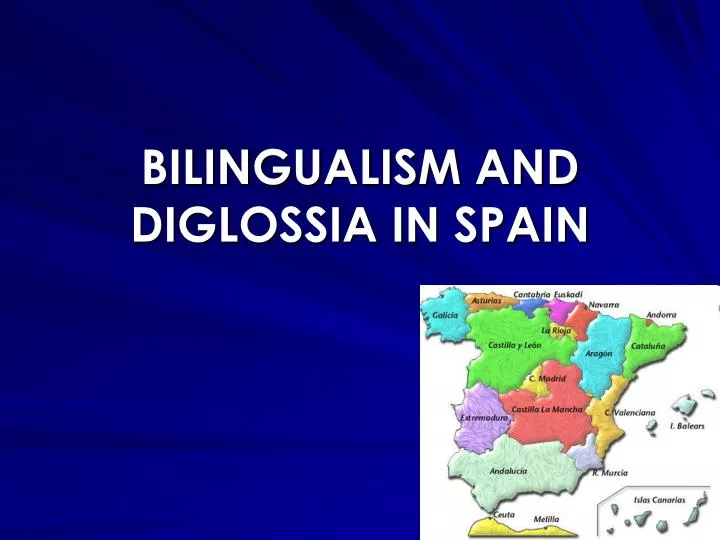
Examples of bilingualism and diglossia in the Basque Country • Euskalherria consists of three principal areas: • the Basque Autonomous Community (BAC), made up of Gipuzkoa, Araba, Bizkaia • Navarra • the three French provinces of Iparralde.
The Basque Autonomous Community Statute of Autonomy 1979 – Castilian and Basque share co-official status • High rate of bilingualism, encouraged by institutions such as the education system, • However, the majority language of the BAC is Castilian. • Basque • family and friends • predominantly oral situations, • used informally and daily • Castilian • high-status situations that required a degree of formality • e.g. academic spheres.
repression under the regime • urbanisation • immigration …mean that the diglossic situation has changed. ‘The situation in the BAC could be best described as fragmentary bilingualism with residual diglossia in the Basque speaking districts of the BAC.’
Euskaldunes: capaces de entender y hablar euskera • Cuasi-euskaldunes: Con alguna competencia activa o simplemente pasiva en euskera • Erdaldunes – Sin ninguna competencia en euskera’ • Since 1991 there has been an increase of 5.3% in the number of euskaldunes in the BAC • an increase of 25% in 1991 to 48% in 2001 of basque speakers in the age range 16 – 24
‘In times of rapid urbanisation, it was seen rather as an annoying obstacle to geographical and social mobility.’ • Suffered harsh repression under Franco’s regime • Immigration - Castilians entered the BAC in the industrial revolution • Drop in number of Basque speakers, in favour of Castilian • Basque became the language of the rural poor, came to represent ‘backwardness’ in an era of progress • Ikastolas – private schools to promote the basque language in 1960s • 1982 the Law of Normalisation of the Use of the Basque Language • Bilingualism Decree of 1983
In the BAC, there are three different models of bilingual education. Model A • the language of instruction is Castilian • Basque is taught as a second language for 3 to 5 hours a week. Model B • Basque and Castilian are both used as languages of instruction Model D • Basque is used as the language of instruction • Castilian is taught as a subject.
Evolution of the three linguistic models at pre-university level • Model A – decline in number of students • Models B and D – increase in popularity • Diglossia • In theory, Basque can be used in all levels of society. • However, in practice, the majority of all daily interactions take place in Castilian • Many don’t use Basque, even if they have the capability to.
‘…the linguistic behaviour of Basque speakers has changed: they now use their own language in more diverse social contexts than ever before. This, together with the language promotion efforts made by many different institutions, has contributed to an improvement in the perceived social status of Basque.’
Catalonia • Population: 6,343,110 • GDP :196,546€million (18.7% of total Spanish GDP) • Officially Bilingual – • Catalan is the official language of Catalonia, together with Castilian, the official language of the Spanish State. All persons have the right to use the two official languages and citizens of Catalonia have the right and the duty to know them.
Diglossia in Catalonia • Historically • Industrialisation • Franco Dictatorship • Current situation : “the diglossic situation that was, in the past, attributed to Catalonia, has ceased to exist” • Biglossia as opposed to Diglossia
Catalan or not Catalan? – That is the Question! • In-group/ intergroup interaction • It is proper to Speak Catalan only to those who are know to be Catalan • Location • Apperence • Accent
Bilingualism in catalonia • Involuntary Bilingualism • Prefer to use their own language but can speak Castilian • Natural Bilingualism • Achieved / Secondary Bilingualism • Passive bilingualism
Conclusions • Catalonia is a bilingual region – re-enforced by the state (language planning) • Probably more appropriate to talk about biglossia or interlingual diglossia • Natural, achieved/secondary, passive and involuntary bilingualism. • Catalan is a language of prestige and is promoted as such by the Catalan people. • Standardised form of Catalan – Some slight regional variation but there is a standard form which also prevents diglossia.
Bilingualism • Individual • Societal • There is no single definition but instead a scale of different interpretations of what constitutes bilingualism
Diglossia • Two languages co existing within a society with completely separate functions • Different statuses for the two languages
Spanish Examples • Only truly a state of diglossia in Galicia • Less distinction between Castilian and the minority language in Catalonia and the Basque Country • Galicia – the language with the least prestige. Perhaps why it is in the most danger?
Bibliography • Hoffman, C. (1991) An Introduction to Bilingualism (Longman : New York) • Romaine, S. (1995) Bilingualism Second Edition (Blackwell Publishing : Oxford) • Wei, L. (2000) The Bilingualism Reader (Routledge : London) • Hudson, A. (2002) Outline of a Theory of Diglossia in International Journal of the Sociology of Language – www.international .ucla.edu • Pradilla, M. (2001) The Catalan-speaking Communities in Mulitilinguaism in Spain ed. Turell, M (Multilingual Matters: Clevedon) • Woolard, K. (1989) Double Talk: Bilingualism and the Politics of Ethnicity in Catalonia (Stanford University Press : Stanford) • Beswick, J (2007) Regional Nationalism In Spain: Language Use and Ethnic Identity in Galicia (Multilingual Matters : Clevedon) • 2001 Spanish Census www.ine.es • Lasangabaster, D. and Huguet, A. (2007) Multilingualism in European Bilingual Contexts – Language Use and Attitudes (Multilingual Matters : Clevedon) • Wright, S. (1996) Monolingualism and Bilingualism – Lessons from Canada and Spain (Multilingual Matters : Clevedon) • www.eustat.es • Etxebarria, M El Bilinguismo En El Estado Español (Bilbao) • Skutnabb-Kangas, T (1981) Bilingualism or not: The Education of Minorities (Multilingual Matters: Clevedon)