Download
1 / 25
250 likes | 377 Views
This chapter introduces computer programs as sets of instructions executed by programmers to solve problems. It covers the essential concepts of program development, including algorithms and flowcharts as foundational tools for creating problem-solving logic. The evolution of programming languages from low-level machine languages to user-friendly high-level languages is discussed, highlighting key examples like FORTRAN, C++, and Python. Understanding these languages and their development stages is crucial for aspiring programmers and helps demystify the programming process.

E N D
Chapter 4 computer Programs and Languages
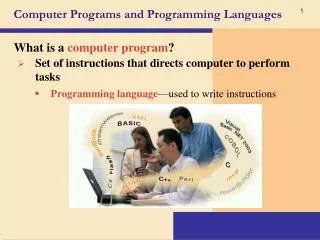
Developing a computer program • Programs are a set (series) of instructions • Programmers determine • The instructions to be performed. • The order in which those instructions are to be performed. • The data required to perform those instructions.
Algorithms • The most basic tools that are used to develop the problem-solving logic • steps are unambiguous • a finite number of steps • that repeat (iterate) • require decisions (logic and comparison) until the task is completed • Different algorithms may accomplish the same task, with a different set of instructions, in more or less the same time, space, and efforts.
Flowcharts • A pictorial representation of an algorithm • steps in the form of different shapes of boxes • logical flow (sequence) by interconnecting arrows • help the programmer in understanding the logic of the program • Flowcharts outline the general procedure • Comparable to blueprint of a building • draws a flowchart prior to writing a program • standard flowchart symbols prescribed by the American National Standard Institute (ANSI).
2 x 200 • 200 • 200
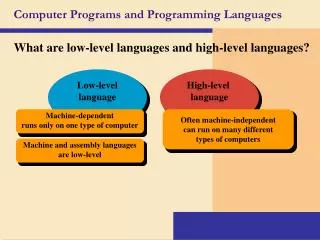
Computer languages • Natural languages are ambiguous, vaguely structured (vs. well defined), and has very large and ever changing (vs. well defined and a stable set) vocabularies • Machine language (Low level ) • Difficult to understand • Assembly language (Low level ) • Symbolic instructions of executable machine codes • High level language • Some rules similar to spoken
Evolution • Programming languages have evolved tremendously • hundreds of different languages • user-friendly and more powerful • five generations • First Generation: Machine/Native Language • Binary- every instruction and data using 0/1 • Instruction consists of two parts • Operation & Operand- where to find or store the data (operation) • Fast and efficient, executed directly on the CPU • Difficult for humans to read, write, and debug
Evolution … • Second generation- Assembly Language • programs can be written symbolically, using English words (also known as mnemonics) Assembler?
Evolution … • Third Generation • High level, general-purpose • FORTRAN, LISP, COBOL, ALGOL • Ada, Basic, C, C++, Java, Pascal, Smalltalk • Easier for humans to read, write, debug • Compiler translates into machine code before running • Interpreter translates into machine code at runtime
Evolution … • Fourth Generation • Specification languages, query languages, report generators, application generators • Maple, Mathematica, Postscript, SPSS, SQL • Fifth Generation • Solve problems using constraints rather than algorithms, used in Artificial Intelligence • Prolog
Assignments IOA, IA, GA, Case !@#$
A family tree of languages Fortran LISP Cobol Algol 60 BASIC PL/1 Simula ML Algol 68 C Scheme Pascal Smalltalk Dylan Ada Prolog Perl C++ Modula 3 Java Python Ruby C#
BASIC (1964) • Developed at Dartmouth in 1960’s by Tom Kurtz, John Kemeny, and a succession of undergraduates; first ran in 1964. • Beginner’s All-purpose Symbolic Instructional Code • Intended to introduce students in non-scientific disciplines to computing. • Influenced by FORTRAN and ALGOL. • Major goal to simplify user interface: • Simplicity chosen over efficiency • Time sharing over punched cards • Distinctions such as intvs real eliminated • Automatic defaults for declarations, values, arrays, output format, etc. • Clear error messages • Students had access to computers at all times • No universal BASIC standard: • ANSI (American National Standards Institute) is a minimal standard. • True Basic – Kemeny’s company