Download
1 / 54
740 likes | 3.82k Views
Joints Bone Connections. Chapter 9. Overview. Classifications of Joints Fibrous Joints Cartilaginous Joints Synovial Joints Movements at Synovial Joints Specific Body Joints Joint Disorders. Classifications of Joints. Articulations (joints) are the unions between bones

E N D
Joints Bone Connections Chapter 9
Overview • Classifications of Joints • Fibrous Joints • Cartilaginous Joints • Synovial Joints • Movements at Synovial Joints • Specific Body Joints • Joint Disorders
Classifications of Joints • Articulations (joints) are the unions between bones • they hold bones together and allow some flexibility to the skeletal system • Arthrology is the study of joints, whereas • kinesiology is the study of human motion – the interactions of the bones, joints and muscles
Classifications of Joints • Joints may be classified either structurally or functionally • Functional classification focuses on the amount of movement allowed at the joint. • Synarthroses are immovable joints (e.g.: most fibrous joints) • Amphiarthroses are slightly movable joints (e.g.: most cartilagenous joints) • Diarthroses are freely moving joints (e.g.: all synovial joints) • Structural classification is based on whether there is connective tissue fiber, cartilage, or a joint cavity between the articulating bones; include fibrous, cartilaginous, and synovial joints
Fibrous Joints • Fibrous CT holds the articulating bones together; joints lack cavities. Three types of these joints include: • Sutures - synarthrotic joints found only in the skull; dense regular CT binds the articulating bones. • Syndesmoses - joints held together by collagenous fibers or sheets of fibrous tissue called interosseous ligaments (e.g.: bet. distal tibia & fibula); may allow slight movement but are synarthrotic • Gomphosis (dentoalveolar joint) - where a tooth root attaches to the periodontal ligament of the dental alveolus (tooth socket) in the jaw
Fibrous Joints Fig. 9.1 Fibrous joints a) sutures of the skull are fibrous joints with very short connecting fibers b) In a syndesmosis, the fibrous tissue (ligament) is longer than that in sutures
Fibrous Joint - Gomphosis Fig. 9.1 c) A gomphosis is formed by the periodontal ligament that holds a tooth in a socket
Cartilaginous Joints • Cartilaginous Joints - allow limited movement in response to twisting or compression • Two types are: - Symphyses - adjoining bones are interconnected by a disk of fibrocartilage (e.g.: pubic symphysis and intervertebral joints) - Synchondroses - cartilaginous joints with hyaline cartilage between the articulating bones (e.g.: epiphyseal plate and costochondral articulations bet. ribs & sternum)
Cartilaginous Joints - Synchondroses Fig. 9.2 Cartilaginous joints a) The epiphyseal plate in a growing long bone in a synchondrosis (hyaline cartilage joint) b) Another synchondrosis in the joint between rib 1 and the manubrium of the sternum
Cartilaginous Joint - Symphysis Fig. 9.2 c) The intervertebral discs are symphyses (fibrocartilage joints)
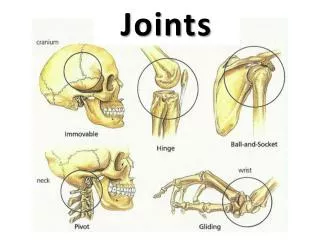
Synovial Joints • Synovial Joints - freely movable (diarthrotic) joints enclosed by joint capsules containing synovial fluid • The most common body joints, they are categorized by the type of movement they permit –gliding, hinge, pivot, condyloid, saddle, ball & socket • A synovial joint’s range of motion is determined by 3 factors: • Structure of the articulating bones • Strength of the joint capsule and associated ligaments & tendons • Size, arrangement, and action of muscles around the joint
Synovial Joints Synovial Joint Structure • Joint surfaces are enclosed by a 2-layered articular capsule (sleeve of fibrous CT), creating a joint (synovial) cavity • The outer layer is a fibrous capsule of dense irregular CT, continuous with the bone periosteum • The interior of the capsule is lined with a synovial membrane ofloose CT, which produces a lubricating fluid that reduces friction • Articulating surfaces of the bones are covered with articularcartilage • The articular capsule is usually reinforced with ligaments and may contain bursae and tendon sheaths (fluid-filled sacs that reduce friction between muscles or where tendons cross the bone) • Fibrocartilage pads (articular discs) may be present within the capsule (e.g., knee menisci) • Each synovial joint is served by major nerves & BVs
Synovial Joint Structure • Fig. 9.3 General structure of synovial joints. A) A typical synovial joint between the ends of 2 bones • b) Frontal section through the shoulder joint
Bursae & Tendon Sheaths Fig. 9.4 Bursae and tendon sheaths. Both these structures, which are filled with synovial fluid, are friction-reducing devices. a) Frontal section through the right shoulder joint. b) Enlargement showing how a bursa eliminates friction where a ligament would rub against a bone
Synovial Joints • Plane (gliding) - articular surfaces are flat or slightly curved, allowing sliding movements in one or two planes • (e.g.: intercarpal & intertarsal joints) • Hinge - rounded process of one bone fits into the concave surface of another to allow movement in one plane (monaxial), usually flexion and extension • (e.g.: elbow & phalanges) Fig. 9.7 Synovial joints, classified by the shape of their articular surfaces. a) Plane joint b) Hinge joint
Synovial Joints • Pivot - rounded or conical surface on one bone articulates with a depression in another bone; permits rotation about a central axis • (e.g.: atlas & axis joint, proximal joint of ulna and radius) • Condyloid - oval convex of one bone fits into a concave depression of another bone; permits angular movement in two directions (biaxial) • (e.g.: wrist joint and metacarpophalangeal = knuckles) Fig. 9.7 Synovial joints continued c) Pivot joint d) Condyloid joint
Synovial Joints • Saddle (modified condyloid) - articulating surfaces are saddle shaped: one bone has a concave surface, the other a convex surface; allows biaxial movement • (e.g.: carpometacarpal joint of the thumb) • Ball & Socket - ball shaped head of one bone fits into a cuplike depression of another; allows movement in all directions and pivotal rotation (multiaxial) • (e.g.: hip & shoulder joints)
Movements at Synovial Joints Every muscle is attached to bone (or other CT structures) at two points: • The origin is the stationary, immovable, or less movable attachment (usually proximal) • The insertion is the more movable attachment (usually distal)
Movements at Synovial Joints • Body movement occurs when muscles contract across diarthrotic synovial joints. Common body movements include: • Angular movements - increase or decrease the joint angle produced by articulating bones • Flexion - decreases the joint angle on an anteroposterior plane; this is typical of hinge joints (e.g.: bending the knee or elbow). • Dorsiflexion occurs as the top surface of the foot is elevated • Plantar flexion occurs as the foot is pointed downward • Extension - increases the joint angle and the distance between two bones or parts of the body (e.g.: straightening the elbow or knee). • If the extension is greater than 180, it is called hyperextension
Movements at Synovial Joints Angular Movements (con’t) • Abduction - movement of a limb away from the body’s midline in a lateral direction • Adduction - movement of a limb toward the body’s midline (the opposite of abduction)
Movements at Synovial Joints • Circular Movements - a bone with a rounded or oval surface articulates with a depression on another bone • Rotation - bone movement around its longitudinal axis, without lateral or medial displacement; common in ball & socket joints and rotation of atlas around the axis dens • Supination - movement of the palm from a posterior (or facing down) to an anterior (or facing up) position • Pronation - opposite of supination
Movements at Synovial Joints • Circumduction - circular movement of a body part in a cone shape • combines flexion, extension, abduction, & adduction • common in ball & socket joints Table 9.3 Movements of Synovial Joints (p.213-215)
Movements at Synovial Joints Special movements • Inversion - movement of the sole of the foot inward (medially) • Eversion - opposite of inversion; movement of the sole of the foot outward (laterally) • Protraction - movement of part of the body forward (e.g.: jutting out the jaw) • Retraction - pulling back the protracted part • Elevation - raises a body part (e.g.: shrugging the shoulders) • Depression - opposite of elevation
Specific Joints of the Body • Temporomandibular joint - formed by the mandibular condyle and the mandibular fossa & articular tubercle of the temporal bone • This joint is a combination hinge and gliding joint; movements include: • depression and elevation of the mandible as a hinge joint • protraction and retraction as a gliding joint • lateral rotary movements • Three ligaments support and reinforce the TM joint • An articular disk separates the joint cavity into superior and inferior compartments • Temporomandibular joint (TMJ) syndrome is a misalignment of one or both TM joints. Symptoms range from moderate facial pain to intense pain in the head, neck, shoulders, or back
Temporomandibular Joint Fig. 9.16 a) Location of the joint in the skull b) Enlargement of a sagittal section through the joint
Shoulder Joint • Glenohumeral (shoulder) joint - formed by the head of the humerus and scapular glenoid fossa • This is a ball & socket joint and the most movable joint of the body, and relatively easily dislocated; allows circumduction and rotation of the arm • Ligaments pass around the shoulder rim, between the corocoid process & greater tubercle, and between the greater & lesser tubercles • The stability of the shoulder is provided mainly by the tendons of the subscapularis, infraspinatus, and teres minor muscles - forms the musculotendinous (rotator) cuff
Shoulder Joint Fig. 9.8 a,b) Frontal section through the right shoulder joint
Elbow Joint • Elbow joint - a hinge joint composed of two articulations: • The humeroulnar joint, formed by the trochlea of the humerus & trochlear notch of the ulna • The humeroradial joint, formed by the capitulum of the humerus and the head of the radius • Both of these articulations are enclosed in a single joint capsule - allows flexion and extension of the forearm
Elbow Joint Fig. 9.9 a) Sagittal section through the middle of the right elbow joint c) Medial views of right elbow: cadaver photo
Wrist Joint • Wrist - formed by the distal ends of the ulna & radius and the scaphoid, lunate, and triquetral carpal bones • This is a synovial, condyloid joint - allows circumduction
Hip Joint • Coxal (hip) joint - formed by the femur head and the acetabulum of the os coxae • The hip is a ball & socket joint that is stronger and more stable than the shoulder; allows circumduction and rotation of the leg • The hip is secured by a strong fibrous joint capsule, several ligaments, and a number of powerful muscles
Knee Joint • Tibiofemoral (knee) joint - located between the femur and tibia, the knee is the largest, most complex, most vulnerable joint in the body; it is formed by 3 joints • Lateral tibiofemoral joint between the lateral condyles of the femur & tibia and the lateral meniscus • Intermediate patellofemoral joint between the patella and patellar surface of the femur • Medial tibiofemoral joint between the medial condyles of the femur & tibia and the medial meniscus • The menisci are fibrocartilage disks between the condyles of the femur and tibia • Collateral ligaments support medial (tibial) & and lateral (fibular) sides of the knee; anterior & posterior cruciate ligaments lie deep within the knee • Knee injuries often involve the 3 C’s - the anterior cruciate ligament, collateral ligaments, and cartilage
Anterior Knee Fig. 9.12 c) Anterior view of right knee
Anterior Knee Fig. 9.12 e) Anterior view of flexed knee, showing the cruciate ligaments. The articular capsule has been removed, and the quadriceps tendon has been cut and reflected distally. f) Photograph of an opened knee joint similar to (e).
Cruciate Ligaments Fig. 9.13 The cruciate ligaments prevent undesirable movements at the knee joint. a) when the knee is flexed or extended, the anterior cruciate prevents anterior slipping movements of the tibia
Ankle Joint Talocrural (ankle) joint - the 2 articulations within the ankle are: • The medial malleolus of the tibia articulates with the tallus • The lateral malleolus of the fibula articulates with the tallus • These are synovial, hinge joints that allow dorsiflexion and plantar flexion
Ankle Joint Fig. 9.15 Lateral view
Joint Disorders Joint Injuries • A strain involves excessive stretching of tendons or muscles surrounding a joint; often caused by not “warming up” before exercise • A sprain involves the tearing of ligaments or tendons surrounding a joint; usually takes longer to heal than a strain • A dislocation (luxation) is a derangement of the articulating bones in a joint; usually more serious than a sprain
Joint Disorders Inflammatory & Degenerative Conditions • Bursitis is the inflammation of the bursa associated with a joint • Tendonitis is the inflammation of a tendon • Arthritis is a designation for joint diseases which have the symptoms of edema, inflammation, and pain. The most common types of arthritis are: • Rheumatoid arthritis - results from autoimmune attack against the joint tissues, results in deterioration of the articular cartilage, joint ossification, and crippling of the joints
Joint Disorders • Osteoarthritis is the softening and disintegration of articular cartilage; it results from aging and irritation of the joints. - more common, but usually less damaging than rheumatoid arthritis • Gouty arthritis results when excess uric acid is retained in the blood and sodium urate crystals are deposited in the joints; the crystals irritate the articular cartilage and synovial membrane, causing swelling, pain, and deterioration. - most commonly occurs in the great toe joint of males