Download
1 / 33
390 likes | 1.39k Views
Brain. Meninges, ventricles, cerebrospinal fluid & blood supply Hindbrain and midbrain Forebrain Limbic system. Brain Description. Brain weighs 3 to 3.5 pounds Major portions -- brainstem, cerebrum, and cerebellum cerebrum is 83% of brain volume

E N D
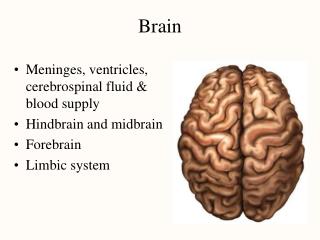
Brain • Meninges, ventricles, cerebrospinal fluid & blood supply • Hindbrain and midbrain • Forebrain • Limbic system
Brain Description • Brain weighs 3 to 3.5 pounds • Major portions -- brainstem, cerebrum, and cerebellum • cerebrum is 83% of brain volume • ___________________ contains 50% of the neurons
Brain Longitudinal fissure separates 2 cerebral hemispheres.
Meninges • Dura mater • outer periosteal layer • inner meningeal layer • dural venous sinuses • dural septa • falx cerebri, falx cerebelli and tentorium cerebelli • dural hemorrhages • Arachnoid mater • Pia mater
Ventricles and Cerebrospinal Fluid • Internal chambers within the CNS • lateral ventricles • third ventricle • cerebral aqueduct • fourth ventricle • central canal of spinal cord • Lined with ependymal cells and contains ______
Cerebrospinal Fluid • Clear liquid fills ventricles and canals & bathes its external surface ________________________ • Brain produces & absorbs about 500 ml/day • filtration of blood through choroid plexus • has more Na+ & Cl- but less K+,Ca+2, and proteins than plasma • Functions (3) • Buoyancy, protection, and chemical stability • Escapes from 4th ventricle to subarachnoid space • Drains from _________________________ into venous sinus
Blood-Brain and Blood-CSF Barriers • BBB - endothelium & perivascular astrocyte feet • permeable to lipid-soluble materials (alcohol, O2, CO2, caffeine, nicotine and anesthetics) • administer drugs through nasal sprays • Circumventricular organs – breeches in the system • Hypothalamus, Post. pituitary, Pineal, & Choroid plexus • monitoring of glucose, pH, osmolarity & others • may allow route for HIV virus to invade the brain • Blood-CSF barrier - choroid plexus is ependymal cells joined by _________________________
Medulla Oblongata • 3 cm long • Ascending & descending tracts • CN nuclei (VIII, IX, X, XI, XII) • Nuclei for somatic and visceral sensory; somatic cerebellar relay • Cardiac, vasomotor, & respiratory centers • Reflex centers for coughing, sneezing, gagging, swallowing, vomiting, salivation, sweating, and movements of the tongue and head
Medulla and Pons Olive
Pons • Bulge in the brainstem, rostral to the medulla • Ascending sensory tracts • Descending motor tracts • Pathways in & out of cerebellum - peduncles • Nuclei concerned with sleep, hearing, balance, taste, eye movements, facial expression, facial sensation, respiration, swallowing, bladder control & posture • cranial nerves V, VI, VII, and VIII
Cerebellum • Connected to brainstem by cerebellar peduncles • White matter _____________________ • Folia? • Sits atop the 4th ventricle
Output from Cerebellum • Smoothes muscle contractions, maintains muscle tone & posture, coordinates motions of different joints, aids in learning motor skills & coordinates eye movements
Midbrain • ____________________ • Mes. aqueduct • CN III and IV • eye movement • Cerebral peduncles hold corticospinal tract • Tegmentum connects to cerebellum & helps control fine movements through red nucleus • Substantia nigra sends inhibitory signals to basal nuclei & thalamus
Superior & Inferior Colliculus • Tectum (4 nuclei) called corpora quadrigemina • superior colliculus • inferior colliculus
Reticular Formation • Clusters of gray matter scattered throughout pons, midbrain & medulla • Regulate balance & posture • relaying information from eyes & ears to cerebellum • gaze centers allow you to track moving object • Includes cardiac & vasomotor centers • Analgesic pathways • Regulates sleep, conscious attention, fatigue
Thalamus • Oval mass of gray matter in center of ________________ • Receives nearly all sensory information on its way to cerebral cortex • integrate & directs information to appropriate areas • Interconnected to limbic system so involved in emotional & memory functions
Hypothalamus • Walls & floor of 3rd ventricle • Functions • hormone secretion & pituitary • autonomic NS control • thermoregulation • food & water intake • sleep & circadian rhythms • memory (mammillary bodies) • emotional behavior
Epithalamus (Pineal Gland) No output In fish, amphibians, and reptiles monitors day and season length Endocrine function in mammals, secreting melatonin Seasonal sexual cycles Humans - circadian
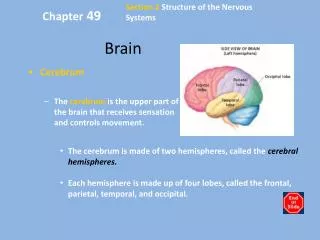
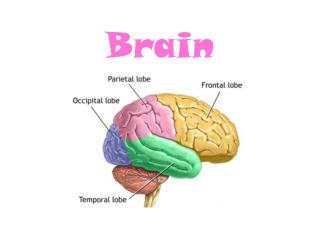
Cerebrum -- Gross Anatomy • Cerebral cortex is 3mm layer of gray matter with extensive folds to increase surface area ---- divided into lobes
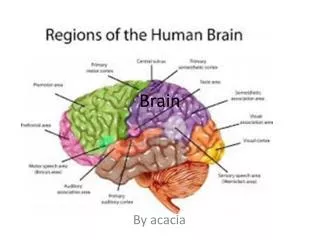
Functions of Cerebrum Lobes • Frontal contains voluntary motor functions and areas for planning, mood, smell and social judgement • Parietal contains areas for sensory reception & integration of sensory information • Occipital is visual center of brain • Temporal contains areas for hearing, smell, learning, memory, emotional behavior
Association Areas Association areas interpret information • Somesthetic association area • limb position, location of touch or pain, and shape, weight & texture of an object • Visual association area • identify the things we see • Auditory association area • remember the name of music or identify a person by voice • Motor association area
Basal Nuclei • Masses of gray matter deep to cerebral cortex • Receive input from substantia nigra & motor cortex & send signals back to these regions • Involved in motor control & inhibition of tremors
LimbicSystem • Loop of cortical structures surrounding deep brain • amygdala, hippocampus, fornix & cingulate gyrus • Amydala important in ________________ and ____________________________ in memory
Somesthetic Sensation Somatosensory area is postcentral gyrus
Sensory Homunculus • Demonstrates that the area of the cortex dedicated to the sensations of various body parts is proportional to how sensitive that part of the body is. Ditto for Motor Homunculus
Motor Control • Intention to contract a muscle begins in motor association (premotor) area of frontal lobes • Precentral gyrus (primary motor area) processes that order by sending signals to the spinal cord • upper motor neurons • to contralateral muscles • Motor homunculus is proportional to number of muscle motor units in a region