Download
1 / 23
310 likes | 2.08k Views
Kano Model. Erica Lynn Farmer CMQ/OE, CSSBB, MBB. Objectives. Origins Purpose Process Model Key Elements Methodology Application Examples. Origins of the Kano Model. Noriaki Kano Professor at Tokyo Rika University International Consultant Received individual Demming Prize in 1997.

E N D
Kano Model Erica Lynn Farmer CMQ/OE, CSSBB, MBB
Objectives • Origins • Purpose • Process Model • Key Elements • Methodology • Application • Examples
Origins of the Kano Model • Noriaki Kano • Professor at Tokyo Rika University • International Consultant • Received individual Demming Prize in 1997
Origins of the Kano Model • Noriaki Kano • Developed foundation for an approach on “Attractive Quality Creation” commonly referred to as the “Kano Model” • Challenged traditional Customer Satisfaction Models that More is better, i.e. the more you perform on each service attribute the more satisfied the customers will be. • Proposed new Customer Satisfaction model (Kano Model) • Performance on product and service attributes is not equal in the eyes of the customers • Performance on certain categories attributes produces higher levels of satisfaction than others.
When to use the Kano Model • Project Selection • Lean Six Sigma • Design for Six Sigma • New Product Development • New Service Development • Determine Market Strategies
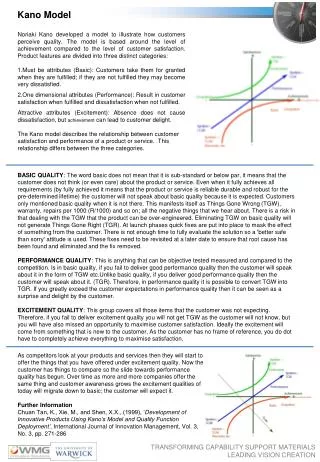
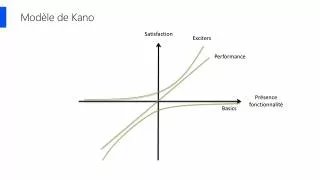
Key Elements • Identify the Voice of the Customer • Translate Voice of the Customer into Critical to Quality Characteristics (CTQs) • Rank the CTQs into three categories: • Dissatisfier - Must be’s – Cost of Entry • Satisfier – More is better – Competitive • Delighter – Latent Need – Differentiator • Evaluate Current Performance
Kano Model Process Research Analyze & Brainstorm Plot & Diagram Strategize • Research available data sources • Determine data collection strategy • Design data collection instruments • Collect and summarize data • Analyze results from data collection • Brainstorm list of features and functionality • Develop Functional and Dysfunctional Questionnaire • Distribute Questionnaire • Develop Customer Requirement Matrix • Record Questionnaire results in Matrix and Summarize • Plot results on Kano Model • Determine Project selection • Product Development • Service Development • Identify Marketing Strategy
Research • Must Be’s - Focus Groups, Lawsuits and Regulations, Buzz on Internet • Satisfiers - Competitive Analysis, Interviews, Surveys, Search Logs, Usablity Testing, Customer Forums • Delighters - Field Research, Marketing/Branding Vision, Industrial Design, Packaging, Call Center Data, Site Logs
Analyze & Brainstorm • Analyze data from available sources • Brainstorm list of features and functionality • Determine type of requirements: • Output Requirements • Service Requirements • Kano Model Requirements Survey • User Survey • “Functional form” vs. “Dysfunctional Form” • “How would you feel if the product had feature X?” • “How would you feel if the product didn’t have feature X?” • Kano Questionnaire Answers: • I like it. • I expect it. • I’m neutral. • I can tolerate it. • I dislike it.
Evaluation Customer Requirements Customer Requirement is: A: Attractive R: Reverse Q: Questionable Result E: Expected O: One Dimensional I: Indifferent
Strategize • Project Selection • Lean Six Sigma • Design for Six Sigma • Organizational Strategy • Dissatisfier – Must be’s – Cost of Entry • Satisfier – More is better – Competitive • Delighter – Latent Need – Differentiator
Application • Break into Teams • Select Team Leader • Select Scribe • Select Presenter • Scenario – You work for a Hotel chain and your company is trying to identify Voice of the Customer information to improve Hotel performance. • Instructions: • Brainstorm important characteristics you expect when staying at a Hotel • Identify whether they are a Must be, Expected or a Delighter from a Business Client perspective and from a vacationer perspective • Add in what the current performance is for the Hotel
Debrief • Analysis • Strategy Recommendations
Summary of Kano Model • Analyze and rank the voice of the customer data • Develop into Categories • Dissatisfier – Must be’s – Cost of Entry • Satisfier – More is better – Competitive • Delighter – Latent Need – Differentiator • Identify and implement strategy
References • Walder, D., (1993). Kano’s model for understanding customer-defined quality. Center For Quality of Management Journal, 39, 65 – 69. • Jacobs, R., (1997). Evaluating customer satisfaction with media products and services. European Media Management Journal, 32, 11 – 18. • Ungvari, S., (1999). Adding the third dimension to auqlity. Triz Journal, 40, 31 – 35. • Sauerwein, E., Bailom, F., Matzler, K., & Hinterhuber, H. (1996). The kano model: How to delight your customers. International Working Seminar on Production Economics, 19, 313 - 327 • Zultner, R.E. & Mazur, G. H. ( 2006). The Kano Model: Recent Developments. The eighteenth symposium on Quality Function Deployment.