Download
1 / 6
60 likes | 179 Views
This text explores the concept of basic blocks in programming, specifically focusing on three-address code (3AC). It provides examples and outlines how to partition sequences of three-address statements into distinct basic blocks. A basic block is defined as a sequence of code that executes linearly without any jumps or branches. Key methods for identifying leaders and organizing statements into basic blocks are discussed. Furthermore, the implications of live variables and references in basic blocks are also examined, enhancing the understanding of flow and structure within programming languages.

E N D
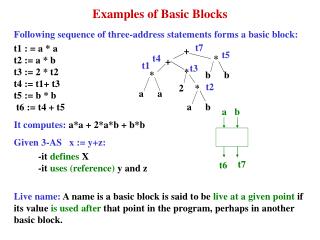
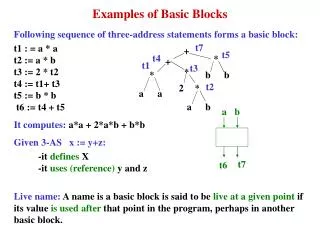
Examples of Basic Blocks t7 + t5 t4 * + t1 t3 * * b b t2 2 * a a a b ab Following sequence of three-address statements forms a basic block: t1 : = a * a t2 := a * b t3 := 2 * t2 t4 := t1+ t3 t5 := b * b t6 := t4 + t5 It computes: a*a + 2*a*b + b*b Given 3-AS x := y+z: -it defines X -it uses (reference) y and z Live name: A name is a basic block is said to be live at a given point if its value is used after that point in the program, perhaps in another basic block. t7 t6
3 Address Code. • i = m-1; j = n ; v = a[n]; • (1) i := m-l; j:=n; t1 := 4*n; v := a[t1]; • while(1) { • do i = i + 1; while(a[i]<v) ; • (5) i := i+1; t2 := 4*i; t3 := a[t2]; • (8) if t3<v goto(5) • do j = j-1; while (a[j] > v); • j:=j+1; t4:=4*j ; t5:=a[t4]; • (12) if t5 >v goto (9) • (13) if( i >=j) goto (23) • x = a[i]; a[i] = a[n]; a[n]=x • (14) t6 := 4*i; x:=a[t6]; • (16) t7 := 4*i; x:=a[t6]; • (18) t9:= a[t8]; a[t7]:=t9; • (20) t10:= 4*j; a[t10]:= x • (22) goto(5) • (23) ... Examples of 3 address code translation C-code void quicksort(m,n) int m,n { int i,j; int v,x; if (n<=m) return; /* fragment begins */ i:=m-1; j=n ; v=a[n]; while(1) { do i=i+1; while(a[i]<v) do j=j-1; while(a[j]>v) if (i>=j) break; x=a[i];a[i]=a[n];a[n]=x;} x=a[i];a[i]=a[n];a[n]=x; /* fragment ends */ quicksort( m ,j); quicksort(l+1,n); }
i:=m-1 j:=n t1=4*n v:= a[t1] B1 Example of Flow graphs I=i+1 t2:=4*i t3:=a[t2] if( t3<v) goto B2 B2 j:=j-1 t4:= 4 * j t5:= a[t4] if( t5 >v ) goto B3 B3 B4 if(i>=j) goto B6 t11:= 4* i X= a[t11] t12:= 4 * i t13:= 4*n t14 := a[t13] a[t12]:= t14 t15 := 4 * n a[t15]:= x B6 t6:=4*i x:= a[t6] t7 := 4 * i t8 := 4 * j t9:= a[t8] a[t7]:= t9 t10:= 4 * j a[t10]:=x goto B2 B5
Partition into Basic Blocks algorithm Input : A sequence of 3 address statements Output: A sequence of basic blocks with each 3A Statement in exactly one block. Method: (1) First determine a set of leaders, the 1st statement of basic blocks: a) The first statement is a leader b) Any statement that is a target of a conditional or unconditional goto is a leader c) Any statement that immediately follows a goto, or conditional goto statement is a leader. (2) For each leader its basic block consists of: a) The leader b) All statements upto but not including the next leader or the end of the program.
Example of Partition into Basic Blocks (1) prod : = 0 (2) i : = 1 (3) t1 : = 4 * i (4) t2 : = a[t1] (5) t3 : = 4 * i (6) t4 : = b[t3] (7) t5 : = t2 * t4 (8) t6 : = prod + t5 (9) prod : = t6 (10) t7 : = i+1 (11) i : = t7 (12) if( i <=20) goto (3)
Example of Partition into Basic Blocks A leader by rule 1.a A block by rule 2 A leader by rule 1.b A block by rule 2 A leader by rule 1.c (1) prod : = 0 (2) i : = 1 (3) t1 : = 4 * i (4) t2 : = a[t1] (5) t3 : = 4 * i (6) t4 : = b[t3] (7) t5 : = t2 * t4 (8) t6 : = prod + t5 (9) prod : = t6 (10) t7 : = i+1 (11) i : = t7 (12) if( i <=20) goto (3) B1 B2