Download
1 / 36
370 likes | 1.95k Views
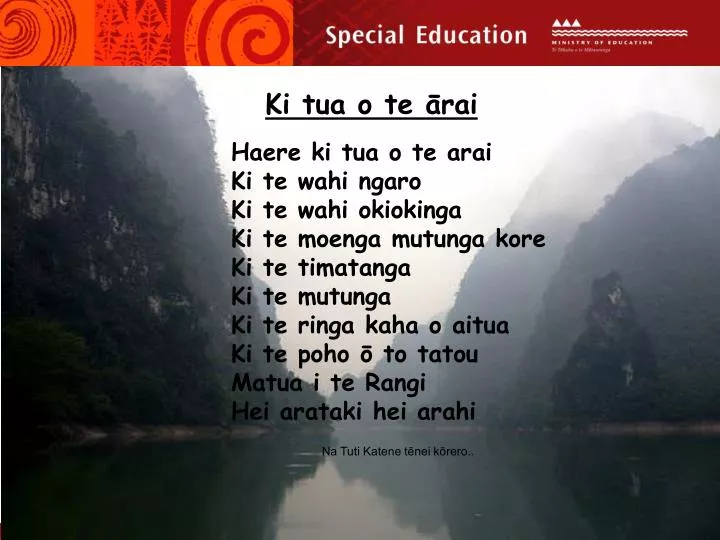
Ki tua o te ārai. Haere ki tua o te arai Ki te wahi ngaro Ki te wahi okiokinga Ki te moenga mutunga kore Ki te timatanga Ki te mutunga Ki te ringa kaha o aitua Ki te poho ō to tatou Matua i te Rangi Hei arataki hei arahi. Na Tuti Katene tēnei kōrero.

E N D
Ki tua o te ārai Haere ki tua o te arai Ki te wahi ngaro Ki te wahi okiokinga Ki te moenga mutunga kore Ki te timatanga Ki te mutunga Ki te ringa kaha o aitua Ki te poho ō to tatou Matua i te Rangi Hei arataki hei arahi Na Tuti Katene tēnei kōrero..
Kaikaranga from both sides, calling to each other to exchange information, to establish intent and the purpose of the visit. They also call our tupuna and clear the pathway for manuhiri. Photo from Kōrero Māori
Kaimihimihi/Kaikōrero Kaimihi from tangata whenua and manuhiri exchange greetings. Acknowledgements are made to significant geographic locations, the whare nui, marae, those who have passed on and the living. Photo from Kōrero Māori
Kaikōrero during their mihi will address the deceased directly and question the manner in which they have found peace of mind, but they will also farewell them with dignity. The kaikōrero now turn their attention to those affected by this aitua, and provide support to the whānau, extended whānau and in some cases the community as well.
Artwork by Robyn Kahukiwa. The hongi signifies the mingling together of the sacred breath of life, and the two sides become one.
HAERE ATU RĀE NGĀ MATE O NGĀ TAU O NGĀ MARAMA O NGĀ WIKIO NGĀ RĀ KUA PAHURE ATU.HAERE, E MOE, E OKIOKIHAERE ATU RĀ. ithacivilla.co.nz
E TE MATE OHORERETE MATE WHAKAMOMORITE MATE KUARE.HAERE, HAERE, HAERE.TAU ANA KOETAUMAHA ANA MATAU.E MOE. E OKIOKI. HAERE ATU RĀ.
Tānenui-a-rangi separated Ranginui and Papatuanuku and from a world of darkness, came light. There was some dissention among the brothers and when things calmed down, Tane set about creating the first woman from the soil at Kurawaka.
Hineahuone Tane fashioned Hineahuone, the earth formed maid, and breathed the life force of his mauri into her mouth and nostrils. Tihei mauriora. Tane cohabited with Hineahuone and Hinetiitama, the dawn maid was born. Artwork by Arthur Thatcher, 2008.
Hine-tītama He then cohabited With Hinetiitama, to produce their children.In due course Hine-titama asked about her father. His evasive response, led to the conclusion that Tāne was also her father. She was overcome with shame and fled to Rarohenga. Artwork by Robyn Kahukiwa.
Hine-nui-te-po Hine-tītama left the world of light, Te Ao Mārama, and moved to Te Ao i Te Pō ki Rarohenga, the underworld of darkness, and became known as Hine-nui-te-pō. Picture from Maui One Man Against the Gods.
Poroporoaki ki ngā Mate.Ka tangi. Ka heke te roimata. Ka heke te hūpē.Aue te aroha e.Ko koutou rā ēnā kua tahuri atu ki tua o te ārai.Haere, hoki atu rā Ki te kāinga tūturu mo tāua te tangata.Hoki atu ki ngā mātua tūpuna.Ki te ūkaipō a Papatuanuku.Ki roto i ngā ringaringa a Hine-nui-te-pō.Haere, haere, moe mai rā i roto i te Ariki.
Te Whakahaere Tikanga e Tika ana mo Te Ao Māori. Providing culturally appropriate, responsive and preventative services for Māori.
Cultural Perspectives Cultural explanations for suicide include: • Colonisation • Westernisation • Breakdown of traditional structures, values, attitudes • Not acknowledging cultural identity • Cultural connectedness • Cultural disaffection
Aue… He Aitua! The project was named Aue...He Aitua! by Tiaki Tuhiwai. The whakapapa has both personal and spiritual significance. “Aue... He Aitua!” is an exclamation that describes thoughts and feelings by Māori upon receipt of news that someone has passed away. The 3 dots are a symbolism of tears of sadness and spiritual dimensions.
Agency: • Provision of cultural expertise and leadership • Respecting and acknowledging cultural differences • Share cultural understandings • Developing internal office protocols • Providing professional development support
Māori Frameworks/Health PerspectivesWhare Tapa Whā(Durie 2004)(four walls of a house) • Wairua Spirituality • Hinengaro Mental Health • Tinana Physical • Whānau Family
Māori Frameworks / Health Perspectives Continued….Te Wheke (Rose Pere, 1991)(The Octopus) • Wairuatanga Spirituality • Hinengaro Mental Health • Tinana Physical • Whanaungatanga Family • Mana ake Uniqueness • Mauri Vitality • Ha a koro mā a kui mā Cultural heritage • Whatumanawa Emotions Adaptations to Central South TI Framework: Di Thomas & Tuti Katene
Special Education (internal processes) Philosophy: Kotahi te kohao o te ngira e kuhuna ai Te miro mā, te miro pango, te miro whero Pre intervention- preparation • Ensure staff are trained regarding Māori perspective of Traumatic Incidents • District Protocols to reflect tikanga Māori • Rosters to include trained Māori staff • Identify support networks
Intervention – upon request for support • Advise Māori TI support staff • Assess safety of staff (wellbeing) • Advise key personnel – kaumātua etc • Organise Māori supervisor (Māori for Māori) • Contact school regarding ensuing process • Organise briefing and karakia prior to attendance • Guide school management team – ensuring whanau are respected, ensure Maori are represented on team, identifying and supporting students at risk, negotiating school processes, suggest support networks, other cultural considerations • Debriefing and supervision • Karakia whakamutunga
Other relevant strategies • Ka Hikitia • Te Hikoitanga • Māori Cultural Supervision • Poipoia Te Reo • Cultural Induction • Noho Marae
Tua o Te Arai: Unveiling UnderstandingsHow Māori cultural constructs are able to sustain whānau……and strengthen resilience
Workshop ActivityHe Taumaha - A Burden sharedKia tere, kia eke tātau i te pahi. An opportunity to discuss some of the challenges and potential strategies for responding to Māori youth suicide: He whakaaro Māori, he whakaaro kē / Kaupapa Māori perspectives – mainstream perspectives: Recognising that whānau and persons at risk are affected by personal and societal attitudes about suicide; He mana kōrero / Culturally-respectful discussion: Discussing suicide / issues with the person at risk in a culturally appropriate way He whakaraerae / Vulnerability: Identifying risk alerts and developing protection related to them He rauemi / Resources: Listing the types of resources available to a person at risk of he whakamomori, including themselves He whakataunga / Resolution: Making a commitment to improving community resources
1/. He whakaaro Māori, he whakaaro kē / Kaupapa Māori perspectives – mainstream perspectives: Recognising that whānau and persons at risk are affected by personal and societal attitudes about suicide NB: there will be similarities as well as differences
2/. He mana kōrero / Culturally-respectful discussion: Discussing suicide / issues with the person at risk in a culturally appropriate way • What might a discussion that is managed in a culturally-respectful and appropriate manner ‘look like’ (sound like, feel like), with a person at risk? • Consider the ‘who’, the ‘what’ and the ‘how’
3/. He whakaraerae / Vulnerability: Identifying risk alerts and developing protection related to them • What do you think the risk alerts might be for rangatahi? • How might we develop protection (resilience, prevention) related to them?
4/. He rauemi / Resources: Listing the types of resources available to a person at risk of he whakamomori, including themselves
5/. He whakataunga / Resolution: Making a commitment to improving community resources • What are the main challenges we face to making a commitment to improving community resources – so that they are more culturally responsive?
Ngā mamae, Ngā mahi tuturu, Hei whakaaro noa:Feelings, Realities, Considerations…… …….at the time ……immediately after ……some time after the event
Māori cultural concepts and practices that are able to support and strengthen whānau who are suffering as a result of whakamomori • Whānau (immediate relationships) • Whānau-whānui(extended whānau) • Ngā iwi (connections and connectedness) • Kaumātua(immediate and extended) • Karakia (sustenance) • Tangihanga rituals (through to the Hura kohatu) • Mokopuna (Te kakano – hopes for the future)
Ngā whakaruruhau mo ngā whānau.Taking the positives – the strengths Whānau / whānui – those close to us Whakapapa – connectedness, connections, who we are, where we come from Whenua – a safe place to be Aroha: manaaki, awhi, tautoko – giving and receiving Tikanga, kawa – safe and known protocols and processes, how things happen, Rangatiratanga – strong leadership Ahi kaa – those who take care of us
Māori cultural concepts and practices that are able to support and strengthen whānau who are suffering as a result of whakamomoriSource: Ministry of Education: Special Education Māori Strategy: Te Urunga mai o te Rā.Professor Mason Durie: Te Whare Tapa Whā (1994) Wairua Spirituality Hinengaro Mental Health Tinana Physical Whānau Family
Māori cultural concepts and practices that are able to support and strengthen whānau who are suffering as a result of whakamomoriSource: Ministry of Education: Special Education Māori Strategy: Te Urunga mai o te Rā.Professor Mason Durie: Te Whare Tapa Whā (1994) Mana Atua – Well-being: Mana Tangata – Self esteem:
Ahakoa ngā piki me ngā heke, Poipoia te āhua o te tangata kia tatū tōna wairua, tōna hinengaro, tōna tīnana me tōna whanaungatanga ki tōna whanau, ki ōna hoa hoki. Aue he aitua, he aitua. Poipoia rā te wairua, te hinengaro, te tīnana, te whānau o te tangata kia noho tatū ai ōna whakaaro i runga i te pono, te tika me te aroha. Haumie! Hui e! Taiki e! Na Tokararangi Totoro