Download
1 / 24
240 likes | 353 Views
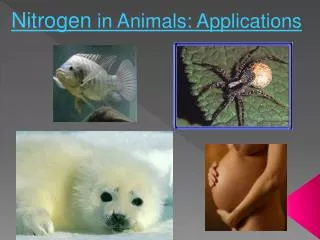
This study delves into how δ15N isotopes are influenced by various biological processes such as pregnancy, nutritional stress, and different diets. Notably, it reveals that both pregnancy and nutritional stress yield similar δ15N outcomes, marked by increased nitrogen fractionation resulting from maternal nitrogen conservation and dietary changes. The research further explores dietary influences on δ15N and δ13C in fish and spiders. Key findings suggest that diet quality significantly affects isotopic composition, offering insights into animal health and ecological studies.

E N D
OverviewHow are δ15N affected by the following processes: • Pregnancy • Nutritional Stress • Different diets & diet quality • Nursing • Fasting Spoiler alert! They all have VERY similar results…
Pregnancy and Nutritional Stress Studies investigate: δ15N & δ13C values in body of pregnant women with and without nutritional stress (Fuller et al. 2004, 2005) Methods Examine δ15N & δ13C isotopes in the body from pre-conception to delivery by: • Conducting dietary surveys 2) Collect hair samples of mother post-delivery
d15N d13C
Happy Mommy Fuller et al. 2004
Sad Mommy Fuller et al. 2005
Negative nitrogen balance = increased fractionation Sick b/w 10-16 weeks Sick throughout 1st trimester
Why? Well…not completely understood DECREASES IN δ15N due to maternal N conservation: • Assimilation of greater percentage of dietary N with lower δ15N values results in a reduction of steady state diet to body trophic fractionation (0.5-1‰) • Decreased urea synthesis and increased urea salvage in colon (peeing out heavy nitrogen) • Mother decreases in N and fetus increases = fetus literally eating mommy and increasing in trophic level
Reasoning for INCREASE in δ15N: As nutritional stress & weight loss continue, increase of muscle protein breakdown, lighter N is not replaced by dietary protein, & remaining tissues are enriched in heavier N (increased fractionation)
Diet quality 2 Studies: Oreochromis niloticus – “Nile tilapia” (Gaye-Siessegger 2004) Paradosa lugubris – “Wolf spider”(Oelbermann and Scheu 2001)
Nile tilapia Study investigates: Influence of different diets on δ15N & δ13C in fish bodies Methods • 32 fish reared on same diet for 11 weeks to equilibrate on diet, then 7 were killed to estimate initial isotopic composition of body • Provide fish with 3 different protein diets in controlled lab for 8 weeks • Analyze all fish at end of experiment after 48 hour fast
Results • No significant decrease inδ15N & δ13C, body mass, b/w averages of feeding groups • Declining trophic shift for individuals in δ15N (6.5‰- 4‰) & δ13C (4‰-2.5‰) w/ increasing protein retention in individual fish Experiment demonstrates high influence of individual protein balance of δ15N & δ13C in animals – dietary protein was conserved differently in tissue of individual fish = less fraction.
Wolf spider Study investigates: Influence of diet quality on δ15N & δ13C in spiders on different quality diets Methods: Changes in δ15N & δ13C w/ time: - Adult females, hatchlings, spiderlings fed intermediate quality food for 3, 6, & 11 weeks Changes in δ15N & δ13C w/ trophic level and starvation: - Adult and juvenile spiders were fed single species diets (low, med, high quality), mixed (high & low), and starved
Results - Since 14N is preferentially excreted during metabolism, the hatchling N would be isotopically lighter. - As individuals become larger, more isotopically like food item, then become enriched over food item by ≈3‰ Changes in δ15N & δ13C w/ time:
Changes in δ15N & δ13C w/ trophic level: 2.5‰ 2.2‰ 3.3‰ 5.2‰ Stepwise trophic level enrichment
Spiders on high-quality diet were bigger and increased in size faster, & had higher δ15N & δ13C values V. High quality Low quality High quality Intermediate quality V. Low quality
Changes in δ15N & δ13C when starved: Starvation leads to enrichment of δ15N due to recycling body nitrogen (i.e. “eating yourself”)
Sea Lions Methods • Teeth and bone collagen samples from two different species with different weaning behaviors • Using δN values to determine age of pup weaning/ trophic level
Results Northern Fur Seal aka Zalophus (bone collagen)
Tooth dentin Northern Fur seal
Applications • May lead to a method for investigating pregnancy and fertility patterns in populations of animals (past & present) • Pregnancy, nutritional stress, diet quality findings need to be considered in diet studies (ca not always assume ≈3‰ fractionation factor for δ15N) • Non-invasive monitoring of nitrogen balance in women during pregnancy – examine overall health • Applied to medical studies of protein stress & N balance: anorexia, bulimia, exercise, disease, weight loss, & burns • Do other tissues detect pregnancy, nutritional stress, changes in diet quality? • Determining feeding habits in animals. • More research to discover the biochemical reasons for δ15N increase and decrease in animals